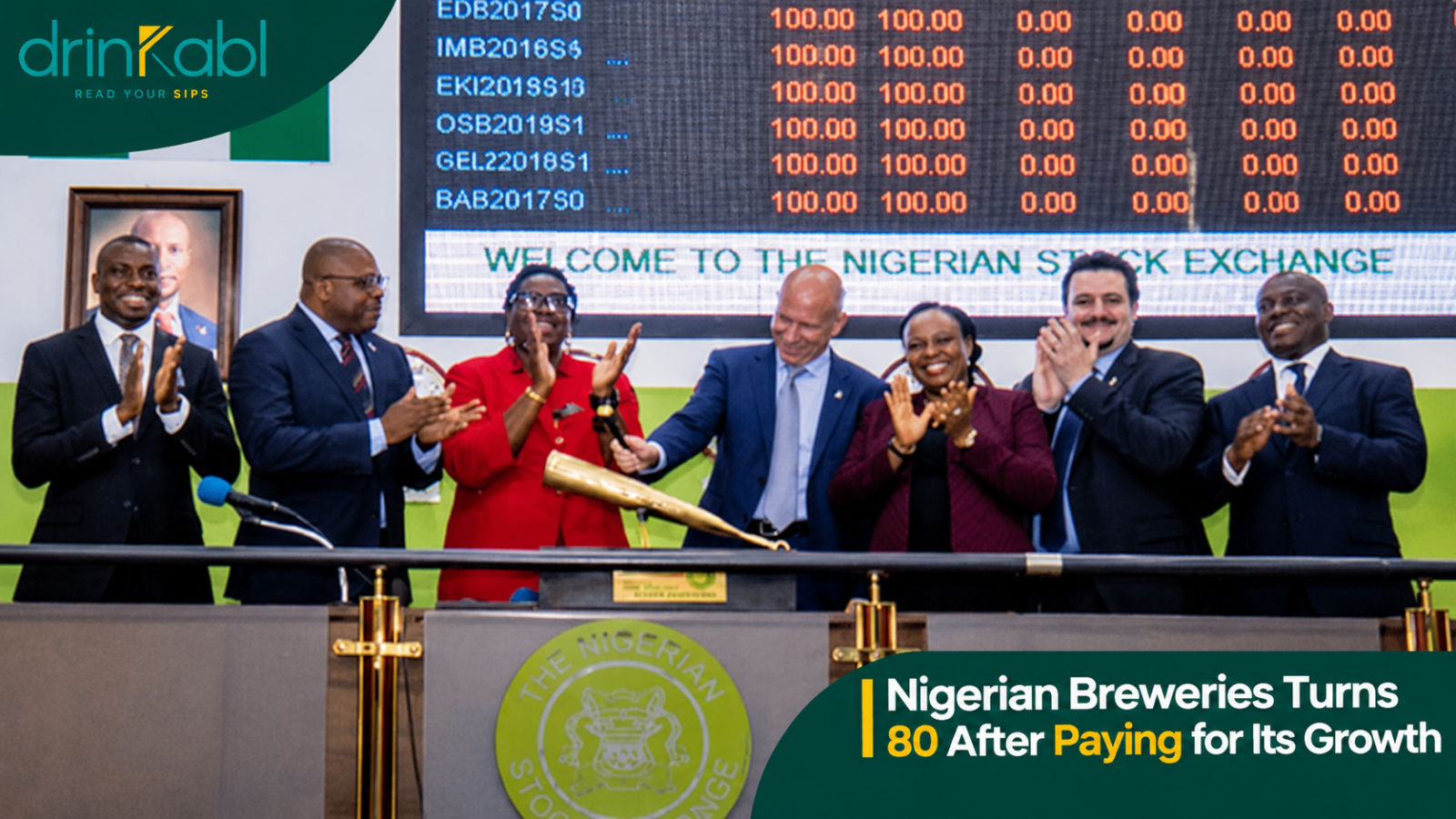

Two years of losses, a ₦599 billion call on shareholders and a return to profit show what it costs to run Nigeria’s largest brewer. The harder test is whether sales can grow without cheaper finance doing so much of the work.
Nigerian Breweries passed ₦1 trillion in annual revenue for the first time in 2024 and lost about ₦145 billion in the same twelve months. Sales had jumped 81 per cent on the year before, and the bottom line went the other way. Both figures sat in one set of audited accounts published in February 2025, and neither was an error. The gap between them is the best way into the company’s 80th anniversary, which falls on 16 November.
This feature follows the money behind that anniversary. Nigerian Breweries spent eight decades assembling nine breweries and a share register that dates to 1973, then met the naira’s collapse while carrying debts owed in foreign currency. Its recovery since 2025 is real and measurable. In 2026, though, more of the gain has come from lower finance costs than from selling more beer, and the latest quarter shows how thin that cushion is.
From one Lagos brewery to nine
In November 1946, UAC and Heineken signed the contract that created Nigerian Brewery Limited in Lagos. The first bottle of Star Lager came off its line in June 1949, and the Aba brewery followed in 1957, the year the company dropped the singular from its name. Gulder arrived in 1970, Maltina in 1976 and a brewery in Ibadan in 1982. In late 2023 it agreed to buy 80 per cent of Distell Wines and Spirits Nigeria, which took it into wines and spirits.
For the anniversary, the company has launched a campaign asking Nigerians to send in photographs, videos and memories of its brands. Its managing director, Thibaut Boidin, explained the idea this way: “An 80th anniversary can easily become a company talking about itself.” That is a fair warning to anyone writing about one. The audited accounts keep a plainer record of the same years, and their hardest chapter began with the currency.

What the naira did to the accounts
A foreign-exchange loss sounds abstract, but the mechanism is plain. When the naira falls, a debt or supplier bill owed in dollars costs more naira to settle, and the difference lands in the income statement as a loss. Nigerian Breweries booked about ₦153 billion of those losses in 2023, which helped turn revenue of ₦599.6 billion into a net loss of ₦106 billion. The company blamed the naira’s devaluation and the high cost of borrowing.
In 2024 the pressure shifted towards interest. The company booked a further ₦157.5 billion currency loss, and its net finance costs, which it tied to higher interest rates and the weaker naira, rose 34 per cent to ₦252.8 billion. That bill equalled nearly a quarter of everything it sold that year. It also suspended operations at two breweries, citing the naira, inflation and weak consumer spending.
Asking shareholders to pay
The board’s answer was a rights issue, an offer that lets existing shareholders buy new shares in proportion to their holdings. Directors proposed raising up to ₦600 billion in April 2024, and the offer ran from 2 September to 18 October. It raised ₦599.1 billion by selling about 22.6 billion shares at ₦26.50 each, and Heineken, the main shareholder, took up its full entitlement.
The company said the money would pay off its foreign-currency debts and cut its local borrowing. The next accounts show the result. Net finance costs fell 83 per cent in 2025, to ₦44.1 billion, and a ₦145 billion loss became a ₦99.1 billion profit. Shareholders who followed their rights paid ₦26.50 a share, and in late July 2026 the stock closed at ₦75.
The recovery, line by line
The 2025 figures show a business that recovered on both sides of the income statement. Revenue rose 35 per cent to ₦1.467 trillion, and operating profit nearly tripled to ₦205.2 billion from ₦69.9 billion, so the swing was not only about finance costs. Accumulated losses, the running total of past deficits, ended the year at about ₦72 billion, down from ₦170 billion twelve months earlier.
By the end of June 2026 that deficit had gone. The company reported positive retained earnings and the elimination of its interest-bearing debt, on first-half profit after tax of ₦92.95 billion. Over nine months profit after tax reached ₦114.1 billion, up 33 per cent, on revenue of ₦1.103 trillion. The third quarter alone brought ₦21.1 billion, the first third-quarter profit since 2022.
The source of that profit matters. Net finance expenses over the nine months fell 78 per cent to ₦7.5 billion, a ₦26 billion improvement, while pre-tax profit rose ₦42 billion to ₦171.7 billion. About six naira in every ten of the extra profit therefore came from paying less to lenders, and the rest came from operations.
What the recovery does not yet show
Management reads the same results as proof of strength. Boidin said the first-half figures demonstrated the resilience of the business and the effect of measures taken to manage a hard operating environment, and the company said it outperformed its competitors. A cleaner balance sheet is also a lasting gain, because interest not paid this year is not owed next year either. On that reading the losses of 2023 and 2024 were a shock that has been absorbed.
The sales line is harder to read that way. Revenue growth slowed from 35 per cent in 2025 to 9 per cent in the first half of 2026 and 5.4 per cent over nine months, and in the third quarter revenue slipped from about ₦308 billion to about ₦299 billion as volumes fell. Guinness Nigeria, a smaller rival, grew nine-month revenue by 20.4 per cent, while International Breweries managed 2.1 per cent.
The ledger at 80
Nine months into 2026, the company has already booked ₦1.103 trillion in revenue, more than the ₦1.084 trillion it reported for all of 2024. It has kept ₦114 billion of that as profit after tax, where 2024 ended in a ₦145 billion loss. What the accounts do not yet show is a payout to the shareholders who put up ₦599 billion. No dividend was proposed for 2025 and none has been declared this year, so they are paid, for now, in share price alone.
Read more