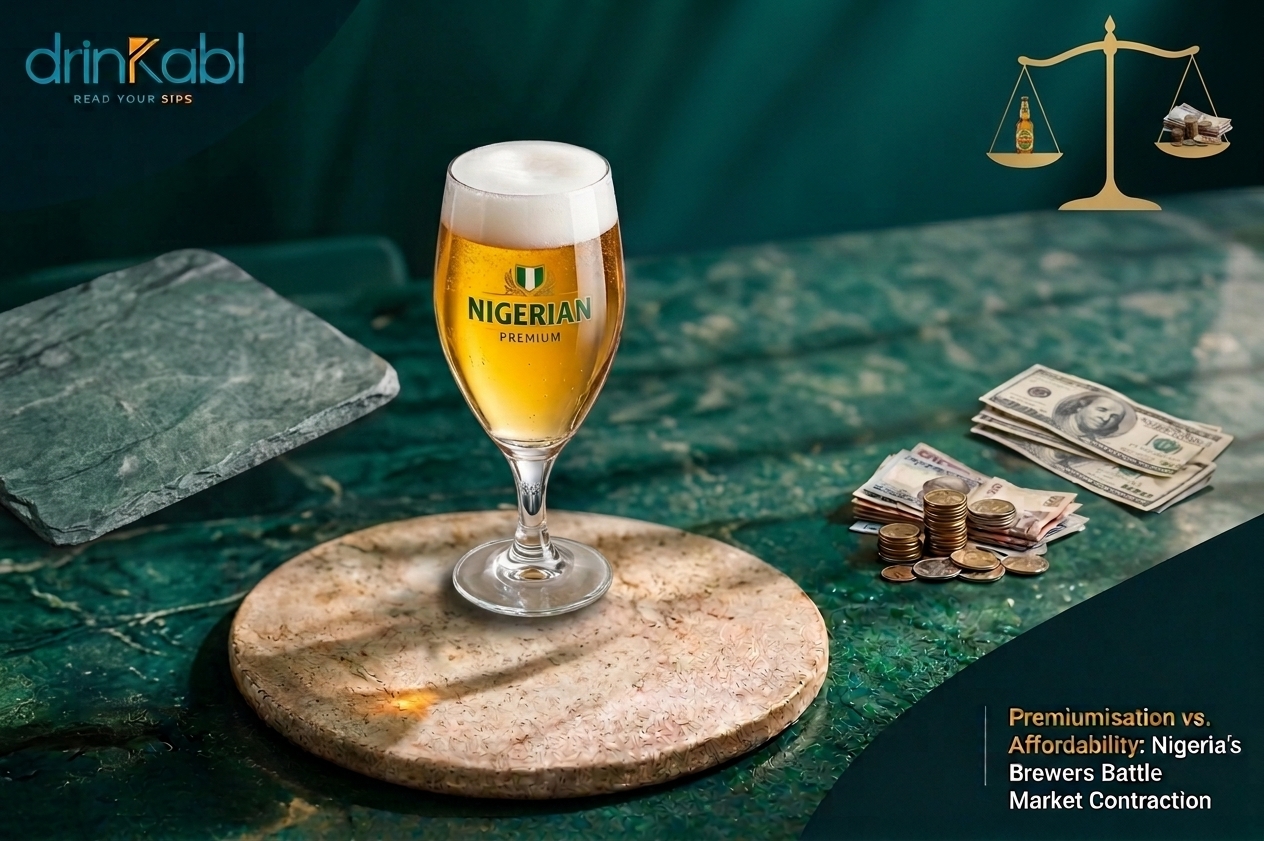

As retail beer volume dropped 4% in 2025, value sales surged by 16%ex, posing a stark divergence that is forcing Nigeria’s major brewers into a high-stakes balancing act. To offset shrinking volumes and climbing input costs, beverage giants are aggressively pushing premium lines and higher price tags. But with consumer purchasing power under severe pressure, this strategy is testing the limits of brand loyalty and reshaping who can still afford a bottle.
Euromonitor International data for 2025 puts the contradiction plainly. Retail beer volume declined 4% to about 1.9 billion litres, while value sales increased 16%. That means the headline growth in the category cannot simply be read as Nigerians drinking more beer. Price increases and changes in what consumers buy are doing much of the work.
The numbers at a glance
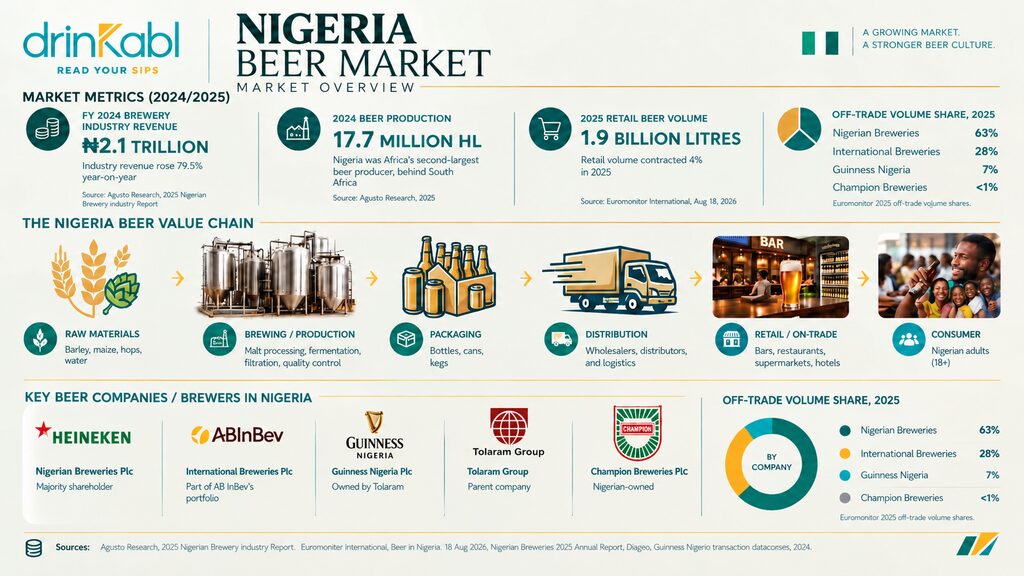
- FY2024 brewery industry revenue: ₦2.1 trillion, up 79.5% year on year, per Agusto & Co’s 2025 Nigerian Brewery Industry Report
- 2024 beer production: 17.7 million hectolitres, Africa’s second-largest output after South Africa, also per Agusto & Co
- 2025 retail volume: 1.9 billion litres, down 4% year on year, Euromonitor
- 2025 off-trade volume share: Nigerian Breweries 63%, International Breweries 28%, Guinness Nigeria 7%, Champion Breweries under 1%, Euromonitor
- 2030 forecast: market value projected to reach $3.9 billion, up from $2.4 billion in 2025, a 10.15% compound annual growth rate, per StrategyHelix
That distinction matters because market forecasts can make the Nigerian beer business look straightforward. The real story is not simply growth. It is a battle over volume, affordability and value.
The naira price tag is becoming as important as the brand
For years, Nigeria’s beer competition was largely a contest of brands: Star against Trophy, Guinness against stout and lager rivals, international premium brands against mainstream labels. The economics have changed.
Euromonitor’s 2025 assessment attributes the 4% volume contraction to inflation and shifting consumer priorities, even as value sales grew. Its analysis describes a market increasingly divided between economy choices and premium products.
This creates an uncomfortable equation for brewers. Raising prices can protect revenue and margins when input costs climb, but every increase also tests the consumer’s willingness to stay in the category.
Revenue is up sharply. That is not the same as more beer
Nigeria’s brewery industry as a whole posted revenue growth of 79.5% in FY2024, reaching ₦2.1 trillion, according to Agusto & Co. The same report puts the country’s 2024 beer production at 17.7 million hectolitres, keeping Nigeria in second place behind South Africa among Africa’s beer producers.
At the company level, Nigerian Breweries reported 2025 group revenue of ₦1.5 trillion, up 35% year on year, citing pricing, premiumisation, innovation and commercial execution among the drivers. Its 2026 first-quarter revenue rose a further 8% to ₦413.02 billion, with profit after tax up 25.6% to ₦55.95 billion. Those are significant financial numbers. They are not, by themselves, evidence that Nigerians consumed proportionally more beer.
That distinction is increasingly important in reading the industry’s financial performance.
A concentrated market, with a new owner behind one big name
Euromonitor’s data shows a highly concentrated formal market. In 2025, Nigerian Breweries held 63% of off-trade beer volume, majority owned by Heineken. International Breweries, part of AB InBev’s portfolio, held 28%. Guinness Nigeria held 7%, and Champion Breweries, Nigerian-owned, held under 1%.
The definitions matter here: these are off-trade volume shares, not shares of every beer consumed in Nigeria, and not revenue shares. Still, the figures show how concentrated the retail beer business has become.
There has also been a structural change behind one of the industry’s biggest names. Diageo completed the sale of its shareholding in Guinness Nigeria to Tolaram Group, while retaining ownership of the Guinness brand under a long-term licensing arrangement. Guinness Nigeria continues to produce and distribute Guinness and other locally manufactured brands.
This is more than a change in the shareholder register. It illustrates the growing distinction between owning a global brand and operating the local manufacturing and distribution machine, one that matters enormously in a market like Nigeria’s.
The brewery is no longer just a factory
A beer market is an ecosystem. It runs from agricultural inputs and raw materials through brewing, packaging, warehousing, transportation, wholesalers, retailers, bars and restaurants, and ultimately to consumers. Every increase in the cost of energy, imported inputs, logistics, packaging or finance can eventually reach the bottle or can.
That is why the industry’s future cannot be understood by looking at brewery revenues alone. Champion Breweries, for example, reported that locally sourced brewing inputs, particularly sorghum grains and sorghum maltose syrup, remained important to its production in 2025. The company reported local sourcing at 59.39% for the year, against a 58% target.
Local sourcing is therefore not merely a sustainability story. For Nigerian brewers, it can also be a supply-security and foreign-exchange management strategy. The more inputs that can be reliably sourced domestically, the less exposed a producer may be to some imported-input and currency pressures, though local sourcing does not eliminate the wider cost problem of energy, transportation, packaging, labour and financing.
Consumers are moving faster than the category chart suggests
The most interesting change may be taking place outside the brewery. Euromonitor describes a market where premium brands are finding growth through what it calls “affordable luxury,” while smaller pack formats, flavour innovation and experiential marketing are becoming important tools. Nigerian Breweries’ own Goldberg Black launch is one example of that push toward newer formats aimed at younger drinkers. Euromonitor also identifies small local grocers as an increasingly important route to consumers, with e-commerce growing from a smaller base.
This points to a more fragmented consumer strategy. One drinker may trade down because a familiar lager has become too expensive. Another may continue buying premium beer but choose a smaller pack. A third may move into spirits, ready-to-drink options or another category altogether, a shift that is already visible in the growth of challenger bitters brands.
The beer industry therefore has to manage polarisation rather than a single consumer trend. The old assumption that the Nigerian beer drinker simply buys more when income rises is becoming too crude.
What the $3.9 billion forecast does, and does not, tell us
The StrategyHelix forecast of a $3.9 billion Nigerian beer market by 2030 is useful as a market-sizing scenario. It should not be confused with a guaranteed expansion in physical beer consumption, particularly after Euromonitor recorded falling beer volume in 2025.
A market can become more valuable without becoming proportionally larger in litres. If prices rise faster than volumes, nominal market value increases while the underlying consumption base stays under pressure. Currency movements add another complication when a naira market is converted into US dollars.
This is why litres, naira value, average prices and market share need to be read together. Looking at only one of them can produce a misleading picture.
The next battle is affordability
Nigeria’s brewers have already shown they can generate substantial revenue in a difficult consumer environment. The harder question is whether they can keep doing so without pushing too much volume outside the mainstream beer category.
The answer will depend on how effectively companies balance pricing with pack sizes, brand portfolios, distribution and local sourcing. It will also depend on what consumers consider worth paying for.
That is where the Nigerian beer market becomes more interesting than a simple growth chart. The industry is not merely trying to sell more beer. It is trying to preserve the value of beer as consumers have less disposable income to buy it with.
That is what makes the most important number in Nigeria’s beer market not necessarily the projected $3.9 billion. It may be the 1.9 billion litres that Nigerians actually bought in 2025, and whether that volume starts growing again without requiring another major increase in the price of the bottle.
Read more: