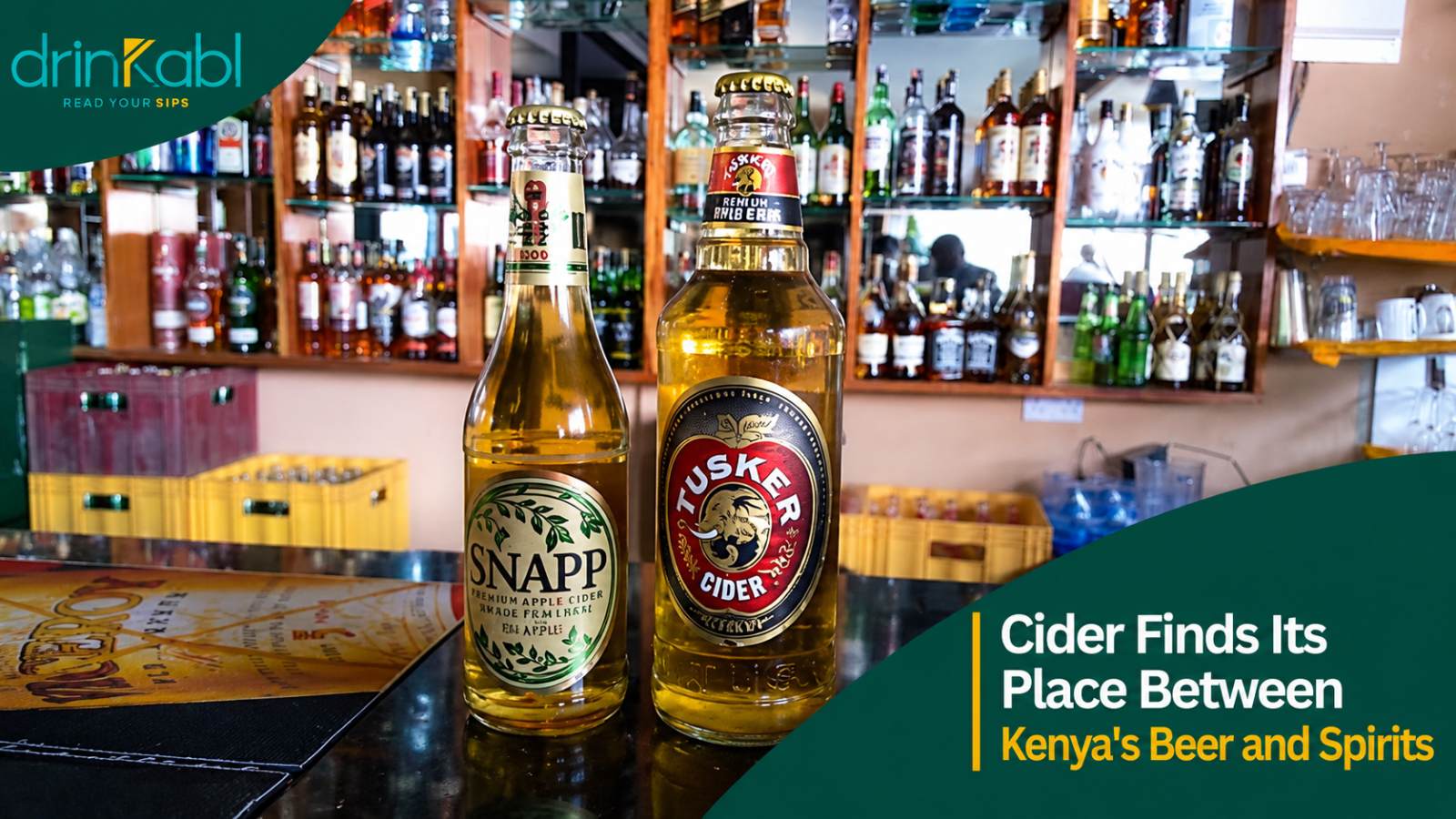

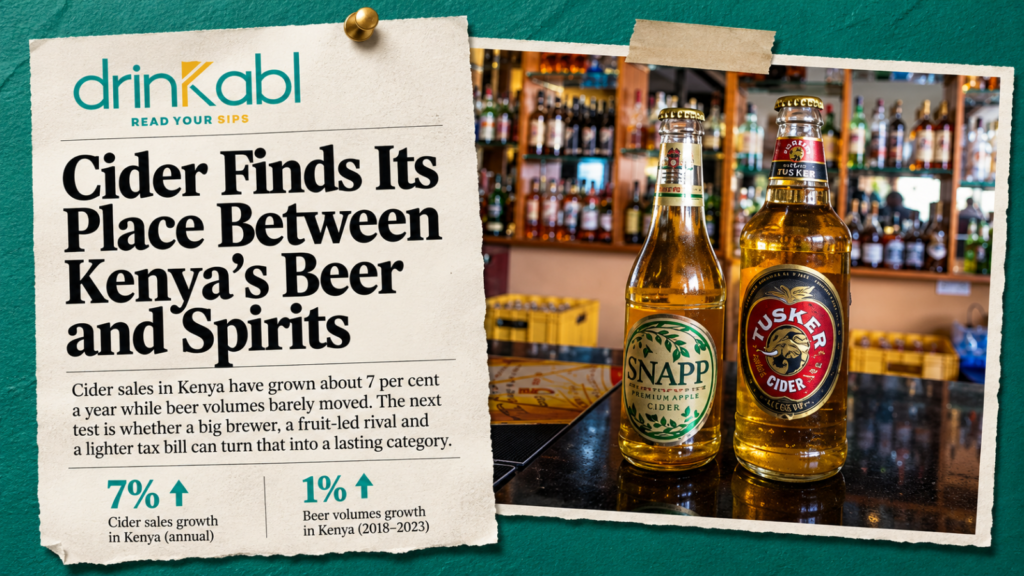
Cider sales in Kenya have grown about 7 per cent a year while beer volumes barely moved. The next test is whether a big brewer, a fruit-led rival and a lighter tax bill can turn that into a lasting category.
On Saturday 8 March 2025, more than 5,000 people filled Eva’s Garden at Red Hill in Limuru for Ngemi Homecoming 3.0, a day of music, fashion and food powered by Manyatta cider. The mugithi singer Samidoh Muchoki performed, and a Manyatta Village section built around cultural displays became a crowd favourite. Kenya Breweries used the evening to launch a can of its Pineapple & Mint flavour. The pitch was a mood for the night rather than an argument against beer.
Cider in Kenya is growing into the space between beer and spirits, and the figures are specific enough to test. Kenya is Africa’s third-largest cider market, behind South Africa and Mozambique, and its cider sales have averaged about 7 per cent a year, with 9 per cent a year projected through 2028. Beer volumes in the country grew 2 per cent a year from 2013 to 2018 and 1 per cent a year from 2018 to 2023. This feature looks at who is capturing that growth and what could slow it.
Why the gap exists
Kenya Breweries says cider consumption has surged among millennial and Gen Z drinkers who want fruitier, lower-alcohol alternatives to traditional beverages. Lower alcohol matters because it changes where a drink fits. A cider can carry a long afternoon at a gathering in a way a spirit cannot, and it gives a beer drinker something different without asking them to leave the familiar end of the shelf.
Two ways to build a cider
Manyatta came out of a Sh1.2 billion microbrewery that Kenya Breweries built beside its main plant at Ruaraka in Nairobi and started up in November 2023, with the stated aim of experimenting with new products. The first brand off the line was a 100 per cent apple cider, launched with three flavoured variants, Mango & Ginger, Lemon & Ginger and Pineapple & Mint. The brewer has since built the brand around a Taste Like Home theme and a run of Homecoming events that tie the drink to music and shared occasions.
African Originals, which sells its Kenyan Originals ciders as KO, took a different route. Founded in 2018, it makes cider from locally sourced fruits and botanicals, and in 2024 it raised US$2 million in a round led by the Mauritian brewer Phoenix Beverages to expand production. The company says KO brings in 80 per cent of its revenue and holds 40 per cent of cider sales in retail chains. Tusker Cider, which Kenya Breweries launched in 2016, still held the largest share of the overall market as of late 2024, so each company leads on a different measure.
What a big brewer brings
Distribution is the plain advantage of the large brewers. EABL, the parent of Kenya Breweries, accounts for roughly 80 per cent of Kenya’s alcohol market, and this September Kenya’s competition regulator cleared Asahi’s purchase of Diageo’s stake in the group on condition that at least a fifth of the fridge space EABL supplies to shops be opened to rival brands. The condition shows how much shelf presence one company holds, and how much of it a challenger has to win on merit.
A smaller brand has different assets. African Originals’ round was split between US1millioninequityandUS1 million in debt, earmarked for working capital and more production capacity. A start-up can test a fruit or a flavour in a season, while a large brewer has to move a new product through a national sales system before it learns whether drinkers care.
Tax, price and what the figures leave out
Cider’s run also owes something to policy. A change to Kenya’s tax law in late 2024 lowered excise duty on cider drinks, the tax levied on alcohol when it leaves the producer, and cut it further for small independent producers in a move meant to draw investment into craft beverages. Kenya Breweries had already won a court case against the Kenya Revenue Authority over how cider is taxed in 2022. Growth that rests partly on a lower tax rate depends on the rate staying where it is.
The cheaper alternatives are also large. Illicit drinks made up 60 per cent of alcohol consumed in Kenya by volume in 2024, and about two thirds of that was artisanal brew such as chang’aa and busaa. None of the growth figures above say how many of cider’s new drinkers came from beer, from spirits or from outside the formal market. Without that split, a 9 per cent projection describes the category’s pace and leaves its source unexplained.
Pineapple & Mint was one of the three flavours with which the Ruaraka microbrewery began production in November 2023. At Limuru in March 2025 it became a can, a format Manyatta’s brand manager said would go to retailers nationwide. The sales figures for the brand itself are not among the numbers cited here.
Read more