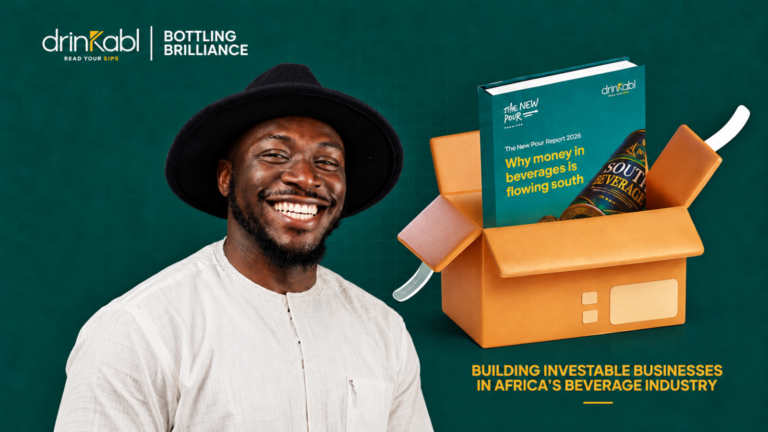

Alcohol-free drinks are moving beyond a wellness niche. The New Pour Report 2026 points to a broader shift in how younger African consumers think about drinking, socialising, and what belongs in the glass.
Zero-alcohol beers, mocktails and functional drinks are moving into spaces once dominated by conventional alcohol. The shift is big enough that The New Pour Report 2026 ranks “The Sobriety Boom” first among its 10 beverage trends and calls alcohol-free the fastest-growing segment in Africa.
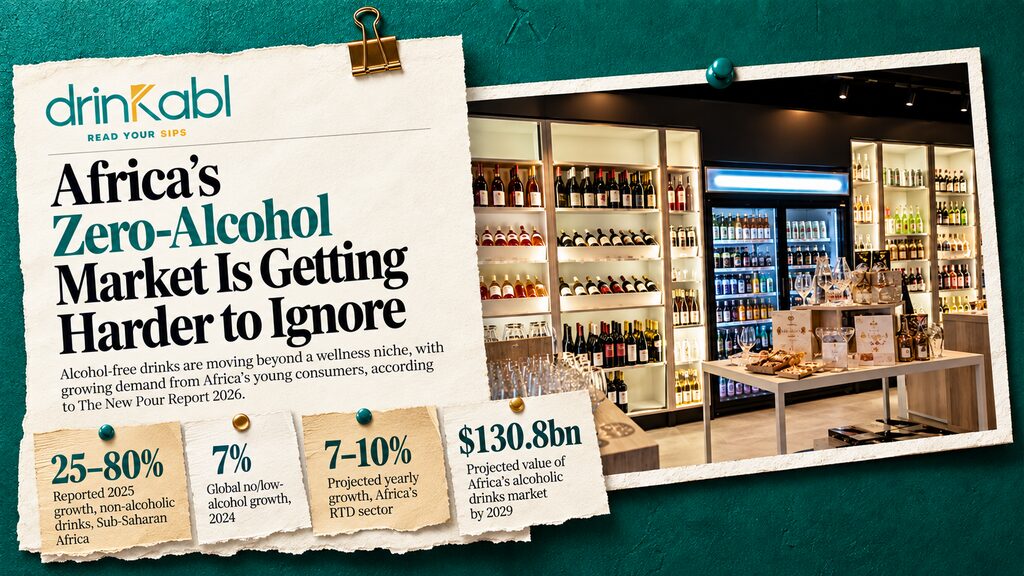
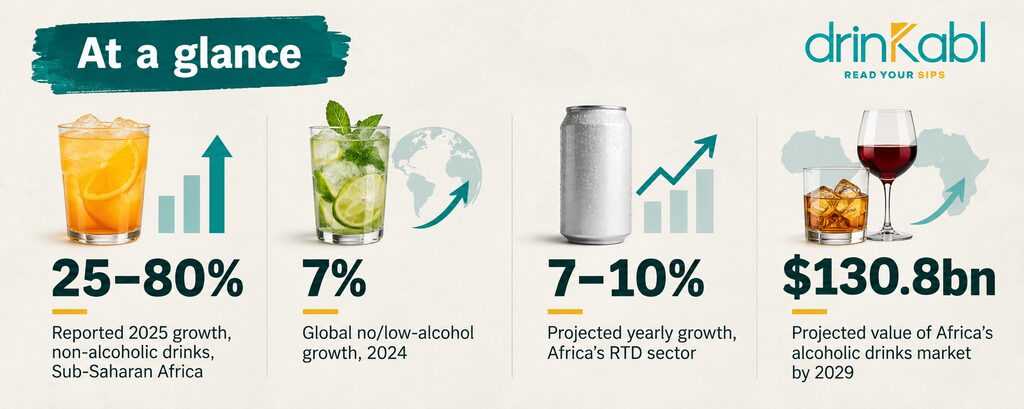
The report cites growth of between 25% and 80% in non-alcoholic beverages across Sub-Saharan Africa in 2025. That range is broad and should not be read as a single continent-wide rate. But the direction is difficult to dismiss.
The occasion is changing before the category does
The most important shift may not be that people have stopped drinking. It is that alcohol is no longer needed for every social occasion.
The report says the movement is driven by health-conscious young professionals who want the social experience of drinking without the health consequences. It names zero-alcohol beers and sophisticated mocktails as the products gaining attention in South Africa, Nigeria and Kenya.
That distinction matters. Someone ordering an alcohol-free drink at a rooftop event is not necessarily rejecting drinking culture. They may be joining it differently. The industry now has to think beyond drinker versus non-drinker: many people drink on some occasions, go alcohol-free on others, and expect the same taste, presentation and social standing from both.
Kenya’s Savanna 0.0 launch shows the logic. Its makers, Kenya Wine Agencies Limited, pitched the alcohol-free cider at consumers who may or may not want alcohol at a given moment.
Young consumers are changing the equation
The report ties the shift to millennials and Gen Z. Research by Pierrine Consulting, cited in the report, finds that health-driven demand in Nigeria, South Africa and Kenya has moved beyond a niche audience. It names functional beverages, plant-based RTDs and locally sourced formulations among the fastest-growing sub-categories.
Younger consumers weigh several factors at once: taste, health, convenience, ingredients, identity and social experience. So the opportunity is broader than alcohol-free versions of existing brands. A drink does not need alcohol to do the social job consumers expect of it.
Africa is not simply importing the trend
No and low alcohol is a global movement. The market grew 7% worldwide in 2024, a figure Pierrine attributes to IWSR. The report argues that Africa is becoming a growth region in its own right rather than a follower.
It points to local producers making non-alcoholic versions of traditional drinks, including ginger beer and hibiscus juice, and pricing them as premium products. That raises a more interesting question than importing global zero-alcohol brands: what does an African no-alcohol drink look and taste like?
The bar menu is part of the evidence
Some of the strongest signals are on menus rather than in forecasts. The report says bars in Lagos that once dismissed mocktails now give them entire menu sections. In Nairobi, it says, Novanta has built a following among young professionals through sparkling botanicals and rooftop events.
A mocktail with the same menu space, visual treatment and glass as a cocktail is no longer the fallback for someone who cannot or will not drink. It is a product in its own right. For hospitality businesses, that also widens who can join the same occasion: one table can hold beer, wine, cocktails and zero-alcohol drinks without splitting the experience.
Beyond zero-alcohol beer
The report links sobriety to the rise of functional beverages and ready-to-drink (RTD) products. Africa’s RTD sector is projected to grow 7% to 10% a year, with functional drinks as a primary driver. Consumers may not be shopping for a “sobriety product” at all. They want something refreshing, attractive, portable and in tune with their lifestyle.
Big brands are already moving. The report says Heineken 0.0 has gained shelf space in South African supermarkets. In Kenya, KWAL introduced Heineken 0.0 in 2022 and added the Savanna 0.0 cider in 2025. The strategic logic is simple: a company that sells across both alcoholic and alcohol-free occasions stays relevant when the consumer’s choice changes.
Premium pricing and a local edge
The category need not compete at the bottom of the market. The report describes premium positioning for non-alcoholic variants and says health-conscious buyers are increasingly picky about ingredients and nutrition. A premium alcohol-free drink can compete on ingredient quality, flavour, packaging, brand story and functional benefit, rather than on the absence of alcohol.
Local ingredients could give the segment an identity. Pierrine identifies baobab, moringa, hibiscus and cardamom as possible sources of advantage for brands that use them authentically. Global brands bring technology, distribution and marketing budgets. African producers can bring ingredients and cultural knowledge that are harder to copy.
“Local” is not automatically premium. The flavour, consistency, safety, packaging and distribution still have to deliver.
A reality check on the numbers
Africa is not becoming a sober market. According to Statista, the alcoholic drinks market is projected to reach $130.8 billion by 2029, growing 7.35% a year. The more useful reading is that the industry is becoming multi-occasion: alcohol is not disappearing, but the portfolio around it is expanding.
Readers should also handle the headline figures with care. The report’s own growth chart puts non-alcoholic beverages at 7.9% a year to 2033 and no/low alcohol at 7%. Both sit below its 13.3% projection for South Africa’s RTD market and 11.3% for South African premium spirits. Those are forward-looking annual rates, so they are not directly comparable with the 25% to 80% reported for 2025, and “fastest-growing” is best treated as a directional signal, not a settled ranking.
The report’s $124 billion figure for African non-alcoholic drinks in 2025 covers the whole non-alcoholic sector, not just alternatives to beer or spirits. Illicit alcohol also remains a pressure on the formal market, as Drinkabl’s earlier analysis of the industry explains.
What it means for the industry
For established brewers and distillers, the lesson is portfolio diversification. For local entrepreneurs, the report’s playbook lists RTDs and non-alcoholic drinks among the fastest
routes to shelf space, with functional products built on African botanicals as an emerging opportunity. They do not need to fight multinational beer companies head-on. They can build around African ingredients, functional positioning, premium presentation and local occasions. Retailers and hospitality operators need to make sure the guest who does not want alcohol still has something credible to order.
The commercial question is shifting from “Will Africans stop drinking?” to “How many beverage occasions can one consumer have, and which brands will own them?” The sobriety boom is less about persuading Africa to stop drinking than about making alcohol optional on more of the occasions where drinks matter. For an industry built on selling alcohol, that is a meaningful change.
Source: The New Pour Report 2026, Drinkabl Africa. The report was launched at The New Pour Summit in Nairobi.