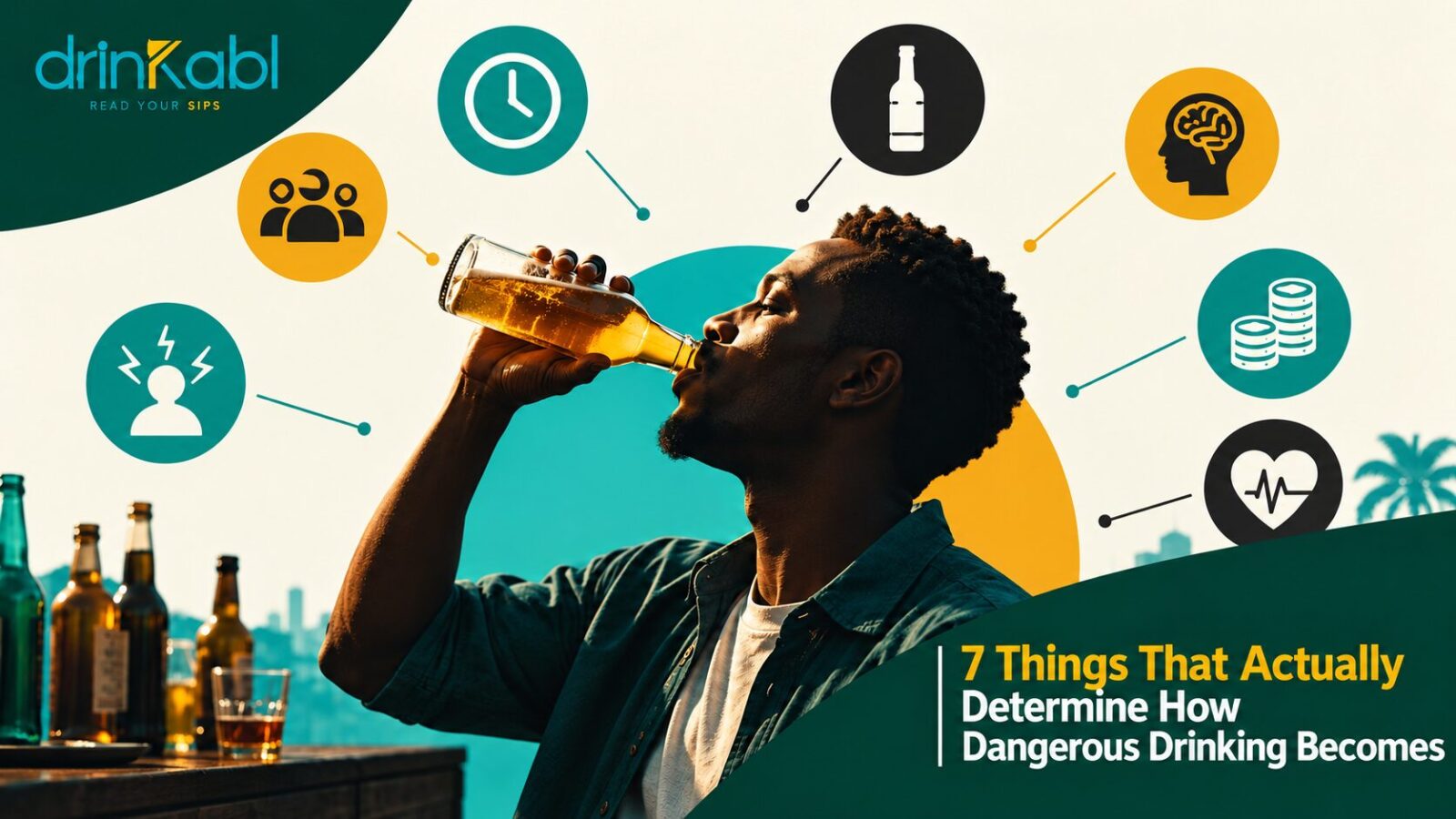

If you drink alcohol, the real question isn’t simply how much you drink. How quickly you drink, how often you do it, the way you drink, and the situation you’re drinking in can all change the level of risk. What feels like an ordinary drinking habit can look very different when you take these factors into account.
Fast Facts
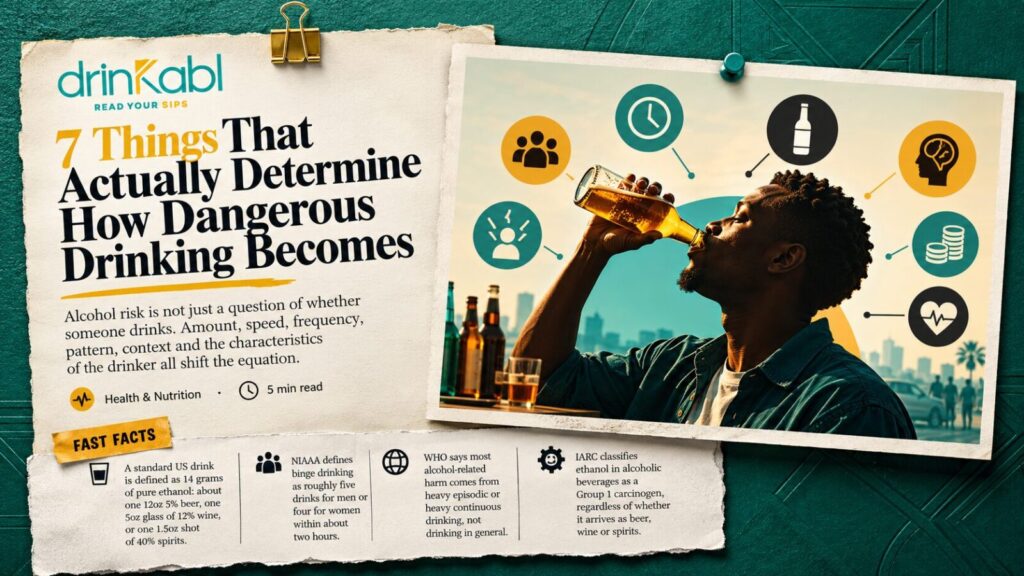
- A standard US drink is defined as 14 grams of pure ethanol: about one 12oz 5% beer, one 5oz glass of 12% wine, or one 1.5oz shot of 40% spirits.
- NIAAA defines binge drinking as roughly five drinks for men or four for women within about two hours.
- WHO says most alcohol-related harm comes from heavy episodic or heavy continuous drinking, not drinking in general.
- IARC classifies ethanol in alcoholic beverages as a Group 1 carcinogen, regardless of whether it arrives as beer, wine or spirits.
The alcohol debate often collapses into a deceptively simple question: do you drink? But science asks a different set of questions. How much do you drink? How quickly? How often? At what age did you start? Are you drinking alongside medication? Are you driving afterwards? Do you already have a health condition? Are you drinking occasionally, or repeatedly drinking heavily?
Those distinctions matter. The World Health Organization says there is no completely risk-free form of alcohol consumption, but it also makes an important distinction: most alcohol-related harm comes from heavy episodic or heavy continuous drinking. Risk varies according to the amount consumed, frequency, drinking pattern, health status, age, sex and the context in which alcohol is consumed.
So if alcohol exists on a risk spectrum, what moves a person further along it?
1. How much alcohol is actually being consumed
The first variable is obvious, but consumers frequently underestimate it. A bottle, glass or can is not automatically one “drink”. Alcohol content depends on both the volume of the beverage and its alcohol-by-volume (ABV).
The US National Institute on Alcohol Abuse and Alcoholism (NIAAA) defines a standard drink as about 14 grams of pure ethanol, roughly the amount found in 12 ounces of 5% beer, 5 ounces of 12% wine or 1.5 ounces of 40% spirits. A stronger beer can contain substantially more alcohol in the same volume, and that gap matters in African markets, where bottle sizes, strengths and serving practices vary considerably, a gap regulators have been scrutinising more closely since Ondo’s methanol deaths exposed how little oversight some informal alcohol carries.
A person can therefore believe they have consumed “one bottle” when the more meaningful scientific question is how much ethanol was actually in it. The relationship between alcohol and harm is broadly dose-dependent: as consumption rises, so does exposure.
2. How quickly you drink
Two people can consume the same total amount of alcohol and face very different immediate risks depending on how quickly they consume it. NIAAA defines binge drinking as a pattern that typically brings blood alcohol concentration to 0.08% or higher, which for a typical adult corresponds to about five drinks for men or four for women within roughly two hours.
Speed matters because alcohol enters the bloodstream faster than the body can eliminate it, which raises intoxication and with it the risk of blackouts, falls, crashes, drowning, assault and other acute harms. This is why “I only drink on weekends” tells us surprisingly little by itself. A person having two drinks slowly over several hours is not engaging in the same drinking pattern as someone consuming eight drinks in a short period. The calendar says “once a week”. The biology says something else.
3. How often you drink
Frequency changes the equation again. Repeated heavy consumption increases exposure over time and is associated with chronic conditions including liver disease and alcohol-use disorder, creating an important distinction between occasional consumption and a repeated pattern of heavy consumption.
The latter matters because cumulative exposure counts. Alcohol is associated with several cancers, including cancers of the breast, liver, colorectum, oral cavity, pharynx, larynx and oesophagus, and the International Agency for Research on Cancer classifies alcohol as a carcinogen with an established causal link to each of them. The relevant measure extends beyond a single night of drunkenness, to how much alcohol the body is repeatedly exposed to over months and years.
“The calendar says ‘once a week’. The biology says something else.”
4. Your age matters
Alcohol does not carry precisely the same consequences at every stage of life. Age influences vulnerability, drinking behaviour and the consequences of intoxication, and WHO identifies it as one of the factors shaping alcohol-related risk.
Younger drinkers face particular risks from impaired judgement and injury, while older adults can face additional risks from changes in metabolism, medication use and underlying health conditions. A drinking pattern that seems manageable at one stage of life does not automatically stay equally low-risk throughout it. The body changes with age, circumstances shift, medications enter the picture, and the risk changes along with all three.
5. Your health status changes the equation
Alcohol does not operate in isolation from the rest of the body. Someone with an existing health condition may have a different risk profile from someone without one, and the same is true for people taking medications that interact with alcohol. WHO explicitly identifies individual health status as a factor affecting alcohol-related risk, which is one reason universal statements about a “safe amount” are difficult to make.
There is also an uncomfortable finding underneath all of this: even relatively low levels of alcohol consumption carry some health risk, even as the greatest share of alcohol-related harm still comes from heavy drinking patterns. That is a more nuanced position than either “alcohol is harmless in moderation” or “one drink is as dangerous as ten.” Neither accurately captures the evidence.
6. What you are doing while drinking can be as important as what you are drinking
Context can turn alcohol from a health risk into an immediate safety risk. Driving is the obvious example: alcohol impairs judgement, reaction time and coordination, and WHO identifies road traffic injuries among the major sources of alcohol-attributable harm, noting that alcohol can affect people other than the person drinking.
The same principle applies to swimming, operating machinery, working at heights, handling dangerous equipment, or any activity where impaired coordination can turn catastrophic. “Responsible drinking” cannot simply mean counting drinks. It also has to mean understanding what you are doing while alcohol is still in your system.
7. Your drinking pattern matters more than the label on the bottle
Perhaps the biggest misconception is that risk can be determined by beverage category. Beer, wine and spirits are routinely assigned different levels of danger by consumers, but scientifically the alcohol itself remains central: IARC identifies ethanol and its metabolism as fundamental to alcohol’s carcinogenic effects, while WHO describes alcoholic beverages collectively as containing ethanol, a psychoactive and toxic substance.
That does not mean a 330ml beer and a 750ml bottle of wine contain the same amount of alcohol. They clearly do not. It means the category name alone does not tell us enough, whether that category is a full-strength lager or one of the zero-alcohol alternatives now gaining ground in African markets. The more useful questions are how much ethanol, how fast, how often, who is drinking it, and in what circumstances.
The Bigger Picture
The alcohol debate becomes less ideological once these variables are considered together. A person drinking occasionally is not automatically equivalent to someone drinking heavily every weekend. A person consuming a small amount slowly is not taking the same immediate risk as someone consuming a large amount rapidly, and a person drinking at home is not facing the same immediate consequences as someone drinking before driving.
None of those distinctions erase the underlying health evidence. Alcohol is an established carcinogen, heavy drinking creates particularly substantial risks, and even lower levels of consumption are not completely risk-free.
The useful lesson is that alcohol risk has dimensions, rather than a single verdict of “safe” or “dangerous”. Amount matters, speed matters, frequency matters, age matters, health matters, context matters, and so does the overall pattern. That is a far more useful way to understand alcohol than simply asking whether someone drinks.