

World Whisky Day landed on 16 May 2026, and Nigeria, reliably, had opinions. From the bars of Victoria Island to private home setups in Abuja’s Maitama and Enugu’s GRA, whisky held its position as the premium spirit Nigerians reach for when the occasion needs to mean something.
The occasion itself has a tidy origin story. Blair Bowman, a Scottish enthusiast studying at the University of Aberdeen, launched World Whisky Day in 2012 with the straightforward idea that whisky should be for everyone. Fourteen years later, it draws distillers, collectors, bartenders, and social drinkers across every continent. Nigeria is one of the louder voices in that room.
The commercial context matters here. IWSR’s Status Spirits report explicitly names Nigeria as one of the emerging markets expected to drive meaningful value growth for premium Scotch through to 2028, placing the country alongside Australia, Malaysia, and Vietnam. That is not ambient optimism; it is specific forecasting from the industry’s most closely watched data authority. Nigeria’s whisky import market grew at a compound annual rate of roughly 4.5% between 2020 and 2024, according to 6W Research, with imports arriving primarily from the UK, Ireland, the US, India, and South Africa. The category’s pull is structural, driven by urbanisation, a younger middle class, and a hospitality sector that treats premium spirits as table stakes.
Against that backdrop, the brands that matter most in Nigeria span a wider map than the usual short list.
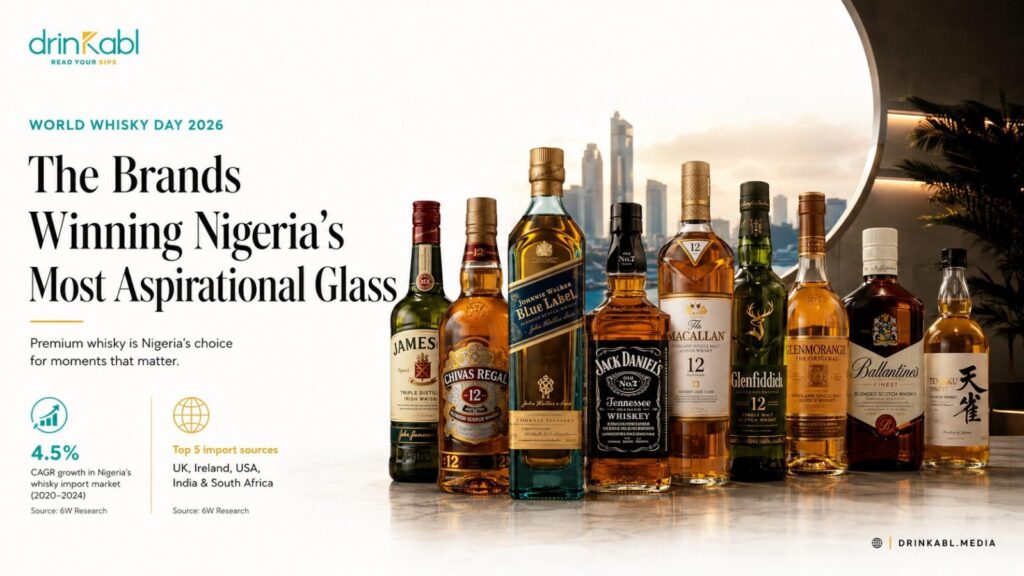
Johnnie Walker holds the commanding position. The Diageo-owned blended Scotch carries a range that covers entry-level and aspiration in the same family: Red Label on a bar counter, Blue Label at a corporate table. Its visibility across nightlife, corporate entertainment, and private celebrations gives it the broadest footprint of any whisky brand in the market.
Jameson is the smoothness play. The Irish whiskey’s triple-distillation process produces a profile that works neat, over ice, or in a cocktail, and that versatility has made it a reliable pick among younger urban consumers and the cocktail crowd. Its growth in Nigeria’s bar scene has been consistent, and it now sits comfortably alongside the Scotch heavyweights.
Chivas Regal occupies the middle-premium lane that Nigerian consumers are increasingly interested in. Blended from more than 40 whiskies, including the Strathisla single malt at its core, it carries strong associations with special occasions and gifting. It is the bottle that shows up at milestone celebrations and that still reads as a signal of taste rather than just expenditure.
Jack Daniel’s crosses categories in a way most whisky brands cannot. Technically a Tennessee whiskey rather than a bourbon, its charcoal-mellowing process sets it apart from both. The brand’s cultural currency in Nigeria extends well beyond the whisky drinker: it is a concert staple, a nightlife fixture, and a credible cocktail base. Among younger consumers especially, the black label still means something.
Glenfiddich and Glenmorangie represent the single-malt tier that experienced whisky consumers in Nigeria gravitate toward. Glenfiddich’s age statements, particularly the 12 Year Old and 18 Year Old, have become familiar at executive gatherings and high-end gifting events. Glenmorangie brings a different expression: aged in extra-tall copper stills that produce a lighter, more floral spirit, respected by drinkers who know what they are looking for.
The Macallan operates at the prestige end. The Edrington-owned Speyside single malt carries significant weight among collectors and serious enthusiasts; Edrington’s partnership with Premium Spirits Nigeria, a business division of Nigerian Bottling Company, brought The Macallan, Highland Park, and The Famous Grouse into broader formal distribution in the Nigerian market. The Macallan’s sherry oak expressions remain a benchmark for what the category can deliver at the top.
Ballantine’s is the volume play among Scotch blends, established since 1827 and now Europe’s top-selling Scotch. In Nigeria it competes in the accessible-premium range, doing what good blended Scotch is supposed to do: consistent, approachable, and commercially smart.
For drinkers exploring further, Tenjaku, a Japanese blended whisky produced in Yamanashi Prefecture by Master Blender Kenji Watanabe, has started appearing on more discerning Nigerian bar lists. Japanese whisky’s reputation for precision and restraint travels well, and Tenjaku’s price point makes it a more accessible entry into the category than Suntory’s established expressions.
The Gen Z angle, which this publication mapped in detail earlier this month drawing on X3M Intelligence’s nationwide survey, suggests that the next wave of Nigerian drinkers is more deliberate than their predecessors, drinking less often but choosing more carefully. For whisky brands, that is both a challenge and an opening: the consumer who buys less is also the consumer most receptive to craft, provenance, and story.
Cocktail culture is doing its part. The Old Fashioned, Manhattan, and Whisky Sour remain the most requested whisky cocktails at Lagos bars. Food pairing is arriving more slowly but arriving nonetheless, as Nigerian hospitality venues start treating whisky with the same seriousness that wine has enjoyed for the past decade.
The next meaningful market test comes during the fourth quarter, when corporate gifting, end-of-year events, and the December social calendar typically drive Nigeria’s biggest premium spirits volumes. How aggressively the major importers position their top-tier expressions for that window will say more about the market’s direction than any occasion-day commentary.
Read More