
The Question Is Who Ends Up Holding the Assets.
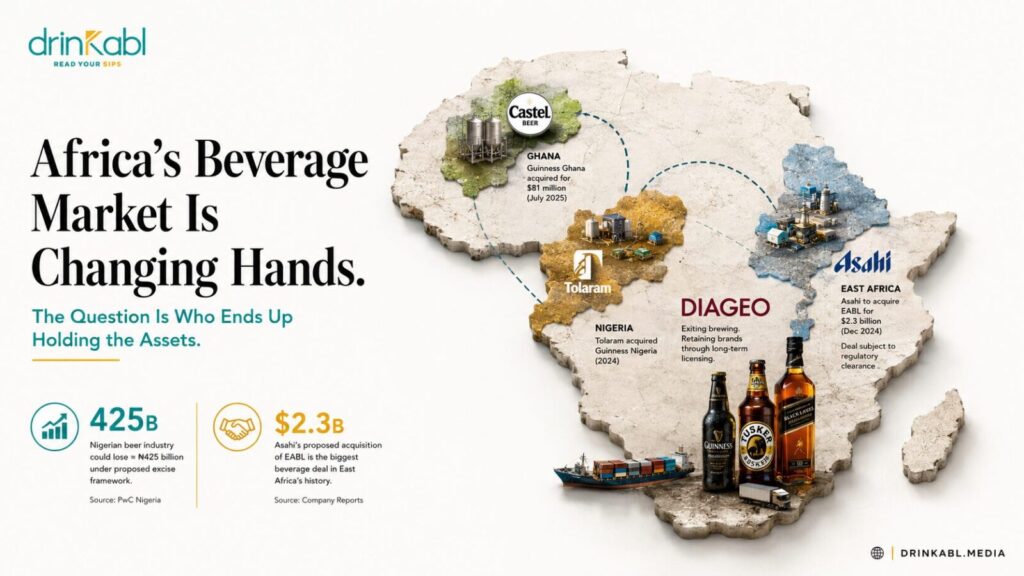
Diageo has spent the last three years methodically exiting African brewing. Tolaram took over Guinness Nigeria in 2024. Castel picked up Guinness Ghana for $81 million in July 2025. Japan’s Asahi agreed to buy East African Breweries for $2.3 billion in December, a deal still awaiting competition clearance across Kenya, Tanzania and Uganda. Diageo retains the brands under long-term licensing arrangements. The equity is gone.
That pattern, a global group monetising the asset and keeping the royalty stream, is not unique to Diageo. It is the emerging operating template for multinationals navigating Africa’s currency risk, excise volatility and capital intensity. Akos Petri, Managing Director at Zenith Consulting, framed the structural question directly in a recent LinkedIn analysis: “Who will control the brands, bottling assets, distribution networks and capital flows? That is where the market is getting interesting.”
The evidence suggests that control is dispersing. Castel now holds Guinness brewing rights across Ghana, Cameroon and other West African markets. Tolaram, a Singapore-based conglomerate with substantial Nigerian consumer goods operations, is integrating Guinness Nigeria into a portfolio built on local distribution depth. Asahi, making its first major African investment, takes on EABL’s $996 million revenue business and a brand portfolio spanning Tusker, Bell Lager, Serengeti, and licensed global names including Guinness and Johnnie Walker.
Carlsberg moved in a different direction. Rather than acquiring an existing brewer, it signed a deal with Varun Beverages, a PepsiCo bottler diversifying into beer, to test Carlsberg sales across select African subsidiaries including Zimbabwe. The arrangement transfers market risk to a regional operator already embedded in the distribution infrastructure. Petri’s framing applies precisely here: some markets justify direct ownership, others reward execution through established local platforms.
The financial logic behind the divestments is straightforward. Diageo’s EABL sale reduces its leverage by approximately 0.25x and is part of a $500 million cost-cutting programme. African beer operations, capital-intensive and exposed to volatile fiscal environments, are not where Diageo’s balance sheet recovery gets built. Premium spirits are. But the departure of a major direct investor does not reduce the commercial complexity of these markets. It raises the stakes for whoever absorbs the assets.
That complexity is visible in Nigeria, where the ownership transition at Guinness runs alongside an unresolved excise dispute. The Beer Sectoral Group, representing Nigerian Breweries, Guinness Nigeria and International Breweries, is contesting a proposed three-year excise framework that PwC analysis estimates could cost the industry roughly 425 billion naira. Nigeria’s beer volumes fell mid-teens in 2025, a market already labouring under naira devaluation and compressed consumer purchasing power. Tolaram inherits a brand with significant equity but an immediate margin problem. Distribution depth, not just brand ownership, is where these ownership transitions will be won or lost. Import taxes of up to 50 percent in Nigeria already inflate prices and fuel illicit trade. Petri identifies cold chain, last-mile logistics and route-to-market execution as the variables that separate successful market entry from stranded capital. The multinationals selling their brewing stakes understand this. The question is whether their successors, Asahi in East Africa, Tolaram in Nigeria, Castel across West and Central Africa, have built or acquired the operational infrastructure to capitalise on the underlying volume opportunity. Asahi’s EABL acquisition still requires competition clearance in Kenya, Tanzania and Uganda. Until those approvals land, the precise commercial terms of the transition remain subject to regulatory negotiation.
Read More: