
India is positioning itself as a sourcing base for non-alcoholic beer exports, with a growing number of operators offering flavoured, private-label-ready product lines aimed at markets where alcohol-free alternatives are not a lifestyle option but a structural requirement.
DC Global Exports, a Rajasthan-based export house run by founder and CEO Sourabh Nagpal, is among the companies building out this pitch. The firm’s current portfolio spans seven flavour variants: German Lager, Cranberry, Ginger, Strawberry, Peach, Kiwi Mint, and Peach Mango. The lineup is deliberately broad, calibrated for the kind of importer who wants differentiation on shelf rather than a commodity product competing on price alone.
The timing is not accidental. According to Future Market Insights, the global non-alcoholic beer market was valued at USD 23.4 billion in 2025 and is projected to grow at 7.7% annually through 2036. India, FMI forecasts, will expand at 8.8% CAGR over that same period, the fastest rate among all countries in its analysis, driven by a younger urban consumer base and a category still in early domestic adoption. That growth trajectory also tells a sourcing story: a domestic market pulling in the same direction as the export opportunity tends to support manufacturing investment.
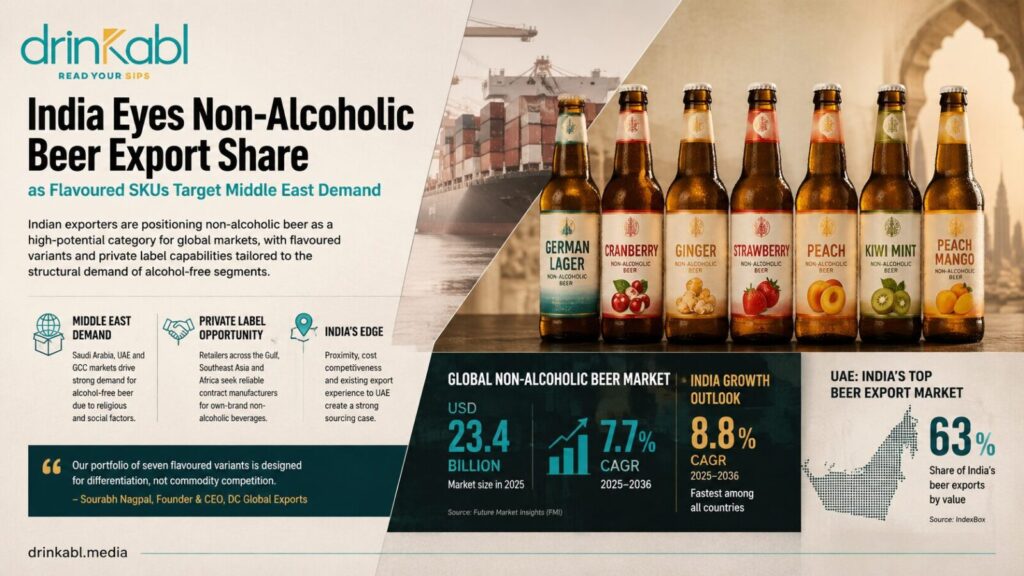
The clearest commercial case for Indian non-alcoholic beer exports runs through the Middle East. Saudi Arabia, the UAE, and the broader GCC region have become substantial consumers of alcohol-free beer, with demand accelerated by religious restrictions on alcohol consumption among Muslim residents and a large expatriate population that prefers to socialise around beer culture without violating local law. European brands, particularly German and Dutch producers, currently hold the dominant supply position in that corridor. India’s geographic proximity, production cost structure, and an already-established beer export relationship with the UAE, which according to IndexBox takes roughly 63% of India’s beer exports by value, give domestic producers a credible argument for a larger share.
Private label is the other angle operators like DC Global are working. Retail chains across the Gulf, Southeast Asia, and parts of Africa with expanding modern trade formats need credible contract manufacturers for own-brand non-alcoholic beverages. The category carries lower regulatory friction than alcoholic products, moves through a cleaner import compliance process in most markets, and benefits from consumer tailwinds that large multinationals have already spent years building awareness for.
The structural tailwinds are real. Drinkabl.media’s March 2026 analysis of Africa’s no-and-low segment documented the acceleration in consumer behaviour across the continent, with alternating drinkers swapping every second or third round for a zero product driving category growth without cannibalising alcoholic beer volumes. That dynamic matters to anyone positioning non-alcoholic beer as a complementary SKU rather than a replacement product.
What India has not yet established is category credibility at scale in this specific segment. German and Belgian provenance carries weight in non-alcoholic beer the way French origin carries weight in wine, and India has not built the equivalent reputational foundation here. Flavour innovation gives smaller exporters a partial workaround: a Peach Mango or Kiwi Mint non-alcoholic beer is not competing with a Paulaner 0.0% on heritage, it is competing on novelty and margin, which is a viable strategy in modern retail and café channels, if not in premium on-trade.
Whether DC Global and operators like it can convert category interest into durable trade relationships depends on consistency of supply, certifications for target markets, and cold chain reliability over distance. The gap between a compelling sourcing pitch and verified importer relationships with recurring purchase orders is where most early-stage export ventures fail.
The category is large enough to reward the attempt. Who executes is the open question.
Read More