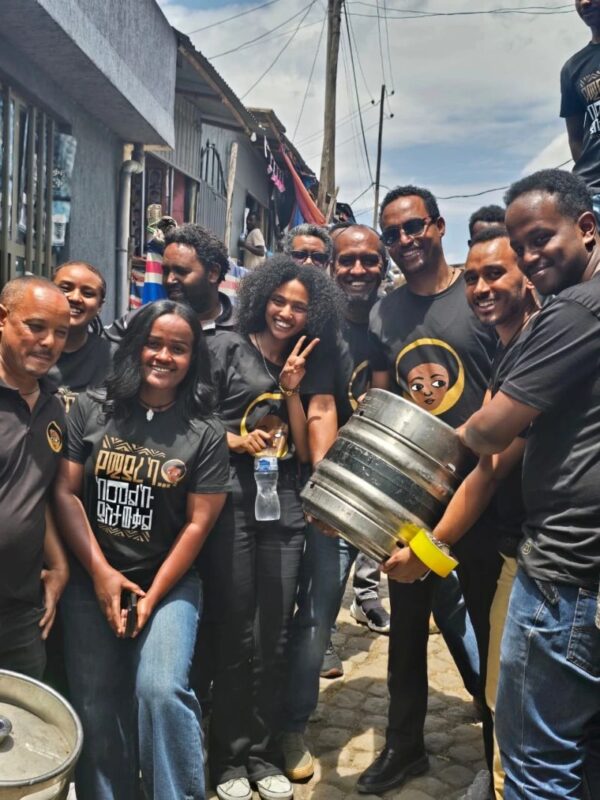

Habesha Breweries ran a coordinated market activation across Addis Ababa on 29 May, deploying staff for direct retailer and consumer engagement the day after its Brand Africa 100 recognition as Ethiopia’s Most Admired Beer Brand.
The timing was not incidental. For a brewer with a single production facility in Debre Birhan and a market share still well behind BGI Ethiopia and Heineken Ethiopia, brand perception is an asset that requires field work to convert. Addis Ababa is the country’s highest-value commercial market: the concentration of outlets, foot traffic, and premium-tier consumers makes visibility there disproportionately important for any brewer with national ambitions.
The activation, described by Habesha contact center manager Akalu Tesfaye on LinkedIn as a “market storm,” involved cross-functional teams executing simultaneously across multiple points in the capital. The operational logic is straightforward: brand equity from an award cycle has a short half-life unless reinforced at distributor and retail level. Habesha appears to have understood the window.
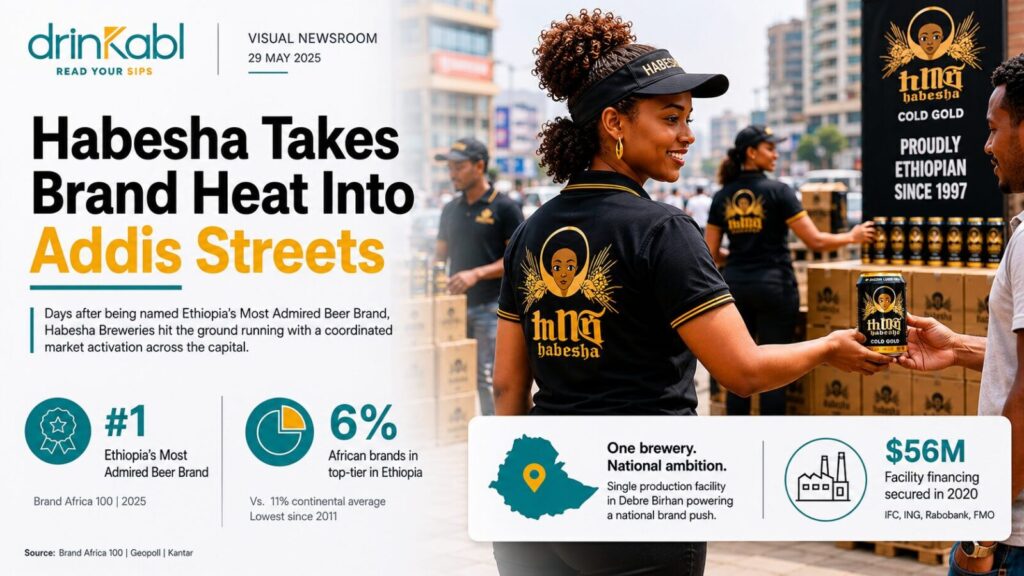
The Brand Africa win itself warrants some commercial context. The ranking is consumer perception-based, conducted by Geopoll and Kantar across 31 countries. It measures admiration, not volume. In Ethiopia, African brands reached only 6% of the top-tier ranking this year, against a continental average of 11%, itself the lowest figure since the survey launched in 2011. Habesha’s beer category recognition sits against that backdrop, giving the win a sharper edge than a standard industry award.
The company’s market position remains constrained by capacity. Its Debre Birhan plant, backed by a $56 million debt package from IFC, ING, Rabobank, and FMO in 2020, was designed to support expansion, but production at a single facility limits the speed at which national distribution can be deepened. Addis Ababa remains the primary arena where Habesha can build consistent on-shelf presence against BGI’s Saint George and Heineken’s portfolio of Harar, Meta, and Bedele.
Drinkabl.media’s coverage of Harar Beer’s recent consumer activation traced how Heineken is using experiential mechanics to hold loyalty as purchasing power tightens across Ethiopia’s beer market. Habesha is operating in the same environment, with less distribution depth and fewer brand lines, making each market-level touchpoint more consequential.
The question for Habesha’s commercial team is whether activations like this translate into measurable distributor commitment and sustained shelf presence, or whether the brand’s equity stays concentrated in awareness and lags at the point of purchase. In a market where volume is still won through route-to-market execution rather than consumer surveys, the gap between admiration and repeat off-take is the one that matters.
READ MORE