

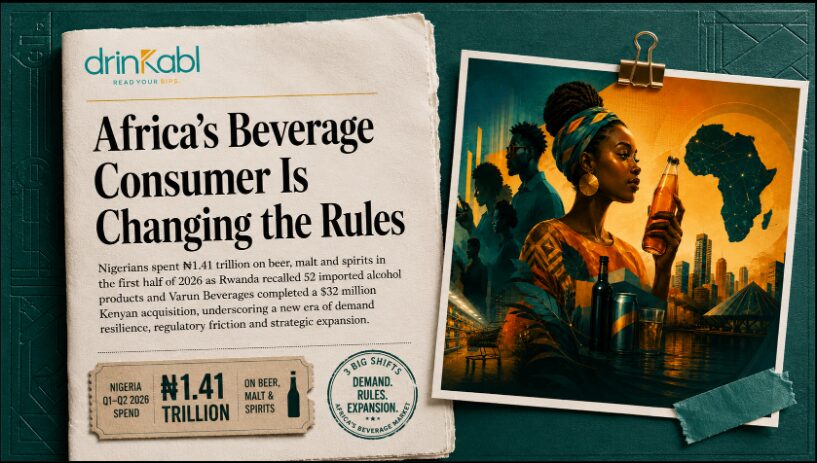
Nigerians spent roughly ₦1.41 trillion, about $1.03 billion, on beer, malt drinks and spirits in the first half of 2026, even as a public-health-driven alcohol recall in Rwanda and a $32 million Kenyan acquisition reshaped the regulatory and competitive map across the region. None of the three developments needed the others to matter. Together, they show a beverage industry where demand holds up while the rules around it keep shifting.
NIGERIANS ARE SPENDING, JUST MORE CAREFULLY
The clearest signal came from Nigeria. Consumers spent an estimated ₦1.41 trillion on beer, malt and spirits in the first half of the year, according to figures compiled from the half-year results of Nigerian Breweries, International Breweries and Guinness Nigeria, the three companies that together control roughly 90% of the country’s formal beer market. Nigerian Breweries led with ₦803.7 billion in revenue, up 9% year on year, while Guinness Nigeria posted the sharpest gain at 11.8% and International Breweries stayed close to flat.
The growth came from price, not volume. All three brewers raised prices in March, and the three companies together put more than ₦130 billion into marketing and distribution in the first half, roughly ₦72 billion of it from Nigerian Breweries alone. Combined pre-tax profit rose nearly 24% to ₦269.4 billion, helped by lower financing costs as naira pressure eased. At current exchange rates, that revenue converts to just over $1 billion, a fraction of what the same naira figure would have bought before the 2023 devaluation.
The spending pattern sits inside a tighter regulatory frame than it did a year ago. Nigeria’s ban on sachet and small-format alcohol has pushed informal sellers into the same conversation as the listed brewers, and traders in Ibadan spent last week protesting the policy directly to the Federal Government, arguing they have no other livelihood to fall back on. The brewers reporting record first-half numbers and the sachet sellers losing their only income sit on opposite ends of the same industry.
RWANDA’S ALCOHOL CRACKDOWN EXPOSES REGIONAL FRICTION
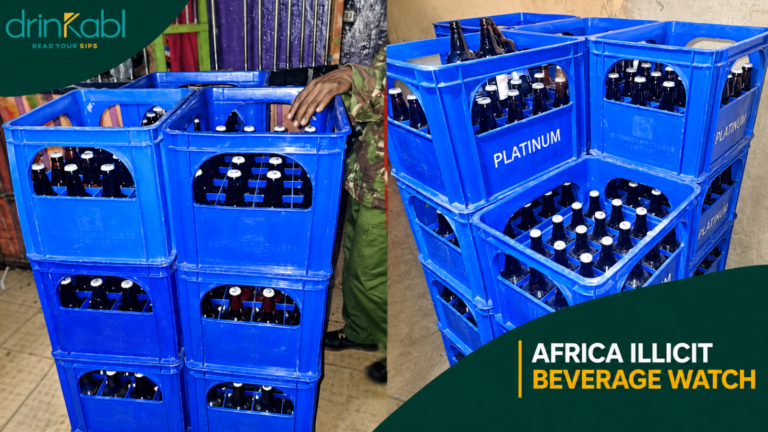
The second signal came from East Africa. On August 5, Rwanda’s Food and Drugs Authority suspended 52 alcoholic beverage listings imported from Kenya, Tanzania, Uganda, Burundi, India and Poland, ordering importers to recall every affected bottle within three working days. The suspension sits inside a much larger domestic crackdown: Rwandan health officials say more than 500 people sought treatment and at least 50 died after consuming illicit alcohol in the first half of the year, with dozens more left partially or fully blind.
Five Kenyan products were on the list, including Kenya King Gin, Safari Gin and Gilbey’s Gin. The Kenya Bureau of Standards (KEBS) responded with fresh inspections at all five manufacturers between August 7 and 10, then said the products carried valid Standardization Marks and met East African quality and safety requirements. KEBS said it is now working through East African Community channels to resolve the gap between its findings and Rwanda’s, and as of last week the Rwanda FDA had not publicly addressed KEBS’s results.
For companies building regional footprints, the episode is a reminder that a product cleared at home can still be pulled off shelves across the border. Harmonised East African standards exist on paper, but they have not stopped Rwanda from moving unilaterally on products Kenya insists are compliant, and the resolution will say more about how the region actually enforces shared rules than any policy document does.
VARUN BEVERAGES BETS $32 MILLION ON KENYA’S EVERYDAY DRINKS
The third signal came from Kenya, where Varun Beverages, one of PepsiCo’s largest bottling partners globally, completed a $32 million acquisition of the dairy beverages, juice and packaged water business of Devyani Food Industries Kenya, effective August 1. The deal is a related-party transaction, since the seller sits inside Varun’s own promoter group, but the company says it was struck on an arm’s length basis.
The acquisition is smaller in value than the Rwanda dispute or Nigeria’s brewing numbers, but it adds more strategically than its price tag suggests. Water, juice and dairy beverages each serve a different occasion, and Varun can now sell into all three using a 52-acre manufacturing site in Nakuru that it already controls, rather than building capacity from scratch. The plant is also positioned to support Varun’s planned carbonated soft drink launch in Kenya, giving the company a manufacturing base for categories it has not yet entered in the market.
A MARKET THAT NO LONGER SERVES ONE CONSUMER
Put together, the three stories describe an industry moving into a more segmented phase. Some Nigerian consumers are still paying more for beer and spirits at the till. Others, priced out of even the cheapest legal formats, are protesting a packaging ban that took away their only product. Kenyan regulators are defending export brands that a neighbouring government has pulled from shelves, while a foreign bottler is quietly building the infrastructure to sell three more categories into the same market.
That segmentation changes what companies need to get right. It is no longer enough to win volume; manufacturers now have to work out which consumer, which price point and which regulatory environment they are actually competing in, and increasingly, that calculation differs by country even within the same region.
WHAT TO WATCH NEXT
Three things are worth tracking into next week: whether Rwanda’s FDA responds publicly to KEBS’s compliance findings or lets the dispute run through East African Community channels; how Nigeria’s Federal Government responds to sachet sellers’ appeal, given the brewers’ first-half numbers make the case for formal-sector resilience harder to ignore; and whether other regional bottlers follow Varun’s lead by buying into adjacent categories in markets where they already have distribution, rather than building from zero.
READ MORE