
Nigerian Breweries has repaid its loans and intends to fund growth from its own cash, chief executive Thibaut Boidin said on 15 October. The brewer, which marks 80 years in Nigeria this year, says it is gaining market share even as weak consumer spending keeps industry volumes under pressure.
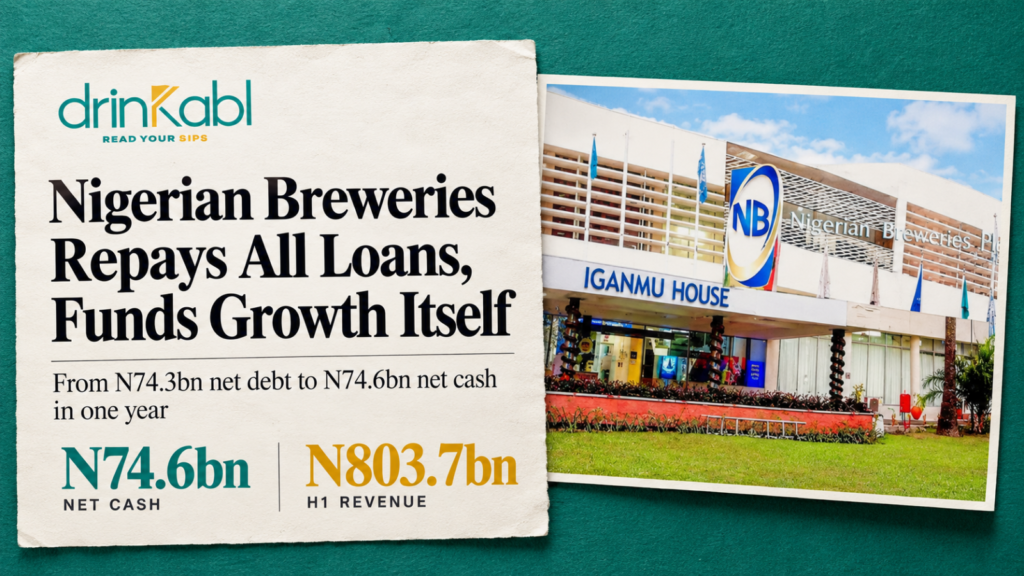
The balance sheet shift shows in the half-year accounts. Net debt of N74.3 billion a year earlier became net cash of N74.6 billion by June, and revenue rose 9 per cent to N803.7 billion. Profit before tax grew 18 per cent to N156.3 billion, though net profit rose only 5 per cent after higher tax rates. Heineken is the majority shareholder.
Debt out, cash in
Boidin said rebuilding the balance sheet was his first task on arrival. Operating profit growth, tighter working capital and stricter inventory control rebuilt the cash position and cleared the loans, he said, and the company ended 2025 in a much stronger position. Operating profit rose 8 per cent to N164 billion in the half, even as selling, distribution and administration costs climbed 20 per cent.
The finance team puts the half-year productivity gains at N76 billion, which helped cushion inflation. Boidin said the freed-up cash lets the company finance its growth priorities itself, and that volumes, revenue and operating profit are all moving up.
Pricing and drinkers
Industry volumes have fallen for several years as pressure on household income cut purchasing power, Boidin said. Brewers raised prices in 2023 and 2024 to cope with cost inflation and currency devaluation, and he argued the alternative would have been an unsustainable operation. All three large brewers adjusted prices again in March 2026.
Boidin said the company now handles pricing with care. Cost savings are used to limit what is passed on to drinkers, and a large share is reinvested in the business, he said. The claim that the brewer is gaining market share is the company’s own and has not been independently confirmed.
Local inputs and a master plan
Many inputs, including sorghum, glass and aluminium, are already sourced in Nigeria, and the company wants to speed up localisation. Sorghum use grew after barley imports were restricted, and a local barley initiative is the next effort to cut import dependence. Glass is the pressure point: most of the industry’s requirement has to come from local suppliers, so their cost and efficiency now affect brewers directly.
Boidin also chairs the Beer Sectoral Group of the Manufacturers Association of Nigeria, which is working on a master plan for brewing. It covers more local production and raw materials, returnable glass bottles, sustainability and responsible consumption. He gave no timeline or targets. He asked for predictable regulation, saying long-term investments need visibility on policy, and backed the direction of current economic reforms.
Room to grow
Boidin said per capita consumption in Nigeria sits well below the average in many other sub-Saharan markets, which he reads as room for the industry to grow to several times its current size. Nigeria is one of the main drivers of future growth for Heineken globally, he said. For 2027 he was cautious, expecting the return to sustained growth to take time while household budgets stay tight.
Nigerian Breweries spent N71.9 billion on marketing in the half, the most of the three big brewers. The Together, Every Moment anniversary campaign asks Nigerians to share photos and stories of moments tied to its brands, with the best entries rewarded. Boidin also pointed to Heineken events in Lagos that included large hot-air balloons and a drone show.