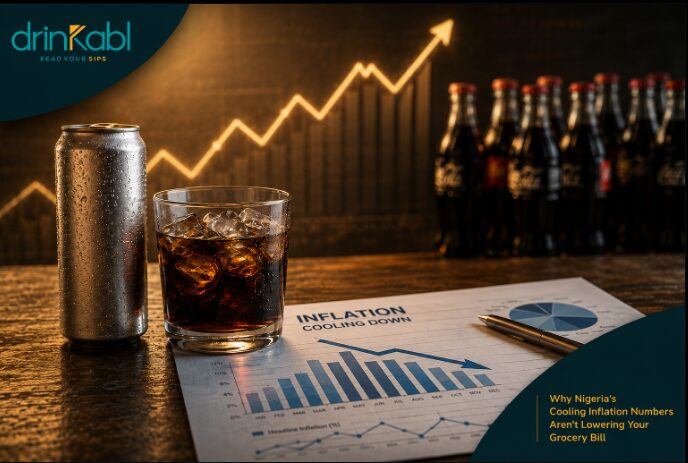

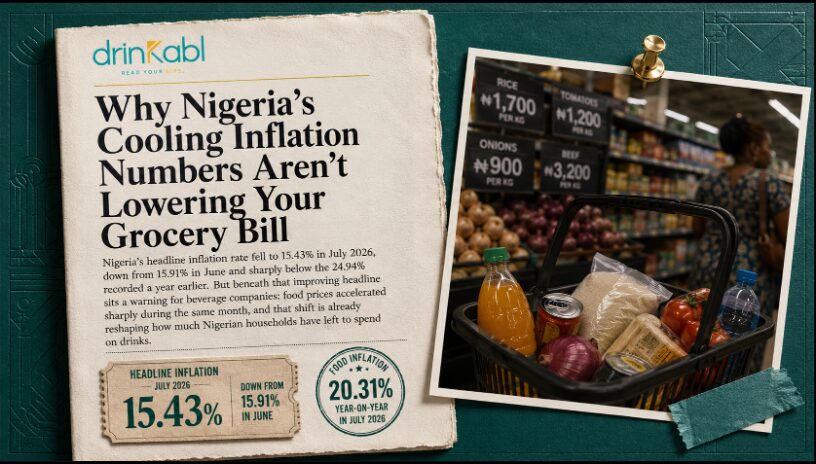
Nigeria’s headline inflation rate fell to 15.43% in July 2026, down from 15.91% in June and sharply below the 24.94% recorded a year earlier. But beneath that improving headline sits a warning for beverage companies: food prices accelerated sharply during the same month, and that shift is already reshaping how much Nigerian households have left to spend on drinks.
The National Bureau of Statistics (NBS) said month-on-month inflation also eased, slowing to 1.57% from 1.66% in June. Taken alone, both figures point to an economya economy gradually cooling off its inflationary peak. Isolate food, though, and the picture turns considerably less comfortable for consumer-facing brands.
Food inflation stood at 20.31% year-on-year in July, up from 17.52% in June, while the month-on-month food figure jumped to 5.56% from 3.75%. NBS attributed the spike to rising average prices for rice, tomatoes, onions, pepper, beef, eggs, crayfish, garri, plantain and ginger, among other staples.
For beverage companies, this distinction is not academic. A lower headline number does not mean prices are falling; it means they are climbing at a slower annual pace, while households are simultaneously absorbing a sharp monthly jump in the cost of feeding themselves. That combination puts direct pressure on the naira left over for beer, soft drinks, water and spirits.
Affordability Moves to the Centre of Strategy
When food claims a larger share of a household budget, beverage purchases become a more deliberate decision rather than a reflex one. Consumers rarely abandon a brand outright; instead, they buy less often, downsize the pack, trade down to a cheaper label, or wait for a promotion.
That behavioural shift is already pushing price architecture to the top of the commercial agenda. Expect greater emphasis on accessible price points, smaller formats and differentiated tiers as manufacturers try to protect both affordability and margin at once. Recent moves already point this way: MILO’s push around its 20g sachet and Fanta’s KES 100 pricing play in Kenya both signal that smaller, cheaper entry points are becoming a deliberate category strategy rather than a stopgap. For mass-market soft drinks, energy drinks, water and alcoholic beverages, offering an affordable entry point may soon matter as much as brand equity itself.
A Narrow Window of Relief for Manufacturers
There is a more encouraging figure buried in the same report. Core inflation, which strips out volatile food and energy prices, eased to roughly 14.9% year-on-year, and its monthly pace dropped sharply to 0.15% from 1.66% in June.
If that moderation holds, beverage manufacturers could eventually see relief from the input-cost escalation that has complicated production, distribution and pricing over the past year. That relief is unlikely to reach shelves immediately, however. Companies squeezed by higher operating costs will likely use any stretch of cost stability to rebuild margin first, before passing savings on to consumers.
A More Complicated Environment, Not a Simpler One
The July numbers describe a market in transition rather than one returning to comfort. Nigeria is clearly moving away from the extreme inflationary pressure that defined 2025, but the average consumer is not suddenly flush.
For beverage companies, the next phase of competition is unlikely to be about simply passing costs through to shoppers. It will be about calibrating price, pack size, volume and margin in a market where the inflation numbers are improving but food affordability is not. That balancing act could define competitiveness in Nigeria’s beverage sector for the remainder of 2026. The headline inflation figure is cooling. The contest for the consumer’s naira is not.
Read More