

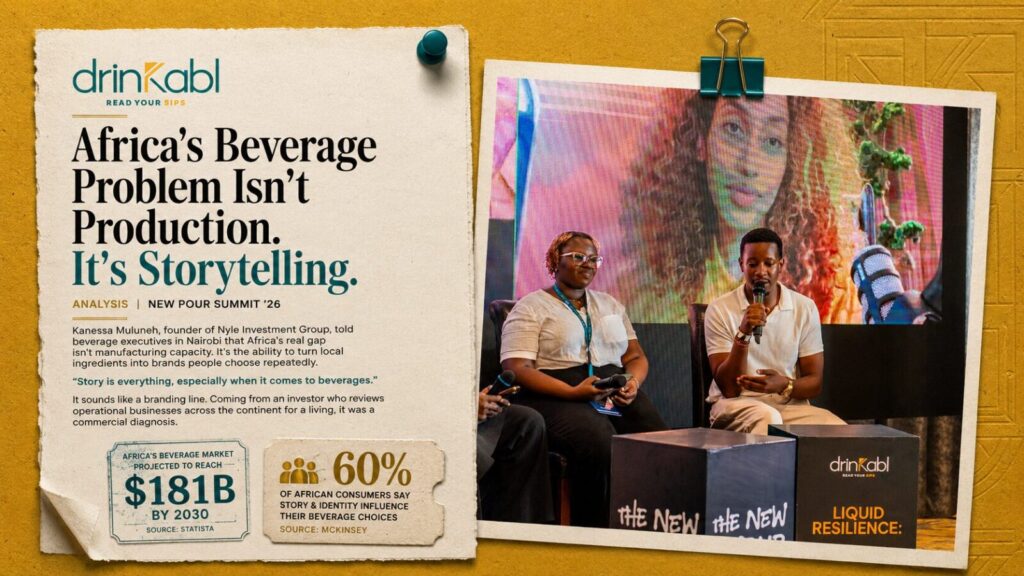
Kanessa Muluneh, founder of Nyle Investment Group, told beverage executives in Nairobi that Africa’s real gap isn’t manufacturing capacity. It’s the ability to turn local ingredients into brands people choose repeatedly.
“Story is everything, especially when it comes to beverages.”
It sounds like a branding line. Coming from an investor who reviews operational businesses across the continent for a living, it was a commercial diagnosis.
The industry already has the raw materials
For years, conversation about Africa’s beverage industry has centred on what it lacks: capital, manufacturing capacity, distribution, infrastructure.
Those constraints are real. But Muluneh’s point at New Pour Summit ’26 was different. Africa already has agricultural resources, increasingly capable manufacturers, young consumer markets and distinctive food and drink cultures.
The harder question is whether those ingredients are becoming African-owned brand value, or whether the continent keeps exporting raw materials while importing the finished, branded product.
Consumers buy meaning, not liquid
Beverage companies understand a reality that applies well beyond Africa: consumers rarely buy the drink alone. They buy familiarity, identity, occasion and belonging.
A soft drink is carbonated water, flavouring and sugar. A beer is malt, hops, water and yeast. Successful companies don’t sell those ingredients. They sell the meaning built around them.
That is the line between a manufacturer and a brand owner. Manufacturing creates the physical product. Brand building creates the reason to choose it.
Muluneh’s question at the summit was pointed: why does a continent with the raw materials and manufacturing potential still import so many finished beverages? Her answer was cultural as much as commercial. Building a beverage culture and brand that originates from Africa’s own strengths is a harder problem than adding another production line.
An investor’s view of storytelling
Muluneh isn’t approaching this as an advertising executive. Nyle is an Africa-focused advisory and investment platform that reviews opportunities across agriculture, manufacturing, healthcare, infrastructure, energy, trade, logistics and consumer goods, with a process that runs from initial review through due diligence to investor introduction.
For an investor, storytelling isn’t about making a brand look attractive. It’s about whether a company understands what it sells, to whom, why consumers should care, and whether the proposition can scale.
Muluneh has also argued that diaspora investors bring experience, networks and international exposure alongside capital, while local operators bring market understanding. That combination matters for beverages specifically: capital alone cannot manufacture consumer loyalty.
Local ingredients need stronger commercial narratives
There is already evidence that African beverage companies can build businesses around local identity. Kenya’s African Originals, which produces ciders, spirits and ready-to-drink cocktails from locally sourced ingredients, has grown by more than 50 percent year on year and recently secured further backing from Phoenix Beverages to scale its production and distribution.
A locally sourced fruit is an agricultural commodity. A recognisable beverage brand built around that fruit becomes an intellectual and cultural asset. That gap, between the raw ingredient and the branded product, is where the value multiplies, and where much of Africa’s beverage industry still has room to grow.
The investor pitch is changing
The old pitch for beverage entrepreneurs was straightforward: here is our product, here is our factory, here is what we need. The stronger pitch now has to answer harder questions.
What consumer problem does the brand solve? What space does it occupy culturally? Why would consumers choose it again? Can the story travel to another market?
These questions matter more as African beverage markets grow more competitive. International companies bring large distribution systems and marketing budgets. Local producers may understand their consumers better, but that advantage only pays off commercially once it becomes a proposition worth choosing. That is where storytelling stops being decoration and becomes strategy.
From ingredients to intellectual property
There is a larger industrial argument underneath Muluneh’s statement. Africa has historically sat in lower-value positions in global supply chains, exporting commodities and importing finished goods. Beverages make that pattern especially visible, because the chain from agricultural input to consumer product is short and clear: fruit becomes juice, grain becomes beer, cocoa becomes a drink, coffee becomes ready-to-drink.
The greatest value doesn’t necessarily sit at either end of that chain. It can sit in the brand. That is why the next phase of African beverage development can’t be measured only by factories and distribution footprints. It also has to be measured by how many African companies build brands with enough consumer equity to compete beyond their home markets.
The story still needs a product behind it
There’s a caution built into the opportunity: storytelling cannot compensate indefinitely for a weak product. An origin story may drive the first purchase, but quality, consistency, availability and price decide whether consumers come back.
Muluneh’s argument works best when storytelling is treated as part of a broader commercial system rather than marketing alone. The story has to be backed by the product. The product has to be backed by the supply chain. The supply chain has to be backed by capital, and the capital has to sit with a business capable of creating sustainable consumer value.
A cultural advantage still to be built
Africa doesn’t need to copy the beverage industries that came before it. It can build brands from its own ingredients, occasions and cultural references, but that takes more than putting an African name or image on a bottle. It requires understanding what African consumers actually value and converting that understanding into brands that feel current without losing their origins.
Muluneh’s point isn’t that Africa can’t make beverages. It’s that making the beverage is only half the job. The bigger opportunity is building brands whose stories are strong enough to turn African raw materials into African intellectual property, consumer loyalty and investment value.
The factory makes the drink. The story makes the brand. Increasingly, the brand is where the economic contest is being decided.
READ MORE