

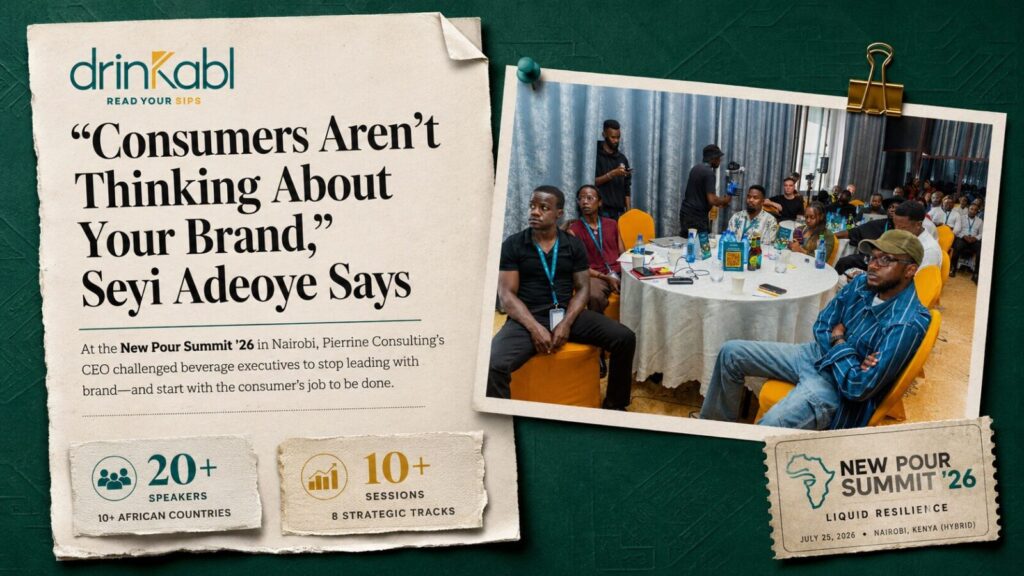
Seyi Adeoye, Chief Executive Officer of Pierrine Consulting, told beverage executives in Nairobi to rethink where their consumer strategy begins.
“When a consumer wakes up, they are not thinking about your brand. They are thinking about a job to be done.”
The line, delivered at the inaugural New Pour Summit ’26, targets a habit built into much of beverage marketing: companies start with the brand and search for the consumer afterward.
Adeoye’s argument flips that order. The starting point should be the consumer’s need, occasion or problem. The brand then has to earn its place in solving it.
A decision already in progress
A consumer buying a drink is rarely making an isolated brand choice. They may want something to go with food, a jolt of refreshment, a fit for a social occasion, or a specific functional benefit. The same person can move between products as the occasion changes.
Drinkabl.media’s own reporting from the summit reached a similar conclusion: occasion can predict beverage behaviour better than age or income, because the same shopper makes different choices depending on what they need in the moment.
That is a problem for brands built around fixed consumer segments. A shopper labelled “middle-income” does not behave the same way every day. The purchase can shift with the occasion, the cash on hand, the social setting and the value on offer. The job changes. So can the brand that wins it.
Pierrine’s research points the same way
Adeoye’s comments track the direction of his own firm’s work. Pierrine, which works across food and beverage, beauty and financial services, has increasingly focused its research on how economic pressure is reshaping behaviour rather than simply cataloguing consumer preferences.
Its Consumer Pulse research, a five-year tracking study across Nigeria, found that price cuts alone will not unlock growth, because consumers are scrutinising value more closely and weighing what they get back for their spending. The report points businesses toward pricing tiers, pack architecture and distribution reach rather than blanket price moves.
That is where “job to be done” becomes a commercial tool rather than a slogan. If consumers are being more deliberate about spending, a beverage company cannot assume a lower price is the only fix. It has to understand what the consumer is buying the product to accomplish, and whether the product still delivers enough value for that occasion.
Value is getting more specific
Adeoye has made a related point before. In April 2025, he told business leaders in Lagos that companies needed to rework their value propositions as consumer expectations shifted, pointing to survey data showing rising incomes alongside a clear pivot toward quality and value in spending. Value, in other words, is not simply a synonym for cheap.
A smaller pack can make a familiar product affordable at a given price point. A premium drink can still sell when the occasion justifies the spend. A functional beverage can win attention when the consumer has a clear reason to reach for it.
The commercial question is less about whether consumers are spending and more about what makes a specific purchase worth it. That reshapes how beverage companies should approach innovation: instead of starting with a new flavour or package and asking consumers to find a reason to care, companies can start with an unmet need and work backward to the product.
Africa raises the degree of difficulty
For companies operating across the continent, the challenge is sharper because there is no single consumer response to economic change. The market differs by country, income band, infrastructure and occasion.
Drinkabl.media’s coverage from the summit described the continent as a set of distinct consumer conversations rather than one market with a single playbook. A proposition built for Lagos may need a different route to relevance in Nairobi. A premium play may need a different value equation in Accra.
The job also decides the competition. A soft drink competes with another soft drink at one occasion, but with water, juice, coffee or an energy drink at another. The category label hides the real competitive map; the occasion reveals it.
The takeaway for beverage executives
Adeoye’s recognition among the industry’s leading professionals by ESOMAR and Insight250, and his subsequent election to lead Nigeria’s marketing research association, reflect a career built on pushing research toward decisions rather than reports. That is the frame behind his New Pour Summit ’26 intervention.
Before strengthening a brand, companies should understand the situation shaping the consumer’s choice. Before another campaign, they should know what role the product is meant to play. Before assuming a consumer has abandoned a category, they should check whether the consumer has simply changed the terms on which the product is worth buying.
For an industry facing tighter household budgets and more varied consumption occasions, the advantage may sit with the companies that identify the job before they sell the drink.
That leaves beverage executives with an uncomfortable question for the next strategy meeting: if the consumer is not thinking about your brand when the day begins, what problem are you solving when they finally reach for it?
READ MORE