

“Building in Africa requires a certain kind of madness to navigate.”
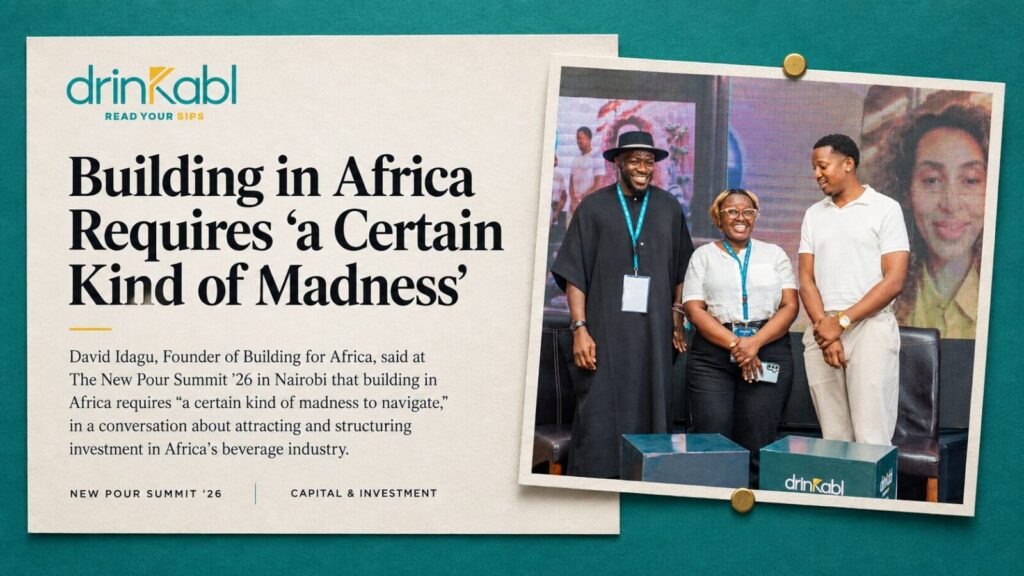
That was David Idagu, Founder of Building for Africa, speaking at the Capital & Investment panel of The New Pour Summit ’26 in Nairobi, where founders, investors and industry executives examined what it takes to move an African beverage business from pitch to pour.
For Idagu, that madness is not a side effect of building on the continent. It is part of the operating system required to do it.
Africa offers real commercial opportunity, but founders have to be prepared for an environment where conventional growth assumptions often collide with local realities: fragmented markets, shifting consumer behaviour and regulatory complexity, on top of the practical difficulty of raising money.
The session
Idagu facilitated the summit’s From Pitch to Pour: Attracting and Structuring Investment in Africa’s Beverage Industry session, joined by Kanessa Muluneh, Founder of Nyle; Caroline Gichure of African Originals; and Brian Kiriba of Handas Juice. Together, they explored how beverage businesses can become more investable and how founders can better read what capital providers actually expect.
Beyond the pitch
For Idagu, investment conversations cannot be separated from the fundamentals of building a real business. Financial discipline, a strong product, a compelling brand story and alignment between founder and investor were recurring themes through the discussion.
A drink can be visually striking and culturally relevant, but investors still need evidence the underlying business works. Packaging and branding can create instant consumer appeal, yet distribution, margins, working capital, manufacturing and repeat purchase are what decide whether that appeal turns into a sustainable business.
Africa’s beverage sector is drawing fresh attention. Reporting around the summit pointed to growing interest across coffee, tea, brewing and value-added beverages, alongside persistent risks: currency volatility, counterfeiting, supply-chain disruption and weak brand development.
The stakes are rising at the top of the market too. Coca-Cola has committed R17.6 billion to expanding production, distribution and innovation in South Africa through 2030, while Diageo’s agreement to sell its controlling stake in East African Breweries to Asahi for an estimated $2.3 billion shows how much strategic capital can move through Africa’s beverage industry when the fundamentals line up.
For emerging beverage companies, the harder task is turning that broader opportunity into an investment case that survives scrutiny.
The “productive naivety” of building in Africa
Idagu’s other memorable line from the summit was “productive naivety,” a companion to perseverance rather than a substitute for it.
Perseverance alone can become endurance without progress. Productive naivety, as Idagu frames it, is believing a hard problem can be solved while staying disciplined enough to keep testing how.
That philosophy runs through his work beyond the summit stage. Building for Africa describes itself as a business, investment and intelligence platform sitting at the intersection of media and capital, built to facilitate intra-African capital deployment, strengthen diaspora participation and produce investment intelligence.
Its argument is that Africa does not need more stories about investment. It needs stronger infrastructure connecting stories, businesses, investors and capital, an idea that led to the Building For Africa Business Investment Show, a Pan-African media property spotlighting investment opportunities and high-growth sectors across the continent. Idagu has said the platform evolved from a media project into a wider capital-mobilisation ecosystem, now including investment events, diaspora capital roundtables, a podcast and plans for a broader investment and diaspora capital summit.
Narrative is part of the capital equation
Idagu’s background helps explain why he weighs narrative and investment together. His work in strategic communications, reputation management and business development has spanned e-commerce, remittances, insurtech and logistics, with companies including Copia Global, WorldRemit, WorldCover, Lori Systems, AFEX and Konga.
That experience feeds a broader argument he has made through Building for Africa: whoever controls the infrastructure through which Africa’s economic story gets told also shapes how investors perceive opportunity.
For beverage founders, the implication is direct. A compelling story does not replace sound economics, but a business that cannot clearly explain what it solves, why consumers care, how it makes money and why it can scale will struggle to make its economics visible to investors, particularly in a category where brand, culture and consumer perception drive so much of the value.
From pitch to pour
That was the real significance of Idagu’s role at the New Pour Summit. The conversation was not simply about finding money for beverage companies. It was about what has to exist before capital becomes useful.
A founder needs to know what kind of investor the business actually requires. An investor needs to understand the company’s economics and growth path. And both sides need to know whether they are suited to the same journey.
Idagu’s own work increasingly sits at that intersection. Building for Africa is moving beyond telling African business stories toward becoming part of the infrastructure through which investors discover, assess and access African opportunities, an ambition reflected in its Capital Circle initiative, built around curated investment opportunities and greater participation by African and diaspora capital.
That makes his “madness” comment less about recklessness than resilience. Building in Africa can mean moving forward when infrastructure is imperfect, markets are fragmented, capital is selective and the path to scale is rarely a straight line.
For beverage founders, the lesson from the New Pour Summit was straightforward: the pitch may open the door, but the business has to survive what comes after it. And as Idagu’s work with Building for Africa suggests, the next phase of African investment may depend not only on finding more capital, but on building better systems for connecting capital with businesses ready to put it to work.