

Nigeria’s Enforcement Push Meets Africa’s Test of Growth
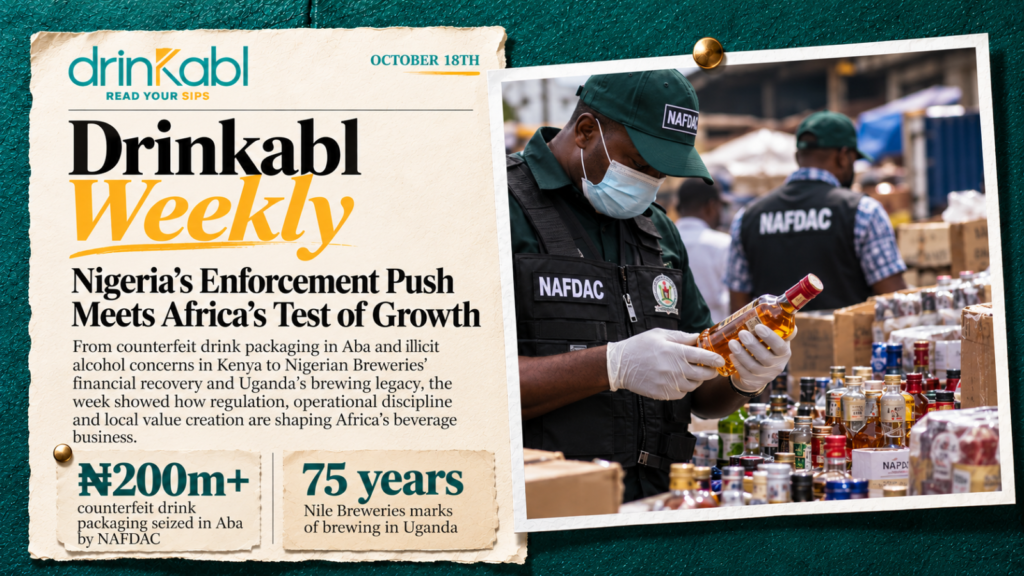
From counterfeit drink packaging in Aba and illicit alcohol concerns in Kenya to Nigerian Breweries’ financial recovery and Uganda’s brewing legacy, the week showed how regulation, operational discipline and local value creation are shaping Africa’s beverage business.
Africa’s beverage industry had a week marked by enforcement, financial restructuring and questions about where future growth will come from. In Nigeria, regulators seized counterfeit drink packaging worth more than ₦200 million in Aba, while a separate Lagos operation uncovered expired and suspected illicit beverages. Kenya’s illicit alcohol trade continued to raise questions about the effectiveness of enforcement. At the same time, Nigerian Breweries reported progress in rebuilding its balance sheet, and Uganda’s Nile Breweries marked 75 years of operations, highlighting the importance of local sourcing and industrial investment.
Taken together, the developments point to an industry dealing with two pressures at once: protecting the integrity of the products it sells and building businesses resilient enough to grow in difficult consumer markets.
Nigeria intensifies its fight against counterfeit drinks
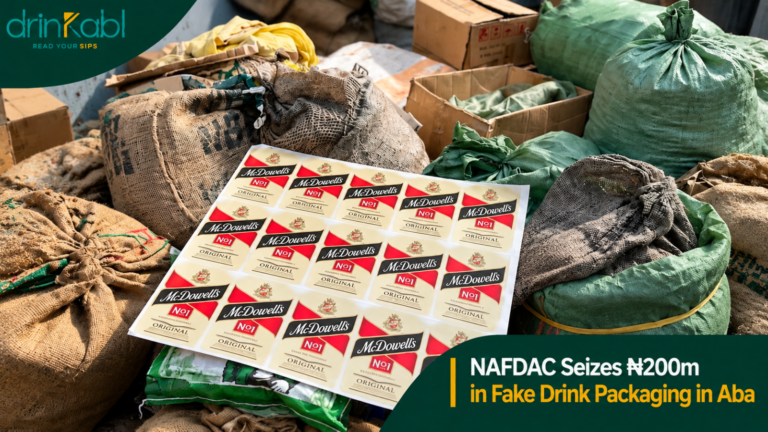
Nigeria’s National Agency for Food and Drug Administration and Control (NAFDAC) seized counterfeit packaging materials valued at more than ₦200 million from five shops in Aba, Abia State, according to a report published on 17 October. The operation adds to a series of enforcement actions targeting the materials and distribution channels that can support the production of fake beverages.
The significance extends beyond the value of the seized materials. Counterfeit labels, packaging and other components can make fraudulent products appear legitimate, complicating efforts by consumers, retailers and regulators to distinguish genuine beverages from imitations. Packaging seizures also shift attention towards the supply chains that enable counterfeiting, rather than focusing exclusively on finished products.
Earlier in the week, NAFDAC reported a separate operation at Zamfara Plaza in Lagos’s BBA Trade Fair Complex, where two men were arrested on 13 October over products the agency described as expired and implicated in an illicit drinks operation. The two cases illustrate the breadth of the enforcement challenge, from suspect finished products to the materials used to package them.
For legitimate manufacturers and distributors, the commercial stakes include brand reputation, consumer trust and the cost of maintaining traceable supply chains. The longer-term test is whether raids translate into sustained disruption of counterfeit production and distribution.
Kenya’s illicit alcohol problem raises harder questions
Kenya’s illicit alcohol trade remained a significant concern during the week, with questions extending beyond the existence of unlicensed or adulterated drinks to the effectiveness of the systems meant to prevent their circulation.
In its 17 October examination of Kenya’s illicit alcohol trade, Drinkabl explored allegations concerning political activity, enforcement and the people responsible for controlling illegal alcohol markets. The discussion draws attention to a problem that takes different forms across the country, from traditional brews to suspected adulterated spirits.
Allegations about official complicity require independent investigation and should not be treated as established findings. Nevertheless, the broader enforcement question is clear: raids alone cannot dismantle an illicit market if production networks, distribution channels and sources of protection remain intact.
For licensed beverage companies, persistent illicit trade creates an uneven competitive environment. Illegal operators can avoid some of the costs associated with product registration, taxation, quality control and compliance, while legitimate businesses bear those expenses. Consumers face the additional risk of products whose ingredients and safety may be uncertain.
The challenge for Kenyan authorities is to demonstrate that enforcement can reach the networks sustaining illicit trade, not merely the outlets where suspect products are found.
Nigeria’s soft-drinks tax debate remains unresolved
Nigeria’s beverage manufacturers also faced continued uncertainty over a proposed change to the taxation of sugar-sweetened beverages. The National Union of Food, Beverage and Tobacco Employees urged the House of Representatives to reject the proposed levy, arguing that a heavier tax burden could threaten employment and investment.
The proposal would replace the existing ₦10-per-litre excise duty with a levy linked to retail price. The final percentage and implementation terms remain central to understanding the likely commercial consequences. The bill’s passage through the National Assembly is not complete, and the proposed change should not be treated as an implemented tax.
The disagreement reflects competing priorities. Public-health advocates see beverage taxation as a way to discourage excessive sugar consumption and potentially support health programmes. Manufacturers and labour representatives are concerned about affordability, production costs, sales volumes and the implications for factory employment.
The eventual effect will depend on the final tax rate, how it is applied and whether producers pass the additional cost to consumers. For an industry already managing energy, logistics, financing and foreign-exchange pressures, uncertainty over future taxation complicates decisions on pricing, investment and product development.
Nigerian Breweries turns financial recovery into a growth strategy
Nigerian Breweries said it had repaid its loans and intended to fund future growth from internally generated cash, marking a significant change in its financial position.
According to the company’s disclosures reported on 15 October, net debt of ₦74.3 billion a year earlier had turned into net cash of ₦74.6 billion by June 2026. Revenue increased 9% to ₦803.7 billion, while profit before tax rose 18% to ₦156.3 billion. Net profit increased by a more modest 5%, reflecting the effect of higher taxes.
The shift matters because debt repayment can reduce financing costs and give management greater flexibility over investment. It may also allow the brewer to direct more of its operating cash towards production, distribution and commercial priorities instead of servicing borrowings.
However, a stronger balance sheet does not automatically resolve the demand challenge. The company has acknowledged that weak consumer spending continues to weigh on beer volumes. Its next task is to convert improved financial capacity into sustainable growth without assuming that consumers will absorb unlimited price increases.
The development offers a wider lesson for African beverage businesses: financial resilience is not simply about returning to profitability. It is about creating enough room to invest while remaining responsive to the purchasing power of the customers who ultimately determine sales.
Ota Brewery earns regional recognition
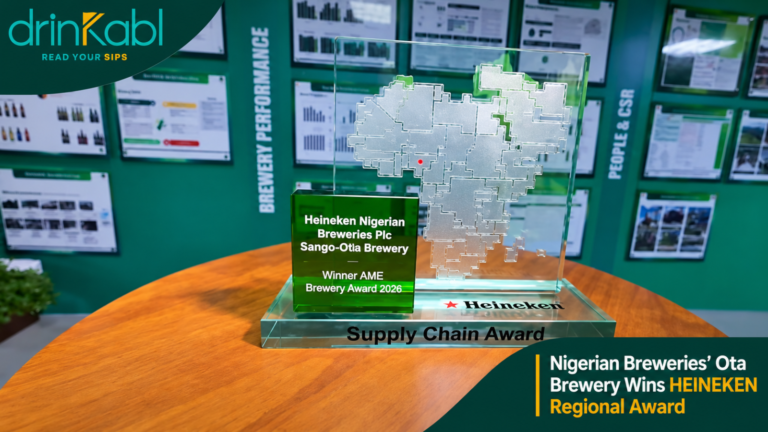
Nigerian Breweries’ Ota Brewery in Ogun State was named Best Brewery in HEINEKEN’s Africa and Middle East region and Best Brewery within Nigerian Breweries, adding two operational distinctions to its Total Productive Maintenance Bronze certification.
The company publicised the recognitions during the week, although it did not disclose the assessment scores, the other breweries considered or the specific operational measures behind the rankings.
The awards nevertheless put manufacturing execution in focus. In a market where companies face pressure from input costs, energy expenses and constrained consumer spending, operational efficiency can influence how competitively products are made and delivered.
For Nigerian manufacturers, stronger plant performance can support product consistency, reduce waste and improve the economics of supplying retailers and distributors. The commercial value of such recognition ultimately depends on whether operational improvements can be sustained and translated into measurable business outcomes.
Uganda’s brewing industry looks back, ahead
Nile Breweries marked 75 years of brewing in Uganda, highlighting its contribution to the country’s manufacturing economy and the role of local sourcing in its operations.
The company has contributed more than US$1.24 billion in taxes to Uganda’s domestic revenue between 2010 and 2025, according to reporting by Food Business Africa. The milestone provides a useful lens through which to consider the relationship between beverage manufacturing, public revenue and domestic economic activity.
For African beverage producers, local sourcing can create opportunities for farmers and suppliers while potentially reducing exposure to imported inputs. But these benefits depend on reliable agricultural supply, competitive quality, consistent volumes and the economics of processing local materials at scale.
A long operating history is therefore only part of the story. The next phase for established brewers will depend on how effectively they modernise production, develop local supply chains and respond to changing consumer demand.
Africa’s coffee industry confronts the value-capture question
Africa’s coffee sector also featured in the week’s industry conversation, with attention turning to the value producing countries retain from the beans they grow.
In its 17 October report on the commercial performance of Africa’s coffee industry, Drinkabl examined the opportunities and constraints facing producing markets including Ethiopia, Kenya, Uganda and Rwanda. The discussion looked beyond production volumes to the economics of exports, processing, branding and the development of stronger commercial identities.
The central question is whether more value can remain within producing economies instead of being captured predominantly further along the international supply chain. Building that value requires investment in quality, processing capacity, market access and the businesses that connect growers to buyers.
For beverage companies, the opportunity extends to the products and experiences built around African coffee origins. Yet a stronger origin story alone will not guarantee higher returns. Consistent quality, dependable supply and access to profitable markets remain essential.
The issue connects coffee to a broader challenge across Africa’s beverage industry: producing a valued raw material is not the same as capturing the full commercial benefit of that value.
What comes next
The coming weeks will test whether Nigeria’s enforcement operations can disrupt counterfeit supply chains and whether lawmakers clarify the future of sugar-sweetened beverage taxation. In Kenya, the effectiveness of illicit alcohol enforcement will remain an important measure of regulatory credibility. For manufacturers, Nigerian Breweries’ financial recovery and Ota Brewery’s recognition put operational discipline and investment capacity firmly on the agenda.
Uganda’s brewing milestone and the discussion around African coffee also point towards the importance of building stronger domestic value chains. Local sourcing, efficient manufacturing and deeper market intelligence can support resilience, but their returns depend on execution and consumer demand.
The common thread this week was the need to build trust and commercial strength at the same time. Regulators must protect consumers, manufacturers must defend the integrity of their products, and businesses must find ways to grow without losing sight of affordability and operating economics. Africa’s beverage industry will be better positioned for its next phase of growth when enforcement, production and investment reinforce one another rather than operate in isolation.
Read more