

An improving corporate earnings outlook is setting the tone for 2027, but Nigeria’s brewers are entering the new year with different financial strengths. The latest figures raise questions about consumer demand, operating margins, borrowing costs and how much of the recovery manufacturers can sustain.
Eighteen companies listed on the Nigerian Exchange are projecting ₦151.88 billion in combined fourth-quarter profit after tax, a 65.1% increase on the same period in 2025. The figure, published on November 26, offers an encouraging view of corporate earnings as businesses approach the end of the year. But behind the headline is a more complicated picture, particularly for an industry where improving profits do not always mean consumers are buying more products.
For Nigeria’s beverage manufacturers, the significance of the forecast becomes clearer when it is considered alongside the nine-month financial results of Nigerian Breweries, Guinness Nigeria, International Breweries and Champion Breweries, as well as the country’s economic outlook. The numbers point to a sector recovering its profitability, although the sources of that recovery differ between companies. They also provide a basis for assessing what manufacturers could face in 2027, when consumer affordability, financing conditions and production costs will continue to influence performance.
The 65% corporate profit forecast needs context
The November 26 analysis by Nairametrics Research covers 18 NGX-listed companies with December financial year-ends. Their combined projected Q4 profit of ₦151.88 billion compares with ₦91.99 billion in Q4 2025, while the full-year forecast stands at approximately ₦623.51 billion, against ₦471.63 billion earned during the first nine months of 2026.
However, the 65.1% increase is not a forecast for the beverage industry. FCMB Group alone accounts for 68.9% of the projected fourth-quarter profit and approximately 88% of the year-on-year increase. Even without FCMB, the other 17 companies are expected to record 18% growth, suggesting that improving profitability extends beyond the largest contributor. The published forecasts therefore provide a broader corporate earnings signal rather than a direct prediction for Nigerian brewers.
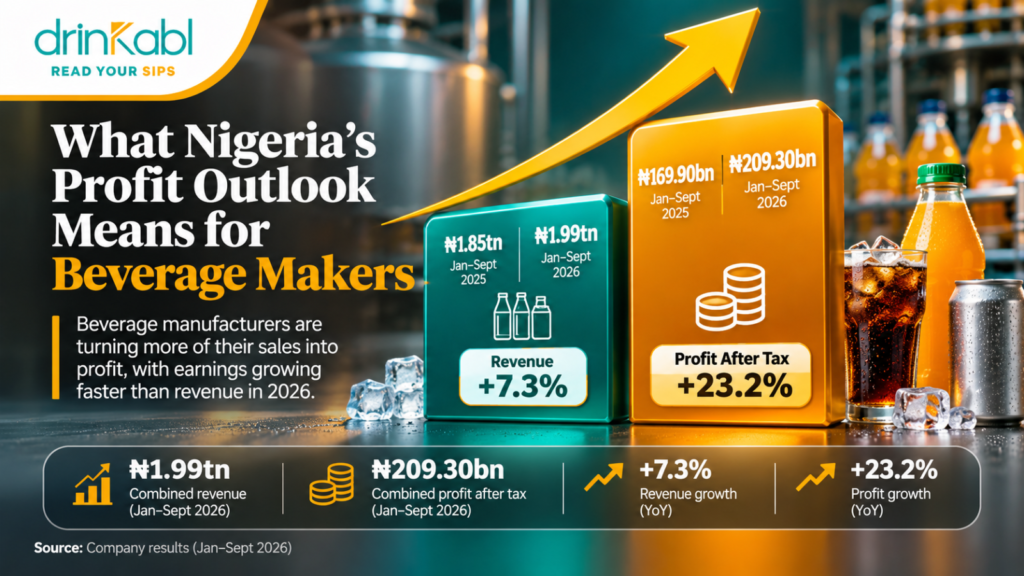
The distinction matters because the major listed beverage manufacturers have their own financial results, and those results reveal a recovery that is already underway. Adding the nine-month statements of Nigerian Breweries, Guinness Nigeria and International Breweries produces combined revenue of approximately ₦1.99 trillion for January to September 2026, compared with ₦1.85 trillion a year earlier. That represents growth of about 7.3%, while their combined profit after tax increased by approximately 23.2% to ₦209.30 billion. These calculations are based on the companies’ unaudited results filed for the period ended September 30.
The difference between sales growth and profit growth is where the more interesting story begins. The three brewers increased their combined gross profit by approximately 17.6% and operating profit by about 14.9%, both faster than revenue. This suggests that improved production economics and operating performance, alongside changes in financing costs, are contributing to the recovery. It does not establish that beer consumption volumes have grown at the same rate.
Three brewers, three different earnings stories
Nigerian Breweries has recorded one of the clearest improvements. Its nine-month revenue increased 5.4% to ₦1.10 trillion, while gross profit rose 15.1% to ₦477.90 billion. Profit after tax climbed 33.4% to ₦114.10 billion, supported by a reduction in net finance expenses from ₦33.66 billion to ₦7.50 billion, a decline of 77.7%. The company also returned to standalone quarterly profitability in Q3, reporting ₦21 billion in net profit against a ₦4 billion loss in the corresponding quarter of 2025. Its nine-month earnings release shows how much of the improvement has come from stronger operating performance and a lighter financing burden.
Guinness Nigeria has delivered an even faster increase in sales and bottom-line earnings. Revenue grew 20.4% to ₦403.33 billion, while gross profit increased by the same percentage to ₦151.38 billion. Operating profit rose 23.5% to ₦64.98 billion, and profit after tax advanced 53.1% to ₦40.69 billion. Finance expenses fell from ₦15.30 billion to ₦5.83 billion, helping the company convert a larger share of its operating earnings into profit before tax. Its September financial statements also show that marketing and distribution expenses increased, a reminder that commercial growth still requires substantial investment.
International Breweries presents a different picture. Nine-month revenue increased by just over 2% to ₦482.61 billion, but gross profit grew 21.8% to ₦195.94 billion and operating profit increased to ₦80.86 billion from ₦67.01 billion. Profit before tax rose 21.9% to ₦90.44 billion, yet profit after tax declined 5.7% to ₦54.51 billion. The difference was largely associated with income tax expense, which increased to ₦35.93 billion from ₦16.39 billion in the corresponding period. Its NGX filing illustrates why stronger operating earnings do not automatically produce equivalent growth in shareholder returns.
Champion Breweries provides another important warning. Its consolidated nine-month revenue increased 139.9% to ₦51.41 billion, while operating profit grew 47.5% to ₦6.33 billion. However, profit before tax fell 70.8% to ₦917.52 million as net finance costs rose 369.5% to ₦5.41 billion, absorbing approximately 85% of operating profit. A ₦1.26 billion tax credit lifted reported profit after tax to ₦2.18 billion, up 6.4%, but without that credit the figure would have been approximately ₦917.5 million. Comparisons also require caution because 2026 is the first year the company is presenting consolidated interim accounts following its acquisition of 80% of EnjoyBev B.V. The financial results show how expansion can increase reported revenue while financing obligations continue to constrain profitability.
The consumer remains the biggest uncertainty
For beverage manufacturers, corporate profitability is only one side of the market. The other is the consumer’s ability to keep purchasing at prices that support manufacturers’ margins.
Nigeria’s inflation figures offer some encouragement. Headline inflation eased to 14.06% in October 2026 from 14.63% in September, while food inflation declined to 19.13% from 19.59%. The Central Bank of Nigeria also reported that the Composite Purchasing Managers’ Index increased to 53.2 points in October, indicating continued expansion in business activity. These developments could create a more favourable operating environment for manufacturers if exchange-rate stability and lower input-cost pressures persist. However, the November monetary policy statement retained the Monetary Policy Rate at 23%, meaning borrowing conditions remain restrictive.
Household sentiment provides a less comfortable counterpoint. The Central Bank’s September 2026 Household Expectations Survey recorded an Overall Consumer Sentiments Index of -18.7 points, down from -9.9 in August. Food remained the highest spending priority, while buying conditions and purchase intentions for expensive goods remained weak. Although households anticipated a gradual improvement in confidence over the following six months, their expectations of continued price increases remained elevated. For beverage manufacturers, this raises a familiar commercial problem: consumers may continue purchasing drinks, but they can become more selective about brands, pack sizes, price points and consumption occasions. The household survey suggests that a broader economic recovery will not immediately translate into unrestricted consumer spending.
This is consistent with the spending patterns already observed in Nigeria’s formal beverage market. An earlier Drinkabl analysis estimated that consumers spent approximately ₦1.41 trillion on beer, malt drinks and spirits in the first half of 2026, based on the financial results of the three largest listed brewers. The figure demonstrated the scale of spending, but it also raised questions about affordability and the changing balance between product categories. Revenue generated by manufacturers should therefore be examined alongside sales volumes and the prices consumers actually pay.
What the 2027 outlook could mean
There is a basis for expecting a more supportive economic environment in 2027, although the available evidence does not justify assigning a specific profit-growth percentage to Nigerian beverage manufacturers. The International Monetary Fund’s May 2026 baseline projected real GDP growth of 4.3% for Nigeria in 2027, compared with 4.1% in 2026. It also projected average inflation of 15.9% and end-of-year inflation of 14.5% for 2027. These are national economic projections, not beverage-sector forecasts, but they provide a reference point for manufacturers planning production, investment and pricing. The IMF economic outlook also makes clear that growth and price stability remain gradual processes.
The Central Bank’s November assessment is more current on domestic conditions. It expects economic activity to remain positive into 2027, supported by improved crude oil production and expansion in agriculture, services and industry. It also expects disinflation to continue, although energy supply disruptions and adverse weather remain risks. For brewers, a more stable naira and easing inflation could reduce the volatility of imported inputs, packaging materials and other production costs. However, the 23% policy rate and continuing pressure on household budgets mean that manufacturers cannot assume that financing will become inexpensive or that demand will rebound immediately.
The likely 2027 picture is therefore one of selective improvement. Companies that have reduced debt exposure, strengthened gross margins and controlled distribution costs could be better positioned to convert revenue into profit. Nigerian Breweries and Guinness Nigeria enter this period with stronger earnings momentum, while International Breweries must translate operating gains into better after-tax returns. Champion Breweries, meanwhile, faces the task of making its expanded business more financially sustainable as acquisition-related financing obligations remain significant.
The next test is the quality of growth
The fourth-quarter forecasts provide an encouraging corporate backdrop, but the beverage industry has already supplied more direct evidence of its recovery. The combined nine-month results of the three largest listed brewers show that profits are growing faster than revenue, while individual company statements reveal how much financing costs, taxation and operating expenses influence the final numbers. The distinction between improved margins and increased consumer demand will remain important as the industry moves into 2027.
For manufacturers, the next financial year will test whether the gains recorded in 2026 can survive a market where households remain cautious and the cost of capital is still high. The most useful indicators to watch will be sales volumes, gross margins, finance expenses, cash generation and capital investment. A recovery that depends mainly on lower financing costs will have different implications from one supported by sustained demand and stronger production efficiency. The next round of full-year results should help establish which of those forces is carrying the industry forward.