

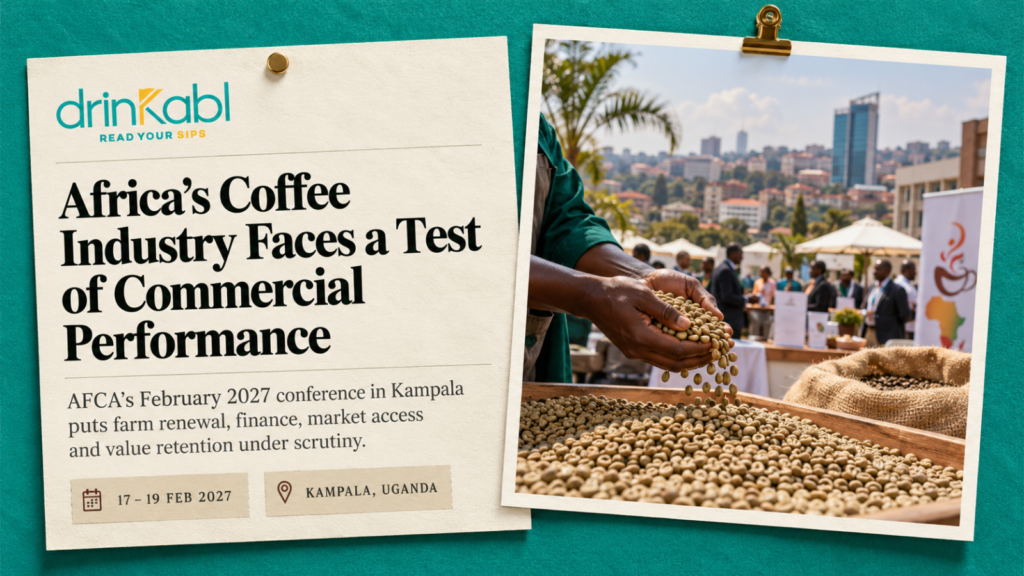
AFCA’s February 2027 conference in Kampala will bring producers, exporters, financiers and buyers together around a question that has followed African coffee for years: how much more value can producing countries retain from the beans they grow?
Africa’s coffee industry has no shortage of origins that international buyers recognise. Ethiopia, Kenya, Uganda and Rwanda have established places in global coffee markets, while other producing countries are working to improve quality, expand exports and build stronger commercial identities. The harder question is what happens after the crop leaves the farm, and how much of the value created along the way returns to the people and businesses that grow it.
The 23rd African Fine Coffees Conference and Exhibition will take place from 17 to 19 February 2027 at Speke Resort Munyonyo in Kampala, Uganda. Organised by the African Fine Coffees Association, the gathering will coincide with the fourth African Coffee Week and focus on four priorities: renewing farms, financing growth, opening markets and creating jobs. The ambition is to move the conversation beyond Africa’s production potential towards measurable commercial results.
The distinction matters in an industry where growing desirable coffee and building a profitable coffee business are separate achievements. Better beans can attract buyers, but lasting returns also depend on processing, quality assessment, reliable supply, access to finance and the ability to negotiate favourable commercial terms. Kampala will bring these interests into one room, but whether the resulting conversations translate into better economics for producers is the more consequential test.
Uganda brings the question closer to home
Uganda is a useful place to examine the relationship between agricultural output and commercial value. The country has expanded its coffee exports and is working to establish a clearer identity for its product in international markets, including through its national coffee branding initiative, which seeks to make Ugandan origin more recognisable to buyers and consumers. The commercial logic is straightforward: a stronger identity can help differentiate the product, although branding alone cannot guarantee higher prices or greater returns for farmers.
The scale of the business provides context for that ambition. Uganda has reported substantial growth in coffee export volumes and earnings, strengthening the crop’s position in its export economy. Yet national export revenue does not reveal how much income individual farmers retain, how much value local processors capture or how profits are distributed among exporters, intermediaries and other participants in the supply chain. Those distinctions matter because a growing export business can still leave producers with limited resources to invest in their next harvest.
That is why Uganda’s progress should be treated as a starting point rather than proof that every participant is benefiting equally. Export growth can coexist with expensive farm inputs, financing constraints and uneven access to premium buyers. A larger export total tells the industry how much coffee is moving and what it earns at the border; it does not establish whether farmers have the working capital to improve their farms or whether local businesses can compete for the most valuable segments of the market.
Quality needs a business behind it
For specialty coffee, quality is both a production discipline and a commercial signal. Buyers assess flavour, consistency, processing and origin, and those characteristics can influence the prices that individual lots command. Producing coffee that meets demanding standards, however, requires investment in harvesting, processing, drying, storage and the people trained to evaluate the finished product.
The gap between growing good coffee and selling it well remains a commercial challenge. Investment in trained coffee graders, dependable processing infrastructure and better quality measurement can help producers understand what they have, demonstrate that quality to buyers and negotiate from a stronger position. Without those capabilities, a producer may grow a valuable crop but lack the tools to distinguish it commercially from lower-priced alternatives. The infrastructure and skills gap in African coffee illustrates why quality improvement must extend beyond the farm.
There is a second complication. Quality improvements deliver their full commercial benefit only when buyers can be found and the supply chain can meet their requirements consistently. An exporter needs dependable volumes and the ability to fulfil orders, a roaster needs coffee that matches its specifications, and a farmer needs payment terms that make the next production cycle possible. These interests are connected, but they do not automatically align, which is why market access and financing belong in the same conversation as farm renewal.
Financing determines what can change
Farm renewal is a long-term investment, particularly where coffee trees are ageing, productivity is weak or climate pressures make yields less predictable. Farmers must pay for labour, seedlings and other inputs before they know the full value of the harvest. When affordable financing is unavailable, even a commercially attractive crop can leave producers struggling to fund the improvements that buyers increasingly demand.
Uganda’s efforts to strengthen its coffee seed systems illustrate the kind of investment that sits behind AFCA’s financing priority. Initiatives involving agricultural institutions and private-sector partners have sought to improve planting material, farmer livelihoods and the long-term resilience of production. The commercial significance lies in the connection between agricultural capacity and future supply: buyers and processors cannot build dependable sourcing strategies if the farms supplying them cannot maintain productive crops.
Finance alone, however, does not guarantee a better outcome. Capital must reach the right businesses on workable terms, and investments in farm productivity must connect with processing capacity, credible buyers and transparent payment arrangements. The question is not simply how much funding can be announced at a conference, but which constraints the money will remove, who will receive it and what commercial results can be measured afterwards.
Market access is about bargaining power
Opening markets is another of AFCA’s stated priorities, but finding an international buyer is only the beginning of a commercial relationship. Producers and exporters also need the ability to compare offers, establish long-term contracts, meet quality requirements and understand the costs of serving different customers. Those capabilities help determine whether additional demand produces better returns or simply moves more coffee through an existing chain.
Kenya offers a useful comparison because its coffee trade has long depended on systems that connect producers with buyers while shaping how prices are discovered and paid. Alternative routes, including direct relationships between producers and specialty buyers, can offer opportunities to negotiate commercial terms outside traditional channels. Such arrangements are not automatically better for every producer, however; their success still depends on governance, reliable settlement, quality consistency and the capacity to meet contractual obligations.
Value addition introduces a further question. Exporting green beans allows producing countries to participate in global coffee trade, but roasting, branding and retailing can capture additional revenue closer to the final consumer. Businesses such as Spring Valley Coffee demonstrate how an African coffee company can build a consumer-facing identity around origin and locally developed expertise. Replicating that model is not straightforward for every producer, since roasting, distribution and brand development require investment and access to customers, but it shows why market access can mean more than finding another buyer for unroasted beans.
Jobs depend on where value is created
AFCA’s fourth priority, creating jobs, brings the discussion beyond export performance. Coffee supports work in cultivation, harvesting, processing, transport, trading, roasting and hospitality, but the number and quality of those opportunities depend partly on which activities take place in producing countries. Expanding production can create demand for farm labour, while developing processing, quality assessment and consumer-facing businesses can open additional routes into the industry.
For African beverage businesses, the opportunity is to connect coffee production with a broader commercial ecosystem. Local processors need dependable raw materials, equipment and technical skills. Roasters need consistent quality and distribution, while cafés and packaged-coffee brands need products consumers will buy at prices that cover their costs. These businesses can reinforce one another, but only when infrastructure, financing and market demand develop together.
There are limits to what a three-day conference can accomplish. The official AFCA conference programme promotes business meetings, industry sessions, competitions, workshops and networking among producers, exporters, roasters and green-coffee buyers. Those activities can help participants identify partners and exchange expertise, but they do not, by themselves, establish investment commitments, financing targets or measurable employment outcomes. Those results will need to be assessed separately from attendance and commercial interest.
Kampala must turn conversations into commitments
AFCA, established in 2000, represents producers, traders, governments and support organisations across 11 member countries. Its regional reach gives the Kampala gathering a practical role in connecting businesses that often face similar commercial constraints under different national systems. The association’s strategic priorities for the African coffee sector include expanding market linkages, production and export growth, making commercial performance a natural measure of its work.
The conference will be judged by what participants can point to after they leave. New buyer relationships matter if they lead to repeat orders; financing matters if it reaches producers and businesses capable of using it; training matters if it improves quality and commercial performance. The same applies to job creation, which ultimately depends on viable businesses rather than the number of people gathered in a conference hall.
For African coffee, the shift from potential to performance will therefore be measured beyond the exhibition floor at Speke Resort Munyonyo. It will show up in the terms on which farmers sell, the capacity of local businesses to process and market their coffee, and the share of commercial value that remains in producing countries. Kampala will bring those questions into one room. The harder work begins when participants return to their farms, trading desks, processing facilities and markets.