
What began as a public-health intervention is becoming something more consequential for the beverage industry.
Sugar taxes are no longer limited to a few markets testing whether higher prices can discourage consumption. More countries are adopting them, existing taxes are being redesigned, and governments are asking whether current rates are strong enough to change behaviour.
The latest debate is unfolding in the Philippines, where a beverage industry group has urged the Department of Finance to review proposed higher taxes on sugary drinks. The industry argues that additional levies could raise the price of everyday products and add pressure to businesses and consumers. The government, meanwhile, sees the tax as part of a broader fiscal and public-health strategy.
The disagreement is familiar.
Governments see sugary-drink taxes as a way to address rising non-communicable diseases while generating revenue. Beverage companies see another cost entering a sector already dealing with inflation, changing purchasing power and rising input costs.
What is changing is the design of the tax, and what governments expect it to achieve.
From a tax on volume to a tax on behaviour
Nigeria offers a useful example.
The country introduced a ₦10-per-litre excise on sugar-sweetened beverages. But as prices have risen, the fixed levy has lost much of its relative weight. Public-health advocates now argue that it is too small to materially change consumption and have called for a percentage-based levy of at least 20% of retail price.
The Nigerian Senate has since moved to abolish the fixed ₦10-per-litre rate and replace it with a percentage-based system, with the eventual rate to be determined by the Finance Minister.
The change reflects a broader problem with fixed taxes: inflation can gradually reduce their impact. A percentage-based tax, by contrast, rises with the value of the product.
But the change has not settled the debate. Industry groups argue that a higher tax would arrive at a difficult time for manufacturers facing energy, logistics, currency and other cost pressures.
Nigeria therefore illustrates the central tension emerging across markets: how do governments make the tax strong enough to influence behaviour without creating disproportionate pressure across the value chain?
The health case is getting stronger
The push for higher taxes is happening alongside growing global adoption.
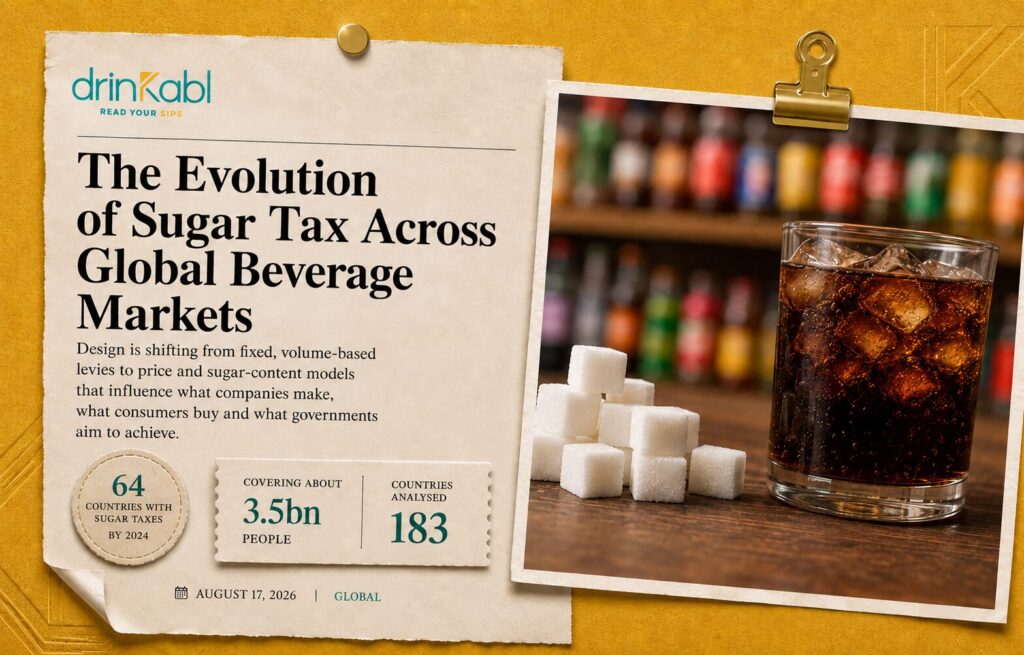
A 2026 analysis published in The Lancet Global Health examined sugar-sweetened beverage tax policies across 183 countries and found that 64 countries had implemented such taxes by 2024, covering about 3.5 billion people. The analysis also found that countries are using different approaches, including price-based, volume-based and sugar-content taxes.
The World Health Organization is pushing the policy further. It has argued that sugary drinks remain too affordable in many countries because existing taxes are often too low, and is calling for governments to make unhealthy products progressively less affordable through taxation.
The attraction for governments is a potential double return: reduce consumption of products associated with diet-related disease while raising domestic revenue.
But the experience of different markets suggests that how the tax is designed matters as much as whether it exists.
When the tax changes the product
South Africa provides one of the clearest examples.
Its Health Promotion Levy, introduced in 2018, is linked to sugar content rather than simply the volume of a beverage. Research found that urban household purchases of taxable beverages fell by 29%, while the amount of sugar purchased through those beverages fell by 51%. The larger decline in sugar than volume points to an important part of the story: manufacturers were also changing their products.
That makes sugar taxation more than a consumption policy.
It can become a product-development tool, encouraging reformulation, lower-sugar recipes and the expansion of no- and reduced-sugar alternatives.
The UK’s Soft Drinks Industry Levy demonstrates this even more clearly. Its tiered structure is based on sugar concentration, giving manufacturers an incentive to reformulate below the taxable threshold.
The results have been significant. UK government data show that around 65% of soft drinks containing more than 5g of sugar per 100ml reformulated below the threshold between 2015 and 2019, while the average sugar content of drinks within the levy’s scope fell substantially. The government is now lowering the threshold further, extending the policy to more products and explicitly seeking additional reformulation.
The lesson from these markets is becoming clearer – a tax based on sugar content can influence what companies make, not just what consumers buy.
What it means across markets
The same policy produces different pressures depending on the market.
In Africa, affordability is central. Nigeria’s debate is unfolding amid inflation, currency pressure and weakened consumer purchasing power. A tax increase may be intended to discourage consumption, but its effect is also felt by manufacturers, retailers and consumers.
In Europe, the emphasis is increasingly on reformulation. The UK has effectively used the tax threshold as a target for manufacturers to reduce sugar, with the government now looking to push that target further.
In the Caribbean, Jamaica demonstrates the price-pass-through effect. After the country’s new sugar-content tax took effect in May 2026, GraceKennedy announced an average 9% increase in prices for non-alcoholic sweetened beverages, citing the tax alongside other cost pressures.
In Asia, the Philippines represents another stage of the debate: whether existing or proposed taxes are strong enough to deliver their intended health and fiscal outcomes without adding excessive pressure to the industry.
These markets are not identical. But the direction is similar.
The beverage industry is adapting through reformulation, zero- and reduced-sugar products, pricing and portfolio changes. At the same time, manufacturers are pushing back where they believe taxes are excessive or poorly timed.
This creates an important policy tension. A tax has to be visible enough in the final price to influence behaviour. But the more of the tax that is passed through, the greater the pressure on consumers, particularly in markets where beverages are highly price-sensitive.
There is also a question of what governments ultimately want the tax to accomplish.
If the priority is revenue, a broad and predictable tax may be sufficient.
If the priority is consumption reduction, the tax needs to meaningfully change the price equation.
If the priority is reformulation, taxing according to sugar content provides a stronger incentive to change the product itself.
And if governments want all three, the trade-offs become harder to manage.
That is where the evolution of sugar tax becomes significant for the beverage industry.
The levy is no longer simply something added to the price of a bottle. It is increasingly becoming a mechanism for influencing what gets formulated, what gets bought, how much it costs and how companies build their portfolios.
The next stage of the debate, therefore, may be less about whether sugary drinks should be taxed and more about how the tax should be designed to change the market, and who ultimately bears the cost of that change.
READ MORE
- Nigeria Scraps Flat Sugar Drink Tax; House of Representatives Now Holds the Rate
- Jamaica’s Sugar Tax Forces GraceKennedy to Lift Sweetened Beverage Prices by Nine Per Cent
- Who Is Silencing South Africa’s Sugar Warning? Inside the ARB’s Conflict of Interest Crisis
- WHO Urges Nigeria to Raise Taxes on Sugary Drinks, Alcohol to Combat Rising Health Crisis