
Momentum had been building within academic circles around alcohol’s short-term neurological impact long before this latest research landed. Scattered findings from birthday-event brain scans and single-week observational studies had pointed in a consistent direction, but the evidence lacked the longitudinal depth needed to make it stick with young adult audiences. That gap has now narrowed considerably.
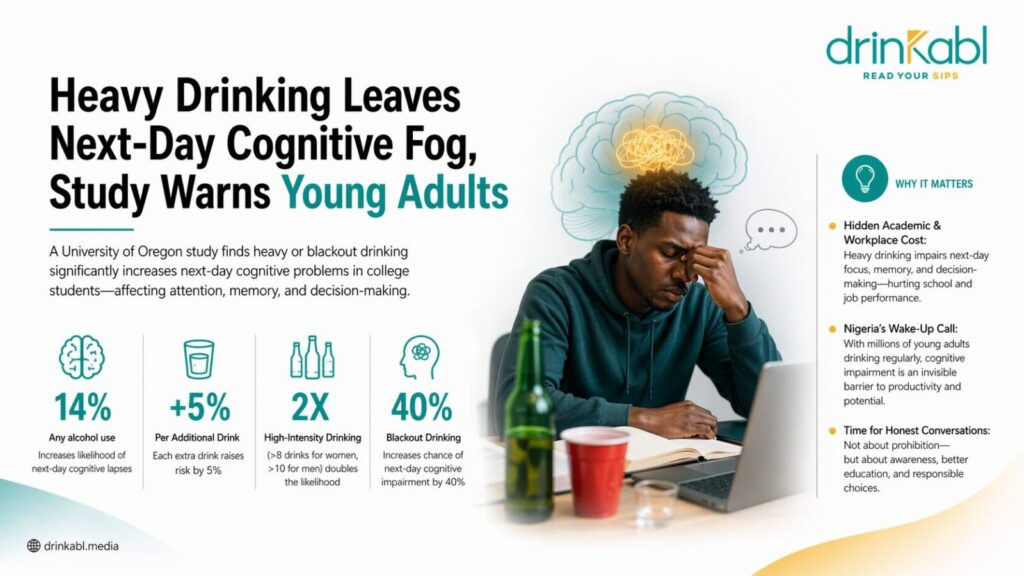
A new study from the University of Oregon, published in Alcohol, Clinical and Experimental Research, delivers some of the clearest evidence yet that heavy drinking among college students does not simply “wear off” by morning. Across a 21-day tracking period, researchers found that students who drank heavily, or blacked out, consistently reported measurable cognitive struggles the following day, including difficulty recalling names, sustaining attention and making sound decisions.
“Young adults who drink heavily often assume that once they sober up, everything returns to normal. It doesn’t,” said Ashley Linden-Carmichael, associate professor at the UO College of Education and one of the study’s lead authors. “We’re seeing in this study that heavy drinking can affect functioning the next day. Students could have a harder time with their schoolwork, going to a job or navigating friendships, and that could have big implications for their mental health.”
The study tracked 304 college students, surveying them every two hours on cognitive performance and pairing those responses with actual brain tasks, including reverse number-string recall. The data revealed that any alcohol consumption raised the likelihood of next-day cognitive lapses by 14%, with each additional drink adding a further 5% increase. High-intensity drinking, defined as more than eight drinks for women or ten for men, doubled that likelihood. Blackout drinking specifically was tied to a 40% greater chance of cognitive impairment the following day.
Nigeria’s Reflection Point
The findings carry direct relevance for Nigeria, a country where alcohol culture is deeply embedded in social, celebratory and even professional settings, and where public health discourse around drinking has historically focused on long-term liver disease rather than day-after cognitive function.
Nigeria’s young adult population, the 18 to 25 demographic that this research centres, is among the country’s fastest-growing and most economically consequential segments. It is also a segment being aggressively targeted by both local and international alcohol brands through sponsorships, concerts, campus activations and social media campaigns.
The cognitive implications outlined in this research deserve serious attention from Nigerian universities, employers and policymakers alike. A student who drank heavily at a Friday night event and arrives at a Saturday morning exam, or a Monday lecture, may not be impaired in the clinical sense, but according to this data, is operating at a measurable disadvantage. That cost is largely invisible and almost entirely untracked in Nigerian institutional settings.
Nigeria’s mental health infrastructure is still developing, and the layered relationship between alcohol, cognition and academic underperformance is rarely part of any campus wellness conversation. The University of Oregon’s model of “just-in-time interventions,” delivering real-time mobile feedback that connects current cognitive struggles to the previous night’s drinking, offers a scalable, low-infrastructure approach that Nigerian universities and health NGOs could adapt without requiring large clinical resources.
There is also a regulatory dimension. While Nigeria’s National Agency for Food and Drug Administration and Control (NAFDAC) regulates alcohol production and labelling, warning messaging on alcohol products in Nigeria remains minimal compared to what the science now suggests is warranted. If next-day cognitive impairment is a documented outcome of heavy drinking, that information belongs in the consumer conversation, on packaging, in campus orientation programmes and in public health campaigns.
The research is not a call for prohibition. It is a call for honesty, with young people especially, about what a heavy night actually costs, not just physically, but intellectually and professionally.
Read More on Drinkabl.media:
NAFDAC’s N350m Lagos Bust Exposes Illicit Alcohol’s Industrial Scale
Nigeria’s Big Three Brewers Seal 5-Year Road Safety Pact
5Alive Targets Nigeria’s Youth with Bold Regional Flavour Launch