

A steady escalation in public scrutiny of alcohol-related harm on Nigerian roads, compounded by a period of intensified government engagement with the brewing sector over excise frameworks and corporate governance, has now culminated in the most formalised iteration yet of the industry’s flagship responsibility programme.
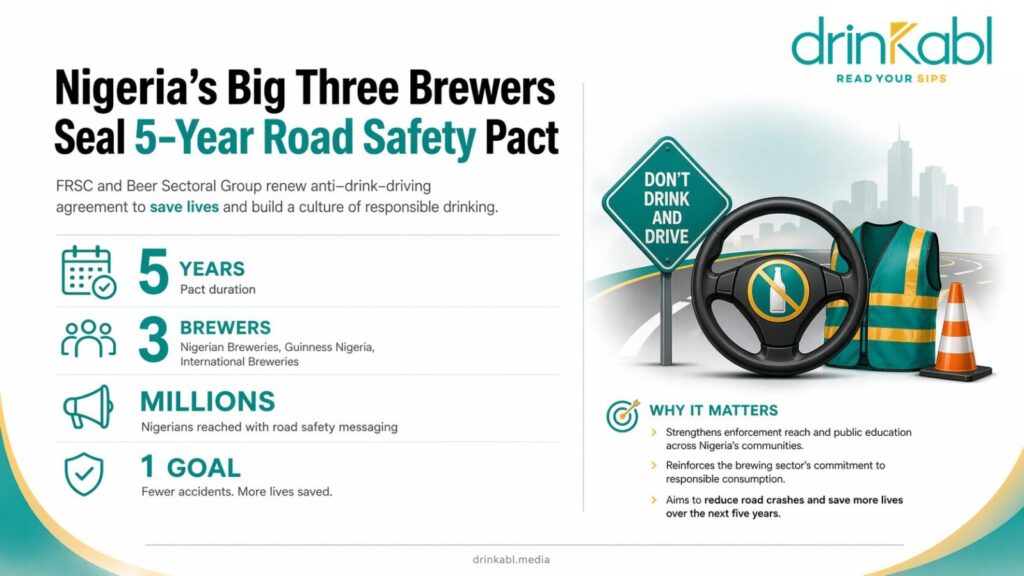
On Monday, April 21, the Federal Road Safety Corps (FRSC) and the Beer Sectoral Group (BSG), representing Nigerian Breweries, Guinness Nigeria, and International Breweries, renewed their Memorandum of Understanding at the FRSC National Headquarters in Abuja, extending their anti-drink-driving collaboration for another five years. The signing marks the latest chapter in a partnership that traces its formal roots to 2008, when Nigerian Breweries launched the Don’t Drink and Drive Campaign in collaboration with the Corps.
Momentum had been building within Nigeria’s brewing ecosystem well before Monday’s event. Nigerian Breweries, as Drinkabl.media reported, has been navigating a confluence of pressures, from lending cost volatility to collapsing beer volumes, conditions that have sharpened the industry’s appetite for constructive regulatory relationships. Against that backdrop, the BSG’s public safety commitments serve a dual function, reinforcing both genuine societal intent and the sector’s credibility as a responsible industry partner at a moment of heightened fiscal scrutiny.
The BSG’s three member companies have separately deepened their individual road safety footprints in the period preceding the renewal. International Breweries, through the AB InBev Foundation, donated road signage and reflective jackets to the FRSC Lagos State Command as recently as February 2025, while Guinness Nigeria has sustained its Ember Months campaign with the Corps for well over a decade. Nigerian Breweries, for its part, allocated 10% of its Heineken media spend in 2025 toward responsible consumption messaging, per company disclosures.
At the signing, FRSC Corps Marshal Shehu Mohammed emphasised that the renewed agreement was not ceremonial. BSG Chairman and Nigerian Breweries Managing Director Thibaut Boidin, who has been notably candid in public forums about the sector’s financial pressures, framed the partnership as a complement to the industry’s enforcement obligations.
“While the FRSC contributes statutory authority and data-driven enforcement, the Beer Sectoral Group supports with reach, resources, and responsibility. Together, we aim to change the culture that views alcohol and driving as compatible activities,” he said.
Guinness Nigeria Managing Director Girish Sharma addressed a persistent tension in the industry’s road safety narrative directly.
“We are here to work with you and ensure that this programme grows bigger and delivers real impact. Saving lives is what matters most,” he said, adding that irresponsible consumption, not alcohol itself, is the primary driver of road fatalities.
BSG Executive Director Abiola Laseinde described the renewal as a milestone, noting that past campaigns had reached millions of Nigerians with road safety messaging. Her reference to scale is not without context, as Nigeria’s beer sector commands Africa’s second-largest market position, meaning responsible consumption messaging disseminated through industry channels carries proportionate reach.
The timing of the renewal is also significant given that the BSG is simultaneously engaged in a high-stakes standoff with federal authorities over a proposed 2026 to 2028 excise duty framework, which PwC modelling suggests could put over ₦425 billion of industry value at risk. In that context, a publicly visible and renewed commitment to road safety governance reinforces the sector’s argument that its interests and national welfare are aligned, rather than in tension.
For the FRSC, the partnership extends enforcement reach into communities and demographics the Corps cannot access through statutory means alone. For the BSG, it offers a credible platform to shape the conversation around alcohol responsibility at a moment when regulatory relationships matter enormously to the sector’s bottom line.
Both parties will measure the agreement’s success, they say, in lives preserved and accidents reduced. Over the next five years, the industry will scale interventions, intensify community engagement, and broaden the reach of public education campaigns.
READ MORE
NB’s Boidin Speaks On Lending Costs, Tax Volatility, Collapsing Beer Volumes At Pre-AGM , Drinkabl.media
Premium Surge Redefines Craft Beer Growth , Drinkabl.media
Nigeria’s Brewers Sound the Alarm on Three-Year Excise Plan, With ₦425bn on the Line , Drinkabl.media