
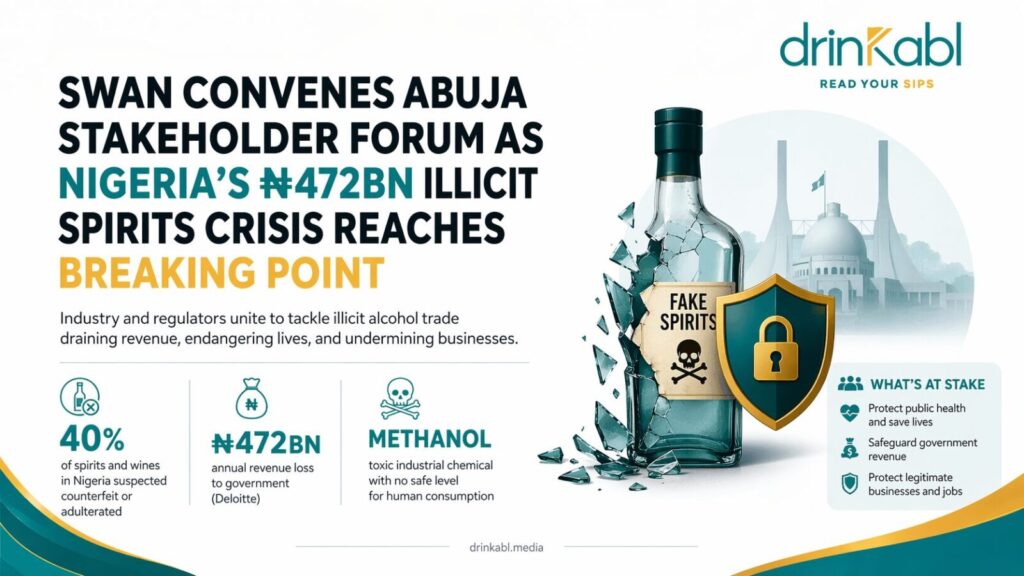
Mounting pressure across Nigeria’s spirits and wines sector, years of documented enforcement failures, a U.S. travel advisory over contaminated alcohol, and a Deloitte-cited annual revenue haemorrhage of ₦472 billion, has now culminated in the most consequential industry-government convening the sector has staged in recent memory.
The Spirits and Wines Association of Nigeria, SWAN, will host a one-day stakeholder workshop on April 22, 2026, at the Abuja Continental Hotel, marshalling regulators, policymakers, enforcement agencies, and producers around a singular mandate: dismantle the illicit alcohol trade at its root.
The forum does not emerge from a vacuum. A steady escalation in counterfeiting activity had been reshaping Nigeria’s spirits market for years, with criminal syndicates systematically scavenging branded glass containers from bars and nightclubs, refilling them with toxic methanol-laced mixtures, and reintroducing them into commercial circulation. As Drinkabl.media reported, the regulatory environment surrounding alcohol in Nigeria has grown increasingly fractured, with NAFDAC, the presidency, and the National Assembly all pulling in divergent directions on enforcement priorities, a context that has allowed illicit operators to exploit policy gaps with near impunity.
The scale of the crisis, crystallised in data, is damning. Approximately four in every ten bottles of wine and spirits circulating in the Nigerian market are suspected to be counterfeit or adulterated, according to SWAN. The economic toll reaches across the entire value chain, depleting government excise revenue, eroding brand equity, and threatening the private sector investments that legitimate producers have made into the category.
“Illicit trade in spirits and wines poses significant risks to public health and safety, undermines government revenue, and threatens legitimate businesses and requires urgent, multi-stakeholder collaboration and policy alignment to tackle,” SWAN said in an official statement.
The health dimension is equally critical. SWAN Director-General Tony Okwoju has consistently highlighted the growing deployment of methanol, an industrial chemical with no safe threshold for human consumption, in the production of fake spirits. “These counterfeiters are not just faking brands, they are killing people,” Okwoju stated at a March 27 engagement with the Brand Journalists Association of Nigeria, BJAN, in Lagos.
In response, SWAN member companies have moved unilaterally, deploying recovery teams to hospitality venues across the country to retrieve and crush their own empty glass containers before they can re-enter criminal supply chains. The premium spirits segment, already under pressure from Nigeria’s broader consumer affordability crisis, is among the most exposed categories, with counterfeit products directly cannibalising authentic brand volumes.
The April 22 workshop, themed “Combating Illicit Trade in the Spirits and Wines Industry in Nigeria,” brings a global dimension to the domestic challenge. Confirmed speaker David Francis, Managing Director of the Alliance Against Counterfeit Spirits, AACS, a joint venture representing the world’s major international spirits producers, brings cross-border enforcement expertise to what SWAN frames as a systemic rather than purely local problem.
“The workshop aims to foster stronger collaboration among public and private sector stakeholders, drive policy alignment and generate actionable insights and innovative approaches to curb illicit trade in the country,” SWAN DG Tony Okwoju said.
The convening arrives at a pivotal juncture for the Nigerian beverage industry more broadly. As Drinkabl.media’s analysis of the sector’s 20 most consequential players outlined, the industry enters 2026 having only recently clawed back to profitability after two years of compounded losses, making the illicit trade threat not merely a compliance matter but a structural risk to recovery momentum. The bitters category, one of the fastest-growing in Nigerian alcoholic beverages, is among those most vulnerable to counterfeiting given its high-volume, widely distributed nature.
For regulators and enforcement agencies expected in Abuja, the forum represents a critical opportunity to translate years of fragmented NAFDAC raids and Customs interdictions into coordinated, durable policy architecture. What emerges from the expert-led sessions and breakout discussions will likely define the industry’s enforcement posture for the years ahead.
READ MORE
Africa’s Drinks Industry Has a Sober Problem & a Bigger Opportunity , Drinkabl.media
These Are the 20 Nigerian Beverage Companies to Watch in 2026 , Drinkabl.media
Economic Shifts and Changing Tastes: The Impact on Premium Spirits in Nigeria , Drinkabl.media
Top 4 Challenger Brands Taking On Nigeria’s Bitters Category , Drinkabl.media