
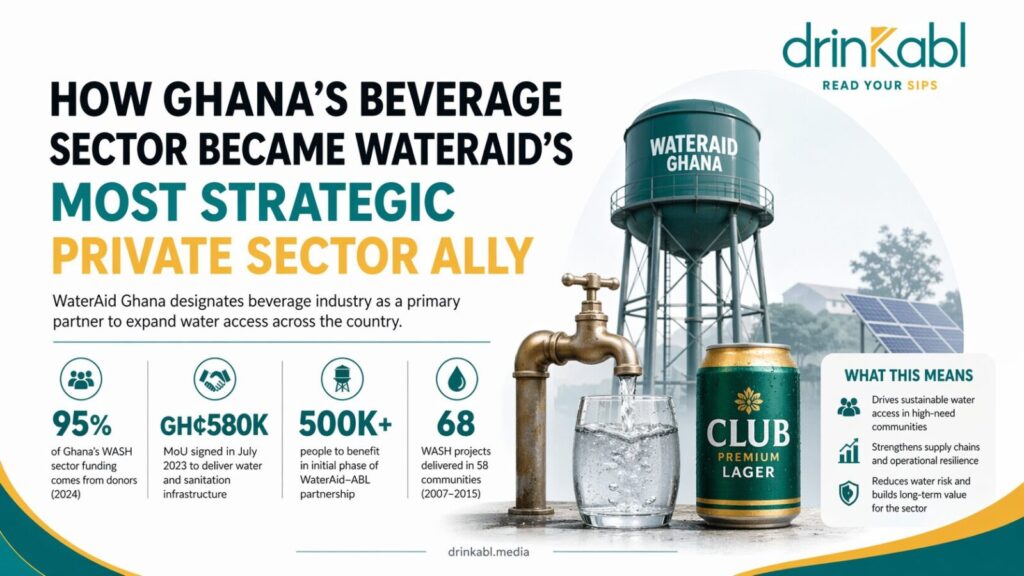
Momentum had been building within Ghana’s WASH financing ecosystem for years before it crystallised into a definitive strategic posture. With government funding accounting for just 5% of the sector’s total budget in 2024, and donor dependency reaching an unsustainable 95%, the structural logic of private sector mobilisation was no longer a matter of policy preference, it was operational necessity.
Against that backdrop, WaterAid Ghana has formally designated the beverage industry as a primary partner in its mission to expand water access across the country, based on years of corporate engagement and deepening supply chain alignment.
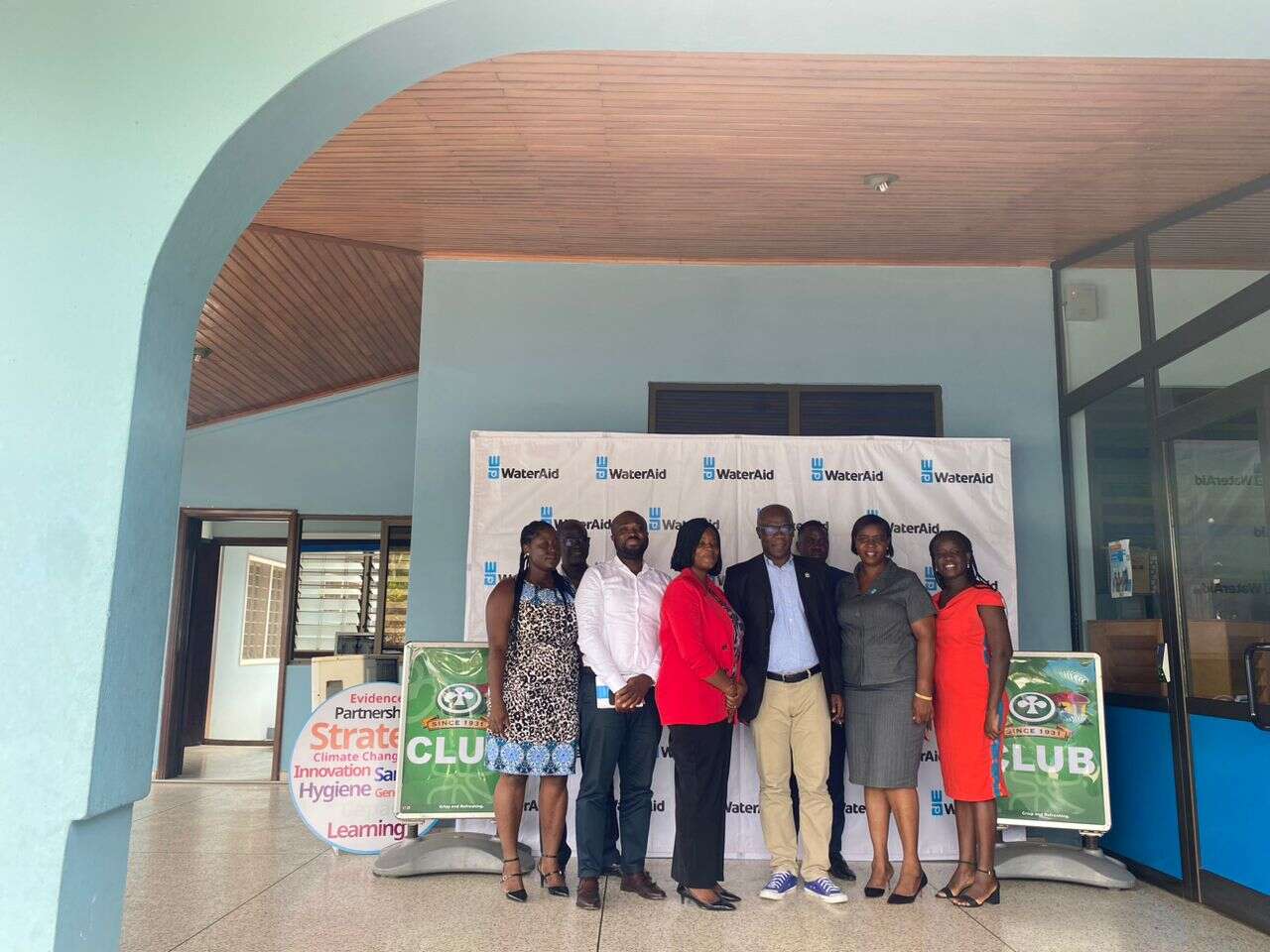
The partnership framework’s most concrete expression arrived in July 2023, when WaterAid Ghana and Accra Brewery Limited (ABL), the AB InBev subsidiary behind Club Premium Lager, signed a GH¢580,000 Memorandum of Understanding to construct water supply and sanitation infrastructure in the communities where ABL sources its core raw materials. The agreement, initiated by Country Director Ewurabena Yanyi-Akofur and ABL’s Head of Legal and Corporate Affairs, Solomon Yaw Ayiah, committed both parties to joint WASH initiatives targeting an initial population of more than 500,000 people.
That MoU rapidly progressed into ground-level delivery. Under Club Lager’s “Together We Are Gold” campaign, ABL funded a solar-mechanised water system in the Bongo District Assembly, Upper East Region, serving a healthcare facility with active maternity services. The initiative extended to handwashing facility installations across all care points and training for community health management committees under WaterAid Ghana’s WASH-R programme. Ayiah made the commercial rationale explicit. “Clean water is life and water is a human right,” he stated, noting that ABL uses approximately 80% water in its production processes, “and it is important to ensure people who need water have access to clean and safe water.”
The beverage sector’s commitment to Ghana’s water landscape is not new, but its strategic depth has shifted considerably. Diageo’s local subsidiary, Guinness Ghana Breweries Limited, partnered WaterAid in Ghana’s Upper West and Upper East Regions between 2007 and 2015, supporting 68 water supply, sanitation and hygiene projects across 58 communities, many of them concentrated in sorghum-growing areas directly tied to brewery supply chains. That decade-long engagement established the template now being institutionalised across the sector.
WaterAid Ghana’s 2023,2028 Country Programme Strategy has embedded this partnership logic into its architecture. The five-year plan targets one million people directly with sustainable WASH services across ten focused districts, with Bongo District as the anchor model. The strategy names private sector actors, alongside governments, civil society, and research institutions, as co-delivery partners required to achieve the scale its ambitions demand. George Yorke, WaterAid Ghana’s Head of Policy, Advocacy and Campaigns, signalled appetite for expansion. “We are hopeful that at the end of this project, we would get more money from ABL to expand and reach deprived communities,” he said.
For the beverage industry broadly, the Ghana model carries significant strategic weight. Water is the primary input for every product category, from lager to malt, and manufacturers operating in high-stress catchment areas face mounting regulatory, reputational, and supply chain risks if community water access deteriorates. ABL’s declared ambition to replicate the Bongo District project across all ten regions of Ghana directly mirrors this logic, with sourcing community stability directly tied to long-term operational viability.
As WaterAid Ghana continues building toward its 2028 milestones, and as Ghana’s government remains under pressure to reverse its shrinking fiscal contribution to the WASH sector, the beverage industry’s role as a structural partner, not merely a philanthropic donor, appears firmly set. The question for the sector is whether this model can be replicated with the consistency and capital scale that Ghana’s access deficit actually demands.
Read More
Industry News, Drinkabl.media
Research and Analysis, Drinkabl.media