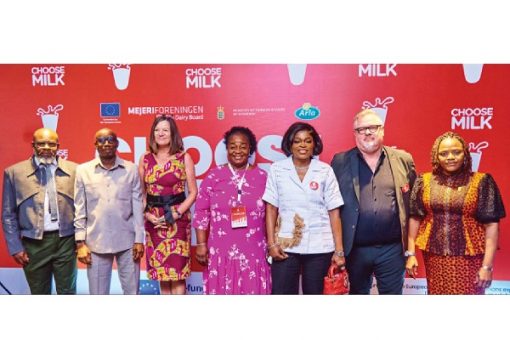

The Danish Dairy Board and the European Union joined Nigeria’s Federal Government on May 25 to launch the Choose Milk Campaign, a three-year nationwide initiative built around a single commercial problem: Nigerian consumers are frequently unable to tell the difference between dairy milk and the non-dairy creamers that share its shelf space.
The campaign was unveiled at the Lagos Marriott Hotel in Ikeja, bringing together the Federal Ministry of Health and Social Welfare, the Ministry of Livestock Development, NAFDAC, and the Standards Organisation of Nigeria alongside the EU and the Danish partners. Lars Jensen, Head of Export Marketing at the Danish Dairy Board, named the gap directly at the launch: “Not all products marketed within the dairy category deliver the same nutritional value. Creamers do not offer the key nutrients found in dairy milk. This campaign is about clarity, transparency, and better health outcomes.”
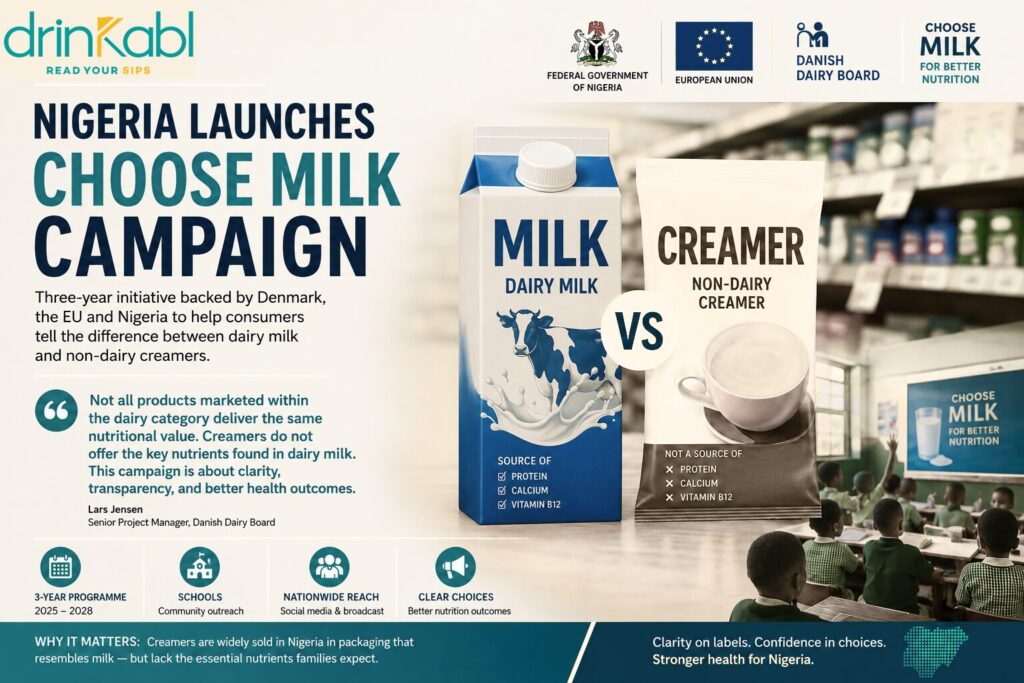
The distinction matters commercially. Creamers occupy broad retail and wholesale presence across Nigeria, often positioned in packaging that closely resembles dairy products. For households using them as functional milk substitutes, the nutritional shortfall is real, and according to organisers, largely invisible to the buyer.
“Not all products marketed within the dairy category deliver the same nutritional value. Creamers do not offer the key nutrients found in dairy milk. This campaign is about clarity, transparency, and better health outcomes.”
Lars Jensen, Head of Export Marketing, Danish Dairy Board
Alhaji Idi Mukhtar Maiha, Minister of Livestock Development, joined the event by video message and tied the campaign to his ministry’s wider dairy value chain objectives. Mrs. Olufowobi-Yusuf Adeola, Director of Food and Drug Services at the Federal Ministry of Health, described it as timely, noting that nutrition literacy remains one of the government’s unresolved public health priorities. Danish Consul General Jette Bjerrum framed the partnership’s logic in structural terms: sustainable progress on nutrition outcomes at this scale requires governments, health institutions, and the private sector working in coordination rather than sequence.
Actress Funke Akindele signed on as campaign ambassador alongside paediatrician Dr. Ayodele Renner. Mrs. Victoria Nsofor, Deputy Director of Nutrition at SON, raised the labelling dimension: regulatory ambiguity in how dairy-adjacent products are classified and presented has compounded the consumer confusion the campaign is trying to address.
The three-year programme will run through schools, community outreach, social media, and broadcast channels. Drinkabl.media’s coverage of Maltina’s 50-school Nourishment Tour earlier this month documented how beverage brands are increasingly treating school-based nutrition education as a long-cycle brand equity investment. The Choose Milk Campaign operates in the same territory, with the addition of regulatory and diplomatic weight behind it.
Whether the campaign achieves measurable behaviour change will depend on how far it travels beyond the Lagos launch venue and into the retail and wholesale channels where creamer penetration is deepest. The school and community activation schedule over the next three years is where that test will play out. As Drinkabl.media’s recent reporting on CAPPA’s push for stronger beverage nutrition policy shows, consumer education campaigns now operate inside an increasingly charged regulatory environment, and organiser’s ability to maintain government alignment across a three-year programme will matter as much as the messaging itself.
READ MORE
Maltina Takes Nourishment Campaign to 50 Schools in Major Nationwide Push