
Mounting pressure across Nigeria’s industrial landscape to demonstrate that homegrown enterprise can match the output of multinational competitors has found its most compelling answer yet.
What had been quietly taking shape within the OJAJA ecosystem, a series of calculated decisions around indigenous sourcing, local manufacturing, and the deliberate construction of an entirely Nigerian value chain, has now converged into a single, unambiguous declaration: that Nigeria possesses the capacity to conceive, develop, and deliver a world-class beverage brand without compromise, and without looking beyond its own borders.
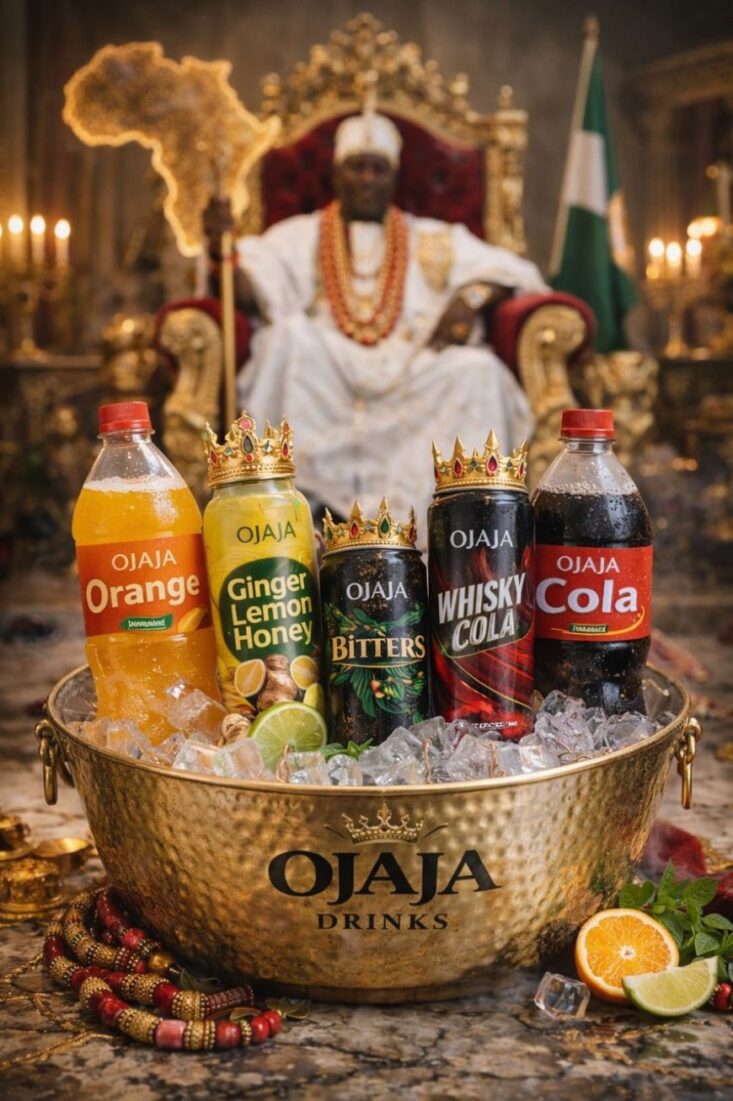
When Drinkabl.media first reported on the OJAJA brand’s debut in February 2026, the Ooni of Ife, His Imperial Majesty Adeyeye Enitan Ogunwusi, Ojaja II, framed the launch not as a commercial venture but as an act of cultural and economic defiance. The range, spanning OJAJA Bitters, Orange, Lemon Ginger, Herbal Drink, and Whisky Cola, was positioned as proof that African brands could compete by distinction rather than imitation. Two months on, that founding conviction has hardened into something the Nigerian beverage industry will find difficult to dismiss.
“This milestone transcends the realm of beverages,” the Ooni declared on April 19. “It is a powerful declaration of identity and an unequivocal affirmation that Nigeria is capable of producing excellence from inception to final delivery without compromise.”
The statement was made in the context of OJAJA Cola and OJAJA Orange now being available in canned format, with the aluminium cans themselves manufactured entirely within Nigeria. But to read this as a story about packaging is to miss the point entirely. The can is not the news. The news is what it represents: a fully closed, indigenously anchored production loop in which every stage of the value chain, from formulation through to finished, shelf-ready product, is owned, executed, and delivered by Nigerian hands.
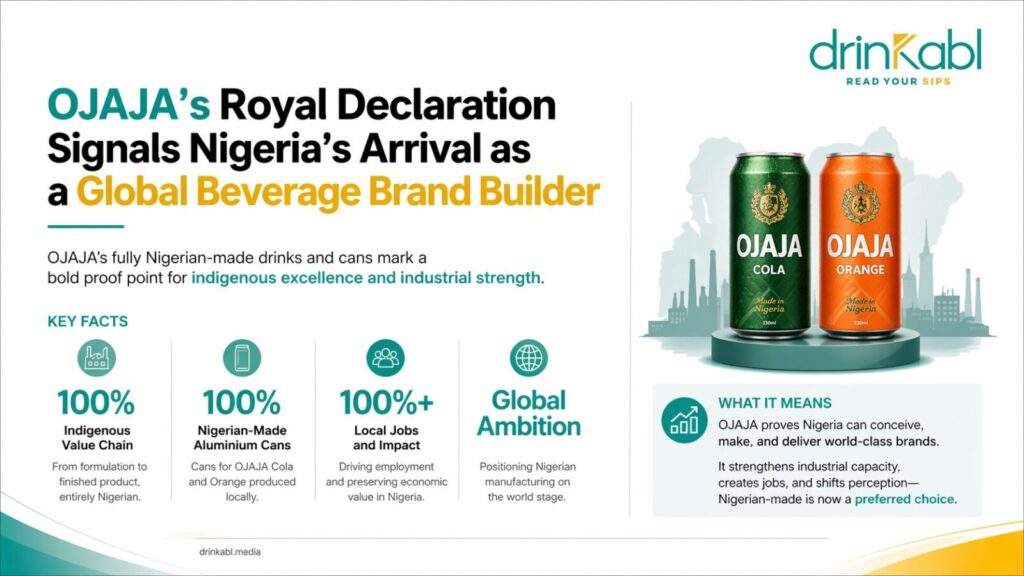
“From the aluminium cans, entirely manufactured within Nigeria, to the meticulously formulated beverages they contain, the entire value chain is anchored in indigenous expertise, resources, and vision,” Ogunwusi stated. “This intentional approach not only preserves economic value within our borders but also projects the strength and sophistication of Nigerian manufacturing on the global stage.”
That industrial ambition arrives at a consequential moment for the sector. As Drinkabl.media identified in its 20 Nigerian Beverage Companies to Watch in 2026 report, OJAJA entered this year as the sector’s most culturally compelling wildcard, capable of becoming either a genuinely iconic brand or a cautionary tale about the gap between concept and execution. The trajectory since February points firmly in one direction. With a growing product range, a completed local manufacturing chain, and a founder whose public platform extends well beyond the boardroom, OJAJA is accumulating the kind of narrative gravity that challenger brands rarely achieve this early.
The broader policy environment gives that narrative additional weight. Nigeria’s non-alcoholic beverage producers are locked in active resistance against the government’s proposed N10 per litre levy, a fiscal pressure Drinkabl.media has covered in detail, while the 2026 to 2028 excise framework continues to threaten margin compression across the sector. In that context, a brand built entirely on local production, local employment, and local materials is precisely the kind of industrial story the government’s own Made in Nigeria campaign needs as a proof point. The political and commercial incentives around OJAJA are, for once, pointing in the same direction.
At the competitive level, the Ooni is explicit about what OJAJA is challenging. “Beyond their sensory appeal, they represent a broader transformation in perception, one in which Nigerian-made products are no longer seen as substitutes but as preferred choices,” he said. On a continent where Heineken’s exit from DRC signals a wider multinational recalibration of African market commitment, the conditions for a confident indigenous challenger have rarely been more favourable.
“By prioritising local production at every stage, this initiative actively supports industrial growth, drives job creation, and reinforces the structural integrity of our economy,” the Ooni added.
The question the market is now asking is not whether OJAJA has a compelling story. It clearly does. The question is whether the distribution infrastructure, retail execution, and consumer pull-through can carry that story from a declaration of intent into sustained commercial volume. That answer will define whether OJAJA becomes the category shift it is positioning itself to be.
READ MORE
OJAJA Drinks Debuts as Ooni Backs Nigeria’s Beverage Industry, Drinkabl.media
Nigeria’s 20 Beverage Companies to Watch in 2026, Drinkabl.media
Non-Alcoholics Push Back on FG’s N10 Per Litre Levy, Drinkabl.media
Heineken Exits DRC as Africa’s Asset-Light Brewery Reset Accelerates, Drinkabl.media