
Momentum had been building within Nigeria’s regulatory landscape for some time, as mounting evidence of illicit alcohol production quietly spread across Lagos State’s commercial corridors. What had been circulating in enforcement intelligence circles as a pattern of coordinated counterfeiting activity ultimately gave way to decisive action, as the National Agency for Food and Drug Administration and Control moved against two clandestine facilities operating at the heart of one of Africa’s busiest trade ecosystems.
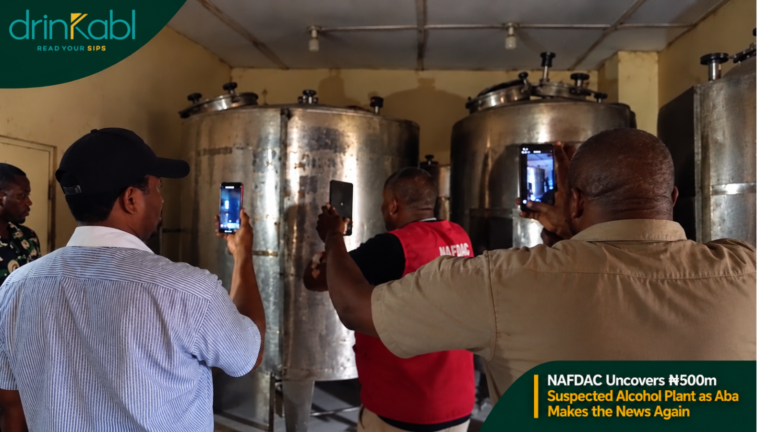
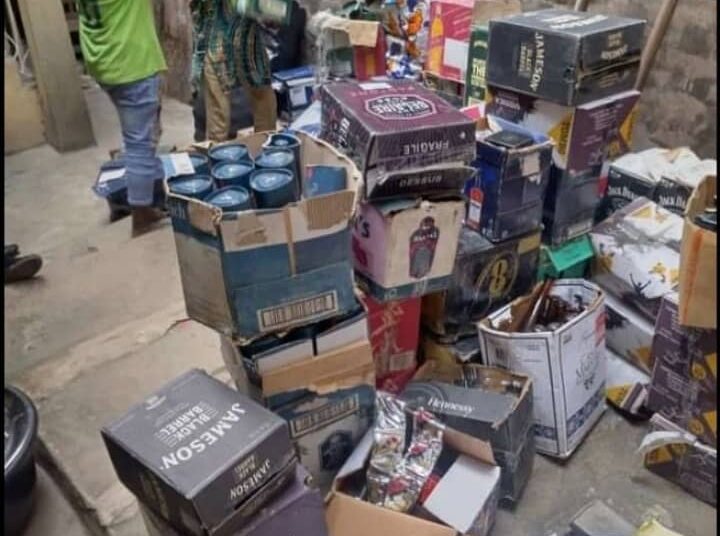
The agency confirmed the seizure of 1,800 cartons of adulterated and counterfeit alcoholic beverages, valued at approximately N350 million, following raids at Zamfara Plaza within the Trade Fair Complex and a separate location on Lagos Island. The scale of the haul reflects not a sudden discovery, but the culmination of credible intelligence work that had been tracking these operations across multiple sites.
At the Trade Fair Complex, operatives uncovered makeshift production infrastructure, including plastic mixing containers, improvised filtering equipment, empty branded bottles, corks and packaging materials, all assembled to simulate legitimate beverage production. The sophistication of the setup signals a supply chain designed not for small-scale distribution, but for volume output capable of penetrating retail networks at scale.
A suspect was also arrested on Lagos Island, believed to be operating both as manufacturer and distributor through a retail front. The dual role underscores a structural challenge that has long complicated enforcement across Nigeria’s beverage corridor: the blurring of production and point-of-sale under a single operation, making detection harder and market contamination faster.
A Sector Under Persistent Pressure
For Nigeria’s legitimate alcoholic beverage industry, the implications extend well beyond a single enforcement action. Counterfeit alcohol has long exerted downward pressure on category integrity, eroding consumer confidence and undercutting the pricing architecture that licensed producers depend on. When fake product enters the market at Trade Fair price points, it does not just steal volume, it distorts category perception at the base of the pyramid.
The threat is not hypothetical. As Drinkabl.media reported, criminal syndicates have been systematically scavenging empty branded bottles from high-end Lagos bars and nightclubs for refilling with toxic substitutes, a practice that implicates even premium venues in the contamination chain. NAFDAC’s warning that adulterated alcoholic products carry risks of poisoning, organ failure and death is not rhetorical caution. Methanol contamination, a common byproduct of illicit spirit production, has claimed lives across West Africa, and each incident carries reputational blowback that touches the entire category, regardless of brand legitimacy.
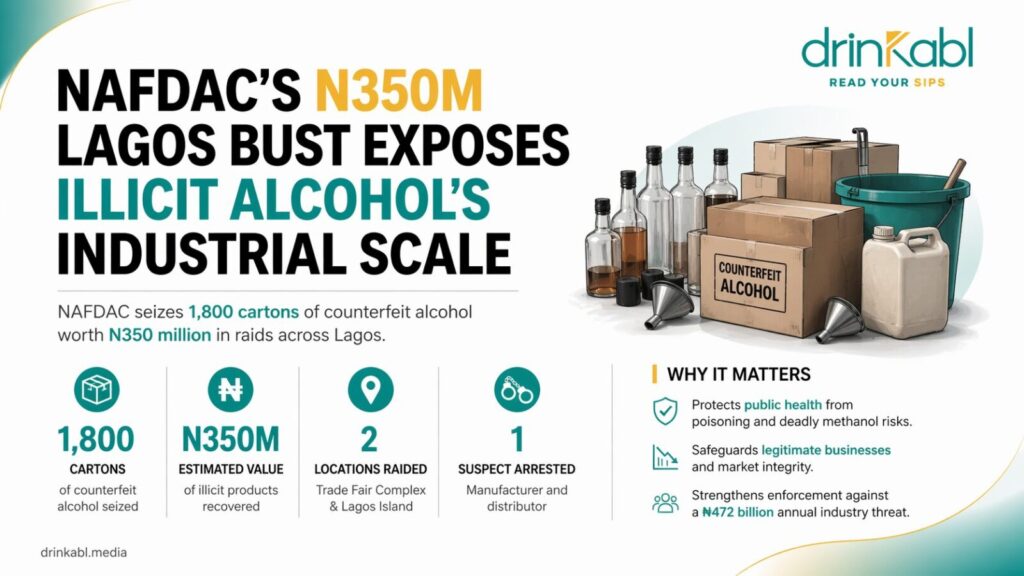
The Lagos raids arrive at a moment when Nigeria’s premium and mid-tier alcohol segments are navigating significant consumer pressure, driven by inflation, naira depreciation and shifting spending priorities. In that environment, counterfeit product finds its most fertile ground, offering price points that legitimate producers simply cannot match without sacrificing compliance. The SWAN forum convened this week in Abuja placed a figure on the damage: Nigeria loses an estimated ₦472 billion annually to illicit alcohol trade, representing approximately 40 percent of the total market.
Regulatory Escalation and Industry Outlook
A series of calculated enforcement moves by NAFDAC across recent months suggests the agency is operating with sharper intelligence infrastructure and greater operational coordination than previous cycles. The targeting of Trade Fair Complex is particularly significant, as the location functions as a major distribution hub, meaning product emanating from sites like this carries multiplier risk across downstream markets.
For licensed operators across spirits, ready-to-drink and value beer categories, the enforcement action reinforces the case for tighter distributor verification and consumer education investment. NAFDAC has advised the public to purchase only from authorised outlets and to report suspicious activity to the nearest agency office.
The structural battle against illicit alcohol in Nigeria is far from resolved, but the N350 million seizure marks a meaningful escalation in the state’s willingness to move decisively against operations that have long treated Lagos’s commercial density as protective cover. As Drinkabl.media’s analysis of Nigerian brewers’ back-to-back losses documented, the sector entered this enforcement era already weakened, making the illicit trade threat not merely a compliance matter, but a structural risk to industry recovery.
Read More on Drinkabl.media:
Vaniti Lagos Fires Back at Fake Drinks Allegations
Economic Shifts and Changing Tastes: The Impact on Premium Spirits in Nigeria
Insights: Why Nigerian Brewers Are Recording Back-to-Back Losses