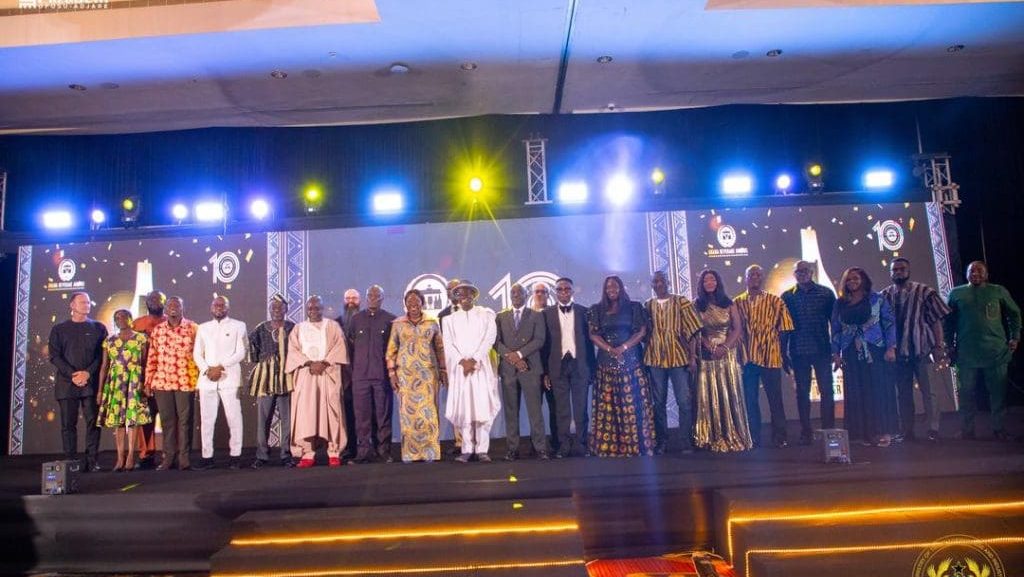

Behind the policy commitments delivered from the stage of the 10th Ghana Beverage Awards lay a more specific commercial challenge: how to translate government intent into measurable market share for locally produced beverages. The GBA’s landmark 10th edition had already crystallised a structural agenda, anchoring supply chain localisation, agribusiness linkages, and value addition as the Mahama administration’s core levers for sector growth. Now, with the Made-in-Ghana Fair confirmed for revival, the focus shifts from policy architecture to execution, and the pressure falls squarely on producers.
The Fair’s return is not simply a branding exercise. It arrives in a market where consumer confidence in domestic beverage products has been uneven, illicit consumption continues to erode legitimate volume, and imported inputs still expose manufacturers to persistent currency and supply-side vulnerabilities. Against that backdrop, a nationally anchored consumer platform carries real commercial weight, offering local producers a structured opportunity to consolidate trust, showcase quality improvements, and compete for shelf presence they have historically ceded to foreign brands.
Trade, Agribusiness and Industry Minister Elizabeth Ofosu-Adjare, speaking on behalf of President John Dramani Mahama at the April 19 ceremony, was direct about the stakes. “The fair will serve as an important tool for promoting local products and enhancing the image of Ghanaian brands, both locally and internationally,” she said, pairing the announcement with a pointed call for producers to raise quality standards and accelerate their global footprint.
That pairing matters. The Fair is not being positioned as a domestic feel-good initiative. It is being framed as a launchpad for export competitiveness, timed to coincide with Ghana’s structural advantage as host of the African Continental Free Trade Area Secretariat in Accra. As the continent edges toward deeper intra-African trade integration, the government is betting that a stronger domestic brand identity will translate into export credibility across the AfCFTA corridor, where beverage categories remain among the most commercially competitive.
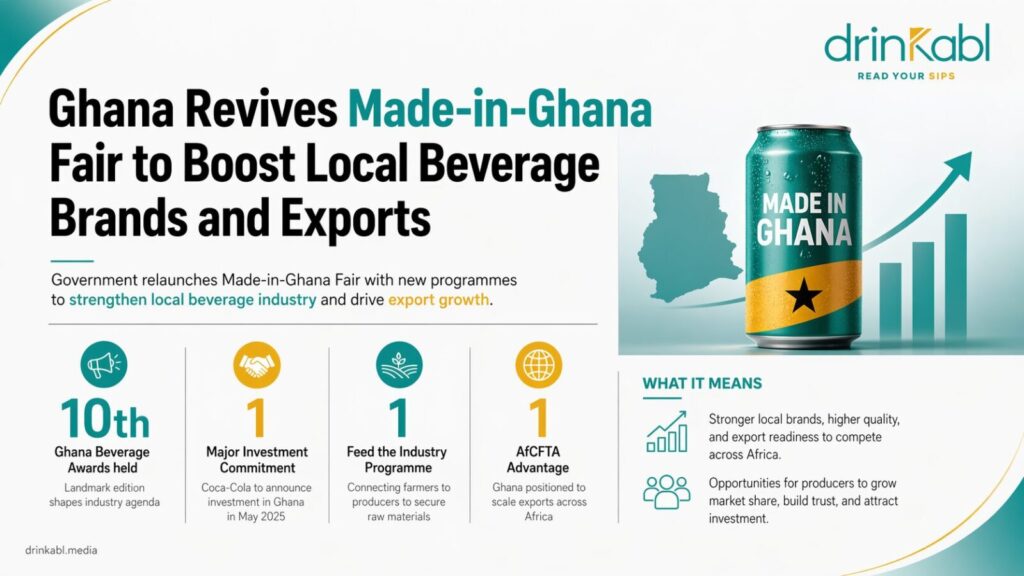
The Feed the Industry Programme, announced alongside the Fair’s revival, reinforces that ambition. By connecting smallholder farmers directly to industrial beverage producers through coordinated land, youth labour, and irrigation infrastructure, the programme targets the raw material dependency that has long constrained local manufacturers from scaling competitively. An incoming agribusiness policy framework, flagged by the minister as imminent, is designed to provide the broader enabling environment for value addition across the processing chain.
The convergence of these instruments, a brand platform, a supply chain programme, and a policy framework, signals that Ghana is attempting a coordinated rather than piecemeal approach to sector development. That coherence is notable, given that previous industrial promotion efforts in West Africa have often stalled at the announcement stage. Whether the current package holds together through implementation will depend heavily on execution timelines, producer uptake, and the government’s ability to maintain policy continuity beyond the current political cycle.
The private sector is not waiting. Ernest Boateng, CEO of Global Media Alliance, which organises the GBA, pressed manufacturers to treat technology adoption as non-negotiable. “Artificial intelligence has the potential to revolutionize how we operate, from predicting customer needs to improving product quality and operational efficiency,” he said, signalling that the industry’s response to government commitment must be matched by internal modernisation rather than passive reliance on state support.
Meanwhile, the sector’s growing pull as a priority market within West Africa’s broader beverages economy is drawing multinational attention. Coca-Cola’s WAMA regional leadership met Ofosu-Adjare days before the GBA to signal a major investment drive in Ghana, to be formally announced at a May conference in Accra. That alignment of state commitment and multinational appetite reinforces the commercial logic behind the Fair’s revival, but it also sharpens the competitive imperative for local producers. A market that attracts Coca-Cola’s investment attention is a market where standing still is not an option.
For Ghana’s beverage manufacturers, the Made-in-Ghana Fair represents both a platform and a test. The government has provided the scaffolding. What producers build on it, in terms of quality, brand equity, and export readiness, will determine whether this revival becomes a genuine inflection point or another well-intentioned initiative that falls short of its commercial potential.
Read More:
How Ghana’s Beverage Sector Became WaterAid’s Most Strategic Private Sector Ally
Heineken Exits DRC as Africa’s Asset-Light Brewery Reset Accelerates
Africa’s Drinks Industry Has a Sober Problem, and a Bigger Opportunity