
Momentum had been building across Canadian provinces for years around deposit-return programs, and now Waterloo Region is adding its voice to a growing chorus demanding Ontario close a significant recycling gap.
A motion tabled by Councillor Julie Wright at Monday’s council meeting urged the provincial government to implement a non-alcoholic bottle deposit-return program, a mechanism that most of Canada already relies on to keep beverage containers out of landfills and waterways.
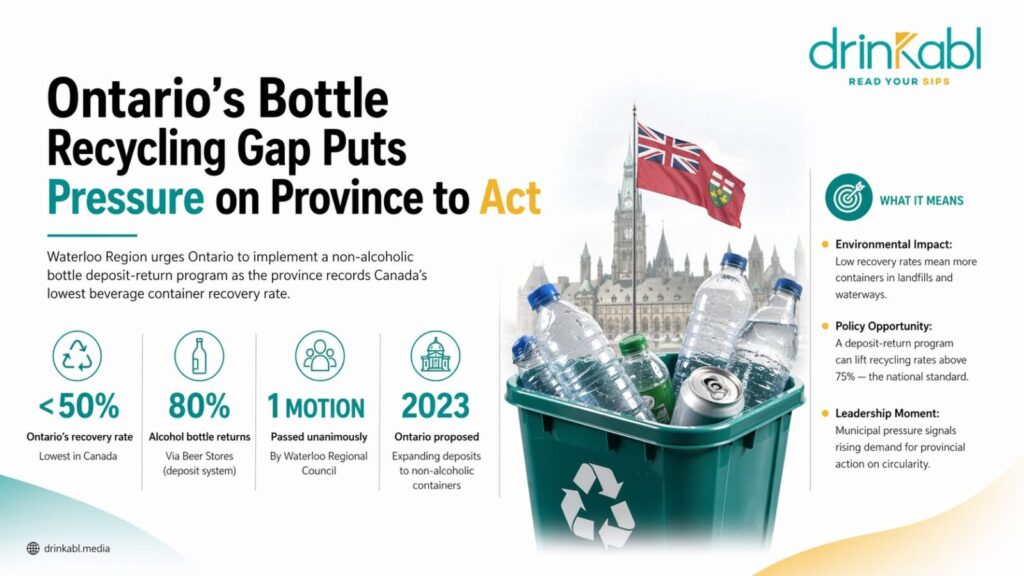
“Canadian provinces and territories that have a deposit-return program are able to recycle over three-quarters of their bottles, and even higher than that,” Wright told council.
The motion passed unanimously, with messages set to reach Premier Ford’s office and the offices of local MPPs directly.
The Recycling Disparity Is Hard to Ignore
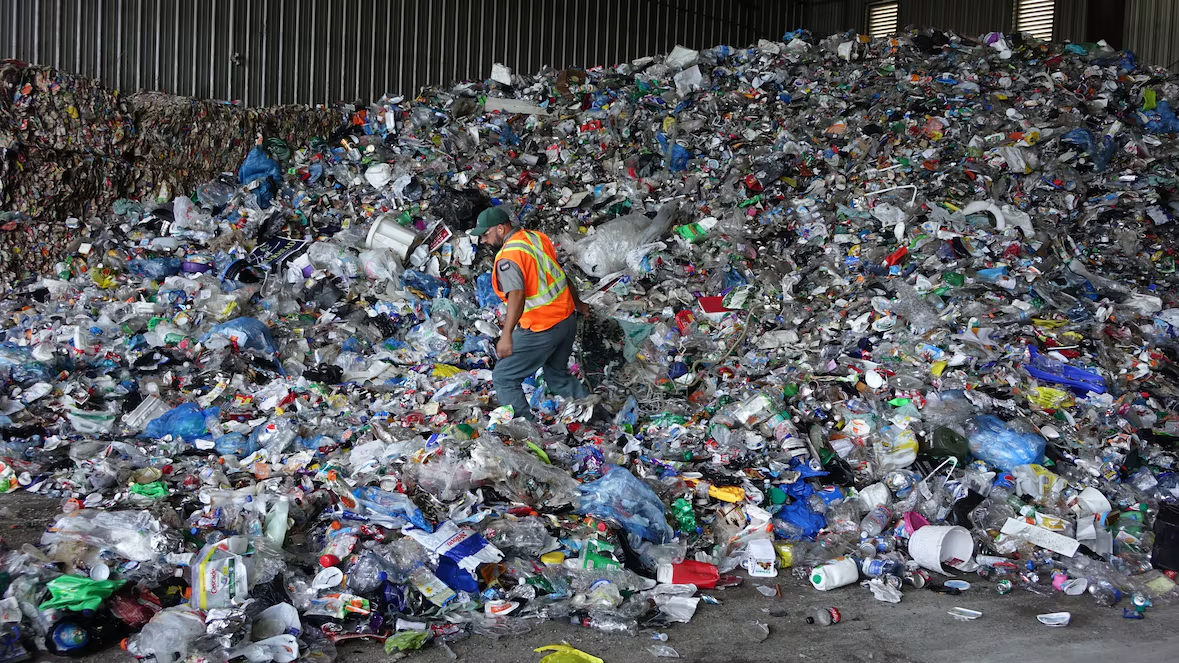
Ontario stands as one of the few provinces without a deposit-return system for non-alcoholic containers, and the data reflects it. The province currently holds the lowest beverage container recovery rate in Canada, a striking contrast to jurisdictions where deposit models have driven collection rates well above 75 percent.
The gap is visible even within Ontario’s own system. Empty alcoholic beverage bottles are returned to Beer Stores at roughly 80 percent, a direct result of the deposit incentive attached to them. Non-alcoholic containers, lacking that financial nudge, fall significantly short.
Wright’s motion noted that the Ontario government had itself proposed expanding the deposit-return program to include non-alcoholic containers as far back as 2023, making the province’s continued inaction a policy question as much as an environmental one.
“Recycling rates are in a weird, fluctuating position at the moment, and we really need leadership in this moment in order to get ahead of this issue,” Wright said.
Industry and Policy Implications
The push from Waterloo arrives at a time when beverage producers, retailers, and municipalities are facing mounting pressure to demonstrate credible circularity commitments. Deposit-return programs are increasingly viewed not as optional policy additions, but as baseline infrastructure for sustainable packaging ecosystems.
For beverage brands operating in Ontario, a deposit expansion would reshape consumer touchpoints, reverse logistics, and brand accountability around end-of-life packaging. It would also align the province with frameworks already normalized across British Columbia, Alberta, and Atlantic Canada, where return rates consistently outperform curbside-only models.
The Waterloo motion signals that municipal governments are no longer willing to wait on the province, and the political cost of inaction may be rising.
What Nigeria Can Learn
Nigeria’s beverage packaging waste challenge mirrors Ontario’s pre-reform reality, but at far greater scale and with fewer formal recovery systems in place. Millions of plastic and glass containers enter circulation daily across Lagos, Kano, Abuja, and beyond, with recovery dependent almost entirely on informal waste pickers operating outside any structured incentive framework.
The Waterloo model points to a clear lesson: financial incentives drive behaviour more reliably than awareness campaigns alone. A naira-backed deposit-return scheme, even piloted in one major commercial city, could formalize the recovery chain, integrate informal collectors as official return agents, and generate measurable diversion data that currently does not exist.
The Nigerian Bottled Water Association, NAFDAC, and the Federal Ministry of Environment have the institutional reach to convene such a pilot. Beverage multinationals already operating in Nigeria, including those with global sustainability commitments, would have both the incentive and the infrastructure to participate.
Ontario’s hesitation is a cautionary tale. The cost of delay compounds. Nigeria’s window to build recycling architecture ahead of its packaging volume peak is narrowing, and Waterloo’s unanimous vote is a reminder that leadership on circularity rarely originates at the top. It is pushed upward from the communities bearing the waste.
Read More
- Varun Beverages Zimbabwe Commits US$650M to Reshape Energy, Agriculture and FMCG Across Southern Africa
- SWAN Convenes Abuja Stakeholder Forum as Nigeria’s ₦472bn Illicit Spirits Crisis Reaches Breaking Point
- Krones Ignites Next-Gen Beverage Production With AI Twins
- PepsiCo’s $19.44bn Q1 Shows Portfolio Strength Ahead of World Cup