

Momentum had been building across Nigeria’s Southeast for months. Investor conversations were shifting, state governments were recalibrating their pitch to private capital, and Aba, long celebrated for its street-level entrepreneurial density, was quietly re-entering the industrial conversation at a different register. What crystallised on March 25, 2026, at the Osisioma Industrial Layout was not simply a factory opening. It was the visible output of a strategic alignment years in the making.
Ultimum Limited, backed by the Kadji Group, commissioned a fully operational beverage production facility in Aba, anchoring a structured, multi-phase expansion carrying a $100 million long-term commitment. Phase One alone represents a $35 million deployment, producing a portfolio of soft drinks and energy beverages including Razzl Cola, Orange, Lemon, Pamplemousse, and KiQ Energy Drink. For a country navigating persistent deindustrialisation pressures and import dependence in the consumer goods segment, the plant’s arrival carries weight well beyond its production output.
Behind the commissioning, the strategic calculus was deliberate. The Kadji Group identified Aba not despite its informality, but because of it. The city’s embedded production culture, its geographic access to major Southeastern and Central Nigerian markets, and its position within one of the country’s most active fast-moving consumer goods corridors made it a compelling case. As Ultimum Limited Chairman Whalen Kadji stated at the launch, “We came here because of the energy of Aba. This is one of the great commercial hubs of West Africa.”
That framing matters. It repositions Aba from a heritage industrial story into a current investment thesis, one where informal entrepreneurial energy and formal manufacturing capital are now operating in the same ecosystem rather than in parallel.
The employment dimension is immediate and significant. Hundreds of direct jobs have been created across production operations, engineering, logistics coordination, quality assurance, and administration. These are structured roles in a labour market where that kind of stability remains scarce. The broader multiplier, extending into transport logistics, warehouse operations, independent distribution networks, retail outlets, and agricultural input supply chains, is expected to generate thousands of additional indirect employment opportunities. In Nigeria’s informal-heavy economy, a single production hub of this scale can sustain entire micro-economies within its radius.
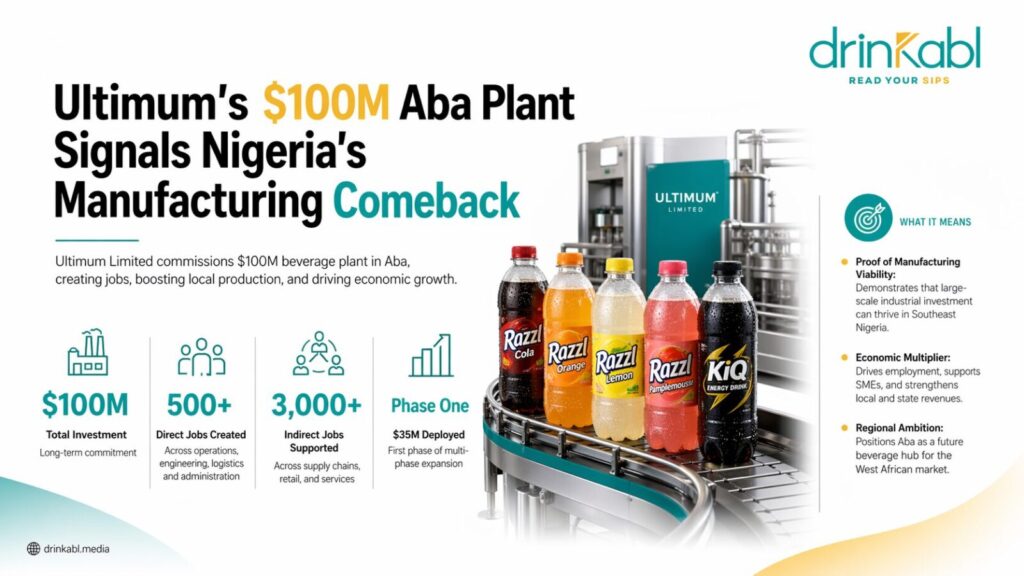
From a competitive positioning standpoint, Ultimum’s localisation strategy addresses a persistent vulnerability in Nigeria’s beverage market. Imported goods carry price disadvantages and supply chain exposure that domestic manufacturing eliminates. By producing multiple SKU variants, including accessible 40cl and 60cl formats, the Razzl portfolio is engineered for market penetration rather than premium positioning. That approach aligns with the broader consumer shift across West Africa toward affordable, locally produced alternatives, a trend accelerating as currency pressures persist across the region.
Abia State Governor Alex Otti, who formally commissioned the plant, framed the investment as validation of deliberate policy work. “Investors are drawn to environments where there is predictability, security, and a clear return pathway,” he noted, describing conditions the state has been actively building. His emphasis on diversifying internally generated revenue beyond federal allocations points to the structural role private industrial capital now plays in sub-national fiscal strategy. Manufacturing investments of this kind contribute directly to state revenue, which in turn funds the infrastructure and security conditions that attract the next wave of investors.
Ultimum has also signalled longer-term investment in human capital, embedding youth development initiatives, technical training programmes, and skills acquisition partnerships into its operational roadmap. In a country where the median age sits below 20 and formal job creation consistently lags population growth, that pipeline approach carries real policy relevance.
The Phase Two roadmap positions the ambition at a regional scale. Kadji Group leadership has outlined plans to expand production capacity, introduce additional product lines, and develop an export strategy targeting West African markets. If that trajectory holds, Aba could evolve from a Nigerian production base into a regional supply hub, a shift that would represent a meaningful rerating of the city’s industrial identity.
The Ultimum plant produces beverages. But its deeper output, employment stability, SME activation, fiscal contribution, and a demonstrated proof point for manufacturing viability in Southeast Nigeria, signals something the broader investment community will be watching closely. Nigeria’s industrial story, long described in the past tense, is being written again, one production line at a time.
Read More
- Varun Beverages Zimbabwe Commits US$650M to Reshape Energy, Agriculture and FMCG Across Southern Africa
- SWAN Convenes Abuja Stakeholder Forum as Nigeria’s ₦472bn Illicit Spirits Crisis Reaches Breaking Point
- Krones Ignites Next-Gen Beverage Production With AI Twins
- PepsiCo’s $19.44bn Q1 Shows Portfolio Strength Ahead of World Cup