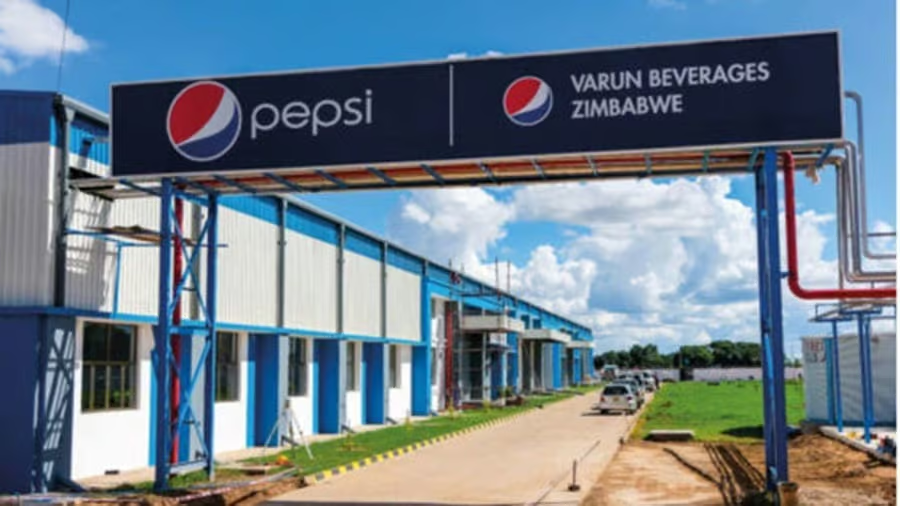

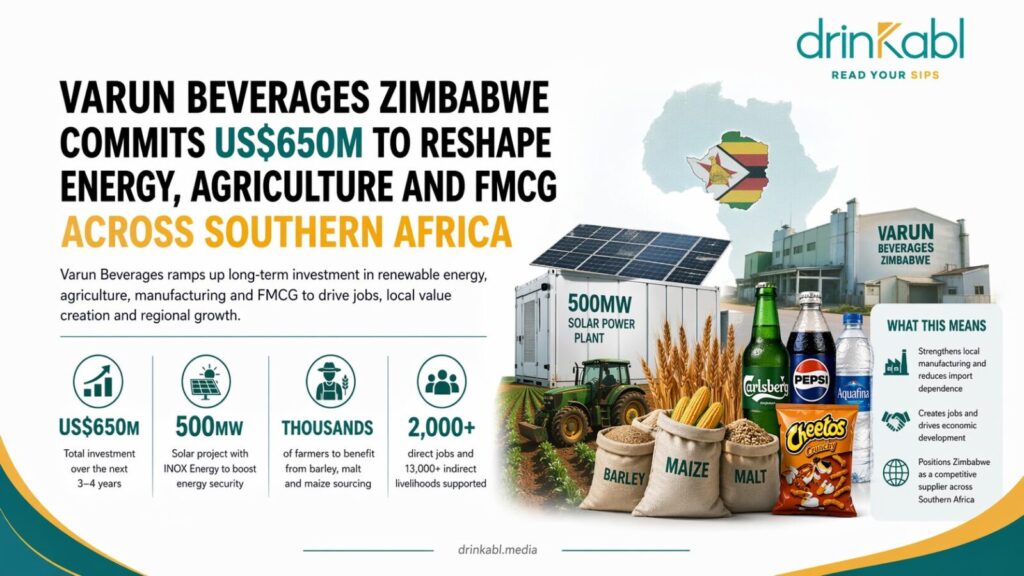
A steady escalation in strategic commitments across Zimbabwe’s manufacturing corridor has now culminated in one of the most ambitious private sector investment declarations the country has seen in years. Varun Beverages Zimbabwe, the local unit of India’s RJ Corp-backed beverages giant, has announced a US$650 million programme spanning renewable energy, agriculture, manufacturing and fast-moving consumer goods, signalling a decisive deepening of its long-term bet on Zimbabwe’s economic recovery.
The programme, to be executed over three to four years in partnership with RJ Corporation and INOX Energy, represents a material escalation beyond the company’s prior footprint. By 2024, Varun had already committed more than US$150 million into Zimbabwean operations and built 11 production units since entering the market in 2018. A US$20 million expansion completed last year extended its carbonated drinks and water capacity at the Harare plant. Its landmark distribution agreement with Carlsberg, signed in late 2025, extended its portfolio into beverage alcohol for the first time, positioning Zimbabwe as the first phase of a continental beer rollout.
Momentum had been building within Varun’s Zimbabwe operation well before this announcement. The company signed a memorandum of understanding with the Zimbabwe Investment and Development Agency in 2024 to formalise a new snacks and juice manufacturing division. President Emmerson Mnangagwa laid the foundation stone for a snacks plant in December of that year, with Cheetos production commencing by early 2026, introducing approximately 20 new SKUs across five flavours and two pack sizes. Simultaneously, construction commenced on a Carlsberg brewery, with regional trading to begin in April 2026 and full local manufacturing targeted by mid-2027.
The energy component is among the most significant dimensions of the new programme. Varun is backing a 500-megawatt solar project developed with INOX Energy, targeting reduced reliance on electricity imports and an easing of pressure on public financing. Power reliability has persistently constrained beverage manufacturing competitiveness across Southern Africa, and a private sector commitment at this scale carries direct implications for the region’s industrial investment calculus.
In agriculture, the company is reinforcing backward integration by working with local farmers to produce barley, malt and maize, inputs that will feed both its Carlsberg brewing operations and its PepsiCo snacks portfolio. Drone-assisted mechanised farming techniques are planned to improve yields, with the broader objective of positioning Zimbabwe as a supplier into regional and continental markets. According to the company, the expanded maize-based snack and beverage projects are expected to create substantial additional demand for thousands of farmers and strengthen upstream agricultural value chains.
“Sustainable economic growth is anchored on reliable infrastructure, productive agriculture and a strong partnership between the private sector and Government,” the company stated.
Employment creation sits at the core of the strategy. Varun currently supports more than 2,000 direct jobs and over 13,000 indirect livelihoods. The company expects the expansion to potentially match or exceed current employment levels. In a country where industrial job creation remains a central policy priority, this scale of commitment carries significance well beyond the beverage sector.
The group also intends to introduce additional multinational FMCG brands into Zimbabwe through RJ Corporation partnerships, with the aim of strengthening local manufacturing, broadening retail and logistics networks, and expanding consumer choice. This positions Varun not merely as a beverage bottler, but as a vertically integrated consumer goods platform with growing category ambitions, a trajectory consistent with its continental expansion pattern across Africa.
The Varun move arrives against a backdrop of accelerating consolidation and repositioning across Africa’s drinks landscape. As Drinkabl.media has reported, global brewers are increasingly rationalising their asset footprints across the continent even as RJ Corp-backed platforms expand aggressively, creating a structural realignment in which franchise-model operators are filling gaps left by retreating majors.
For Zimbabwe, the investment marks a convergence of private sector confidence and government reform momentum. It sets up a material competitive challenge to Delta Corporation, the dominant local beverage manufacturer, particularly in beer, where Delta holds an estimated 96 percent market share. Varun’s phased Carlsberg rollout, once local brewing matures, will test the durability of that dominance directly.
The company affirmed strong consumer demand for its recently launched Cheetos range and confirmed it is evaluating further expansion to meet rising consumption, signalling that this programme is a floor, not a ceiling.
Read More