Nigerian beverage companies are rebuilding informal field-intelligence systems abandoned during years of dashboard-driven management, as inflation, weakening consumer spending, and fragmented retail data expose how much ground the industry has lost to paper-based assumptions about its own markets.
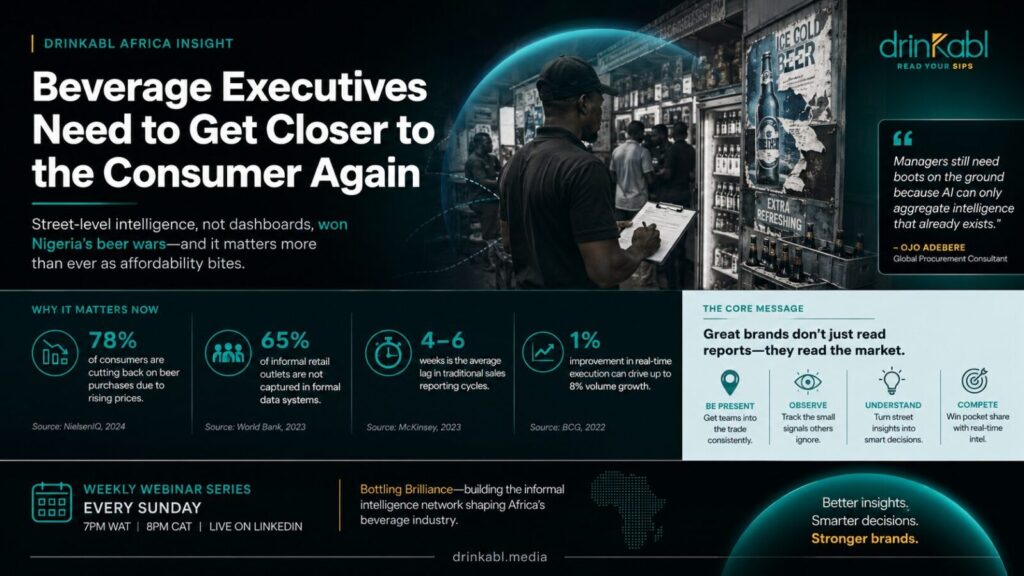
The warning came from Drinkabl Africa’s Bottling Brilliance session on LinkedIn Live on May 10, where procurement and supply chain professional Ojo Adebere walked participants through how Nigeria’s beer wars were won on street-level observation and why that discipline is again commercially relevant.
Adebere’s career spans Nigerian Bottling Company, Diageo, PZ Cussons, and Cadbury Nigeria. He told the session that the Nigerian beverage companies which dominated their markets did not do so by waiting for weekly sales reports. They sent management into the trade directly and continuously.
“Management teams were out in bars until early morning because they wanted to understand exactly what was happening in the market,” Adebere said during the session.
The system was more structured than informal. Employees across departments, not only sales teams, were assigned specific bars and outlets to monitor. Companies reimbursed staff for purchases made during visits. The result was a decentralised intelligence network that could surface operational problems, competitor activity, and shifts in consumer behaviour faster than any formal reporting cycle could capture. What made it work was volume and consistency: many observers, covering many outlets, reporting regularly.
The intelligence being gathered was deliberately granular. Companies tracked torn posters, expired competitor branding, failed chillers, and discarded packaging as early indicators of market-share movements. These were not vanity metrics. Torn point-of-sale material signalled a competitor’s distribution team had stopped visiting. A failed chiller meant product was being served warm and losing to whoever could serve cold. Discarded packaging showed what consumers were actually buying, regardless of what distribution data suggested. At the outlet level, these details told a more accurate story than any aggregated sales figure.
One case study discussed during the session illustrated what that granularity was worth in practice. An unexpected sales increase near the Cameroon border attracted internal attention. Rather than treating the numbers as confirmation of brand strength, the company sent people into the field. The investigation revealed the surge was driven by temporary industrial demand from outside Nigeria, not by any sustainable shift in consumer purchasing. Production expansion, which would have been the obvious corporate response to the dashboard data, was avoided. The field intelligence saved a capital decision.
That example anchors the session’s central argument: formal reporting systems show what has already happened in markets that formal systems can adequately measure. In Nigeria and across African FMCG markets more broadly, those conditions frequently do not hold.
Drinkabl Africa noted during the session that sales, trade marketing, and brand teams routinely operate in silos, despite the sales function being the one closest to actual consumers. Each team develops its own picture of the market, and those pictures do not always match. When strategic decisions are made from aggregated, reconciled data that has passed through several internal filters, the result is often a version of the market that is tidier than the truth.
The affordability crisis is making that gap more expensive. Adebere told the session that lower-income consumers are cutting back on beer purchases or abandoning them entirely as retail prices climb. The dynamic is not simply that consumers are choosing a cheaper brand. Some are leaving the category. Brands that detect this through sales data alone see a volume decline. Brands with people in the trade can identify the mechanism: whether consumers are trading down, switching channels, reducing frequency, or exiting. The commercial response to each is different.
“Managers still need boots on the ground because AI can only aggregate intelligence that already exists.”
Ojo Adebere, speaking at Drinkabl Africa’s Bottling Brilliance session
Participants described the competitive pressure this creates as a fight for “pocket share” rather than brand loyalty. When consumer spending compresses, every naira a brand captures is a naira a competitor does not. The brand with better real-time intelligence on where consumers are and what they are spending knows where to compete and where to hold. The brand relying on last month’s report is competing blind.
Artificial intelligence entered the discussion, and Adebere’s position was precise. AI is not useless. It is useful for aggregating and interrogating data that already exists within an organisation. But it cannot observe what no one has recorded, and in fragmented African retail markets, a large share of what matters commercially is never formally recorded at all. The weak signals that precede a market shift, a chiller going down across a cluster of outlets, a competitor increasing bar-staff incentives, a packaging format gaining traction in a specific neighbourhood, exist in the trade before they exist in any dataset.
“Managers still need boots on the ground because AI can only aggregate intelligence that already exists,” Adebere said.
That position has implications for how beverage companies structure their intelligence gathering as AI tools become more widely available. Investing in AI-based market analytics while cutting field observation capacity does not upgrade a company’s market intelligence. It automates the analysis of incomplete information.
Leadership proximity emerged as a separate but connected theme. Adebere argued that executives who remain physically close to trade channels are better positioned to challenge the assumptions that form inside organisations during periods of stable or growing revenue. When the market turns, those assumptions become liabilities. An executive who has been in bars and outlets recently has a faster mechanism for detecting when internal models no longer match external reality.
The session’s concluding point was structural. African FMCG markets are not failing to produce market intelligence because the intelligence does not exist. It exists in outlets, in consumer behaviour, in the daily decisions of bar operators and trade staff. The problem is that most of it is never captured, because the observation systems required to capture it have been allowed to atrophy. Companies that rebuilt those systems during previous periods of competitive pressure gained durable advantages. The current environment, with inflation, affordability compression, and slowing consumer spending, is creating the same incentive again.
Drinkabl Africa said the Bottling Brilliance sessions will continue weekly.