

Africa’s Beverage Industry Faces a New Test of Regulation, Restructuring and Growth
From Nigeria’s brewing recovery and a proposed corporate restructuring at Champion Breweries to Kenya’s alcohol-control debate and Zimbabwe’s stronger beverage earnings, the week of 9–15 November showed an industry balancing expansion with rising regulatory and operating pressures.
The African beverage industry entered the second week of November with significant developments across corporate strategy, regulation, manufacturing and consumer markets. Nigerian Breweries marked its 80th anniversary against the backdrop of a financial recovery, while Champion Breweries proposed a new holding company to accommodate its expanding portfolio. In Kenya, a proposed overhaul of alcohol legislation triggered resistance from manufacturers and county licensing authorities.
Elsewhere, Zimbabwe’s Delta Corporation reported stronger half-year earnings and beverage volumes, Kenya’s coffee industry moved towards a national flavour-mapping initiative, and Nigeria’s regulator uncovered packaging materials bearing the identity of an established international gin brand during an investigation into suspected counterfeiting.
The stories reflect a sector where growth opportunities remain substantial, but the ability to convert expansion into sustainable returns increasingly depends on regulation, manufacturing efficiency, brand protection and access to consumers.
Nigerian Breweries Turns 80 With Its Recovery Still Under Examination
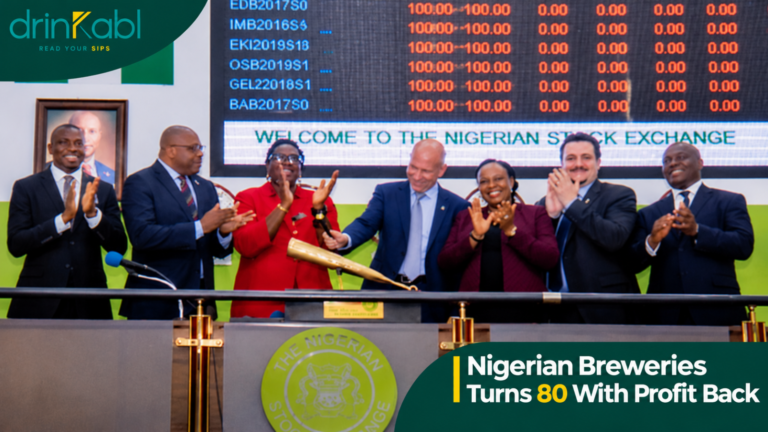
Nigerian Breweries marked its 80th anniversary in November, reaching the milestone after two difficult years in which currency depreciation, high borrowing costs and weak consumer purchasing power placed considerable pressure on its finances.
The company’s recovery has been supported by a major balance-sheet restructuring. Its 2024 rights issue raised approximately ₦599.1 billion, providing funds to reduce foreign-currency exposure and borrowing obligations. The intervention helped bring net finance costs down sharply in 2025 and supported a return to profitability after substantial losses in the preceding years.
For the nine months ended September 2026, Nigerian Breweries reported revenue of approximately ₦1.103 trillion and profit after tax of ₦114.1 billion, up 33 per cent year-on-year. However, the quality of the recovery deserves closer examination. Net finance expenses fell 78 per cent to about ₦7.5 billion, while revenue growth slowed to 5.4 per cent over the nine-month period.
The figures show a company that has substantially repaired its balance sheet, but still faces the challenge of generating stronger sales growth in a market where consumers remain sensitive to price increases.
At 80, Nigerian Breweries has a portfolio and distribution network built over several decades. Its next phase will depend on whether operational improvements and renewed consumer demand can sustain profitability without relying so heavily on the financial relief provided by debt reduction.
Read more in Nigerian Breweries Turns 80 With Profit Back.
NAFDAC Finds Gordon’s Gin Packaging Materials in Lagos Counterfeit Investigation
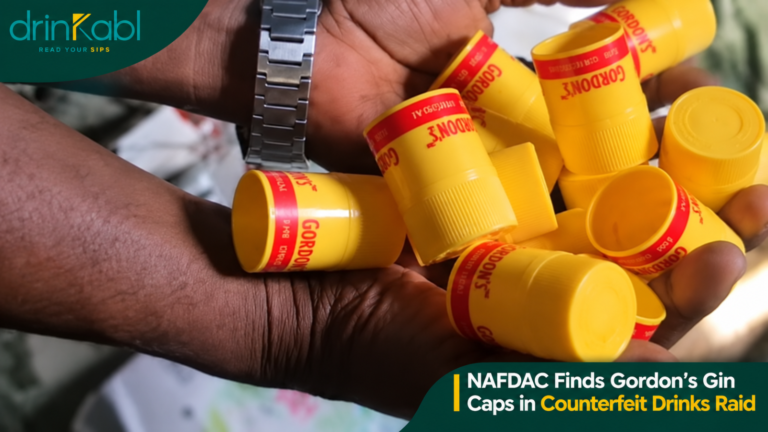
Nigeria’s National Agency for Food and Drug Administration and Control (NAFDAC) uncovered packaging materials bearing the Gordon’s Gin brand during an enforcement operation at the Tools and Hardware Complex of the Trade Fair Complex in Lagos on 14 November.
The operation followed intelligence gathered by the agency and also uncovered materials associated with suspected falsified medicines, including packaging bearing the names of Augmentin 625mg tablets and Ampiclox capsules.
The discovery raises fresh concerns about the use of established product identities in unauthorised packaging operations. For beverage manufacturers, the appearance of branded bottle caps outside legitimate supply channels creates a risk that counterfeit operators could use familiar packaging to make unauthorised products appear genuine.
The location had already come under scrutiny in October, when NAFDAC uncovered more than 20 illegal stores allegedly involved in counterfeiting alcoholic beverages, repackaging expired drinks and storing banned imported products. The agency valued the products seized during that operation at more than ₦2 billion, while two suspects were arrested.
However, the latest discovery should not be confused with proof that counterfeit Gordon’s Gin was manufactured at the warehouse. NAFDAC has not established that finished counterfeit gin was produced there, disclosed the quantity of materials recovered or identified those responsible.
The investigation now needs to establish the intended use of the packaging, trace its supply chain and determine whether it was connected to a wider counterfeit beverage network.
For legitimate brand owners, the incident reinforces the importance of packaging security, distributor verification and cooperation with regulators. Removing counterfeit products from the market is only part of the task; identifying the suppliers and distribution networks behind them is equally important.
Read the full report: NAFDAC Finds Gordon’s Gin Caps in Counterfeit Drinks Raid.
Kenya’s Alcohol Bill Triggers Industry and County Government Opposition
Kenya’s proposed Alcoholic Drinks and Drugs Control Laws (Amendment) Bill, 2026, faced growing opposition during the week after manufacturers and county licensing authorities questioned its potential economic and constitutional implications.
The Alcoholic Beverages Association of Kenya (ABAK), which represents major industry participants including Kenya Breweries, Heineken, Kenya Wine Agencies and Pernod Ricard Kenya, called for the proposed legislation to be withdrawn and subjected to wider consultation.
Among the provisions attracting criticism are a proposed increase in the minimum drinking age from 18 to 21, a KES 2-per-litre levy on legitimate manufacturers, restrictions on alcohol transportation to between 6am and 6pm, and tighter controls over advertising and promotions. The bill also proposes additional national licensing and product registration requirements.
ABAK’s preliminary modelling estimates that raising the minimum drinking age could put approximately KES 3.3 billion in annual retail and hospitality revenue at risk, alongside KES 1.8 billion in government tax revenue, 8,960 jobs and 1,792 licensed outlets. The association also estimates that the proposed levy could impose an additional annual burden of KES 1.3 billion on legitimate manufacturers.
These are industry estimates rather than independently established outcomes, but they illustrate the scale of the commercial concerns surrounding the proposed measures.
The opposition is not limited to manufacturers. The umbrella body representing liquor licensing and control boards across Kenya’s 47 counties has raised constitutional objections, arguing that liquor licensing is a devolved responsibility and should not be transferred to national authorities through ordinary legislation.
The dispute exposes a difficult policy question: how can Kenya strengthen alcohol controls and reduce alcohol-related harm without weakening licensed businesses or creating further opportunities for illicit operators?
The bill remains a proposal, not an enacted law. Its progress through Parliament will be important for manufacturers, distributors, retailers, hospitality operators and investors assessing the future regulatory environment.
Champion Breweries Proposes New Holding Company for Expansion
Champion Breweries Plc has proposed establishing a new holding company, Champion Brands Limited, as it prepares to expand its operations across additional beverage categories and African markets.
Under the proposed arrangement, Champion Breweries would become a subsidiary of Champion Brands, which would take its place as the listed parent company on the Nigerian Exchange. Existing shareholders would receive one share in Champion Brands for every share they currently hold in Champion Breweries, maintaining their ownership proportions without requiring additional payment.
The proposed group structure would include Champion Breweries and enJOYbev B.V., the business behind the Bullet range of ready-to-drink and energy beverages.
The restructuring follows Champion’s acquisition of enJOYbev, which expanded its portfolio beyond traditional beer and extended its commercial presence to 14 African markets. The company has also entered a manufacturing and distribution agreement with Bature Brewery to take three Nigerian craft beer brands into wider circulation.
Champion reported nine-month revenue of ₦51.4 billion for the period ended September 2026, representing a 140 per cent increase from ₦21.4 billion in the corresponding period of 2025. Operating profit rose 48 per cent to ₦6.3 billion.
The proposed holding-company structure is intended to give management greater flexibility in allocating investment across its businesses, developing brands and pursuing new market opportunities.
However, the restructuring remains subject to shareholder and regulatory approvals. It is not yet a completed change in the company’s listed structure.
For the Nigerian beverage market, the proposal is another indication that local operators are looking beyond conventional brewing operations towards broader portfolios that include energy drinks, ready-to-drink products and craft beverages.
The proposal follows the company’s recent partnership with Bature Brewery to expand craft beer distribution nationwide.
Delta Corporation Records Stronger Half-Year Performance in Zimbabwe
Zimbabwe’s Delta Corporation reported an 18 per cent increase in group revenue to US$607.5 million for the six months ended September 2026, while operating income rose 13 per cent to US$112.2 million.
The performance was supported by growth across its domestic lager beer, sorghum beer and spirits operations. Earnings before interest, tax, depreciation and amortisation increased 13 per cent to US$126.8 million, while profit before tax rose 10 per cent to US$115.3 million.
The company’s beverage volumes increased by 8 per cent overall to approximately 7.02 million hectolitres. Domestic lager volumes rose 13 per cent, while Zimbabwean sorghum beer volumes increased 19 per cent. Cordials and juices recorded 29 per cent growth, while African Distillers’ wine and spirits volumes rose 35 per cent.
The results suggest that demand remains relatively resilient across several beverage categories, even as producers contend with rising costs and a challenging operating environment.
Delta also increased its interim dividend by 20 per cent, signalling confidence in its earnings performance.
However, the company continues to face a significant tax dispute valued at approximately US$97 million. The outcome could have implications for its financial position and future investment capacity.
For the wider African beverage industry, Delta’s results demonstrate the value of maintaining exposure to multiple categories and consumer segments. Growth in lager, traditional sorghum beer, spirits and non-alcoholic beverages provides a more diversified earnings base than dependence on a single product category.
The company’s half-year operating income and volume performance provide further detail on the results.
Kenya Uses Coffee Flavour Mapping to Strengthen Market Position
Kenya’s coffee industry moved towards a new market-development initiative with the Kenya Coffee Flavour and Origin Expo, held in Nairobi from 14 to 16 November.
The event, organised with the involvement of the Coffee Board of Kenya, FAO Kenya and the Kenya Coffee Platform, brought together producers, traders, researchers, roasters and other stakeholders to document the country’s coffee diversity.
More than 300 trained coffee cuppers were expected to evaluate up to 500 coffee samples representing different coffee-growing regions. The exercise is intended to contribute to a National Coffee Flavour Map scheduled for release in 2027.
The initiative reflects a shift in how coffee-producing countries communicate value in international markets. While traditional grading systems place considerable emphasis on bean size and physical characteristics, specialty coffee buyers increasingly consider sensory profiles, traceability and geographical origin.
A national flavour map could give farmers and cooperatives more detailed information with which to differentiate their products, improve market positioning and engage premium buyers.
For Kenya, where coffee remains an important export commodity, the commercial opportunity lies in connecting origin-specific information with stronger producer access to international markets. The longer-term test will be whether the resulting data translates into better prices and more predictable market opportunities for growers.
The FAO Kenya announcement of the Coffee Flavour and Origin Expo provides details of the initiative.
KWAL Puts Local Manufacturing and Women’s Leadership in Focus
Kenya Wine Agencies Limited (KWAL) hosted more than 50 female business executives and industrial leaders at its Tatu City manufacturing facility as part of the Kenya Association of Manufacturers’ Women in Manufacturing programme.
The visit, held on 5 November and reported during the week, formed part of the association’s industry engagement series. Participants toured KWAL’s production and packaging operations before taking part in discussions on industrial investment, leadership resilience, local value addition and brand expansion.
The engagement comes as Kenya pursues a target of increasing manufacturing’s contribution to gross domestic product from approximately 7.6 per cent to 20 per cent by 2030.
KWAL used the visit to highlight its investment in automated production and packaging lines, environmental management and quality-control systems. The company also said its Tatu City facility had become the only EDGE Advanced-certified manufacturing facility in Kenya.
Beyond the leadership discussion, the visit points to the wider role beverage manufacturers can play in industrial development. Investment in local production infrastructure can strengthen domestic supply chains, reduce reliance on imported finished products and support employment across manufacturing, logistics and distribution.
The challenge for Kenya will be to translate individual factory investments into broader industrial capacity, while ensuring that women have a stronger presence in technical, operational and executive leadership positions.
Read more about the visit in KWAL Hosts 50 Women Industrial Leaders as Kenya Targets 20% Manufacturing GDP Contribution.
What comes next
The next phase of Kenya’s alcohol-control debate will depend on how Parliament responds to objections from manufacturers and county licensing authorities. The proposed legislation has implications extending beyond alcohol producers to retailers, hospitality businesses, logistics operators and public revenue.
In Nigeria, NAFDAC’s latest discovery at the Trade Fair Complex will require further investigation to establish whether the recovered Gordon’s Gin packaging materials were connected to finished counterfeit products or a wider illicit supply chain. The regulator’s ability to identify the operators behind such activities will be an important test of enforcement effectiveness.
Champion Breweries’ proposed holding-company arrangement will also require shareholder and regulatory approval before it can take effect. If completed, the restructuring could provide a more flexible platform for managing its growing portfolio and regional ambitions.
Meanwhile, Nigerian Breweries faces the challenge of turning its improved financial position into stronger underlying sales growth, while Delta Corporation’s results show the importance of category diversification in markets where consumer demand and operating conditions can vary considerably.
Across the continent, the central question remains whether beverage businesses can expand their portfolios, strengthen local manufacturing and protect their brands while navigating increasingly complex markets.