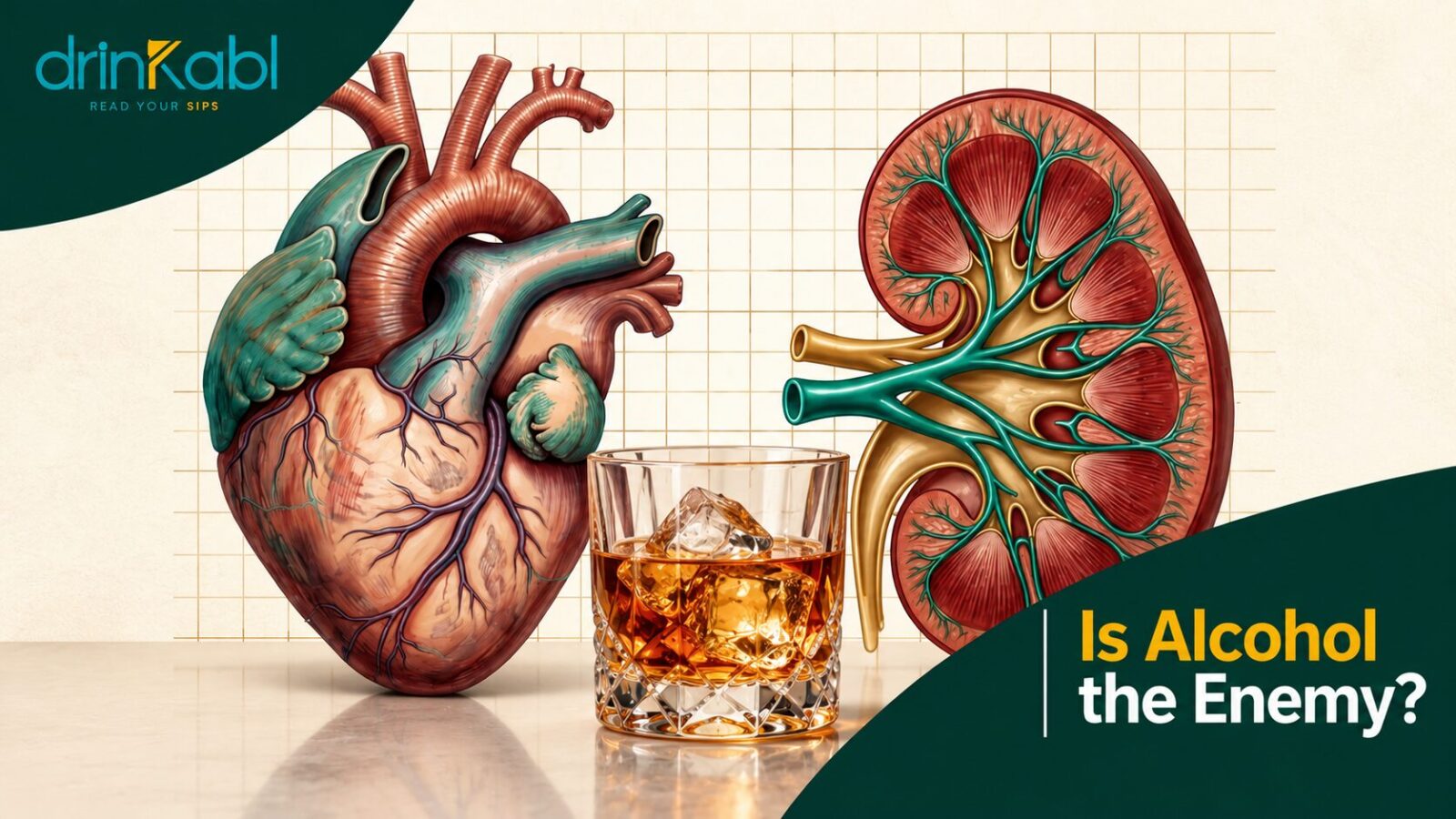

For decades, alcohol has occupied two contradictory positions in society: a product tied to celebration, culture and commerce, and a substance increasingly linked by science to cancer, disease, injury and dependence. So which story is closer to the truth?
Alcohol has a public-relations problem that is also a scientific problem. For generations, the conversation around drinking followed a simple script. A glass of red wine was good for the heart. Beer was relatively harmless. Spirits sat at the dangerous end of the spectrum. Heavy drinkers had a problem; moderate drinkers were simply enjoying themselves.
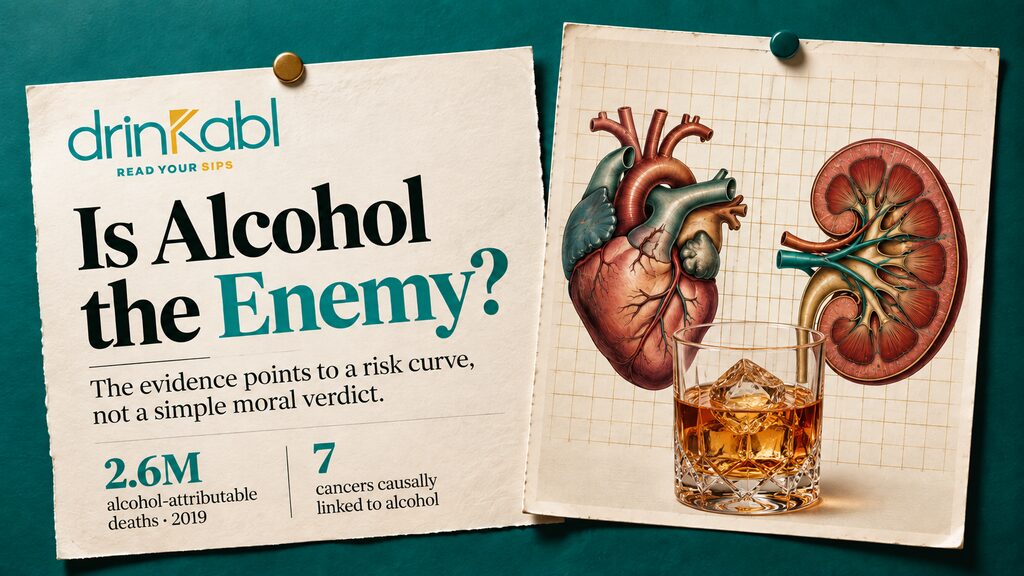
Then the science got harder to ignore. The World Health Organization now describes alcohol as a psychoactive and toxic substance with dependence-producing properties. Its most recent global assessment estimates that 2.6 million deaths were attributable to alcohol in 2019, or 4.7% of all deaths that year. About 400 million people aged 15 and older were living with alcohol-use disorders, including 209 million with dependence.
That does not settle the question this article is asking. Because “is alcohol the enemy” assumes alcohol is one thing with one effect. The evidence says otherwise. The more useful question is what happens to risk as the amount, frequency and pattern of drinking change.
Myth One: A Little Alcohol Is Good for You
No claim has shaped public perception of alcohol more than the idea that moderate drinking, especially red wine, protects the heart.
The idea did not come from nowhere. Many observational studies have found moderate drinkers have lower rates of some cardiovascular outcomes, and in some cases lower overall mortality. But association is not proof of cause.
One of the hardest problems in alcohol research is finding a genuinely comparable non-drinking group. People who do not drink can include former drinkers who quit because they got sick. Drinkers and non-drinkers also differ in income, diet, exercise and smoking, all of which affect health independently.
A 2023 meta-analysis of 107 cohort studies covering 4.84 million people and 425,564 deaths found no significant drop in all-cause mortality among occasional or low-volume drinkers, once researchers adjusted for these biases.
Yet the story does not end there. A 2025 review by the National Academies of Sciences, Engineering and Medicine reached a different conclusion: moderate drinkers had a 16% lower risk of all-cause mortality than never-drinkers, based on eight eligible studies. The committee flagged serious concerns about bias in that evidence, particularly confounding, and graded the finding as only moderate certainty.
That disagreement matters. The literature cannot responsibly be reduced to “alcohol is healthy” or “alcohol is poison.” What can be said with more confidence: drinking should not be recommended as a health intervention.
Then There Is Cancer
Here, the case is far less ambiguous. Alcohol is classified by the International Agency for Research on Cancer as a Group 1 carcinogen, the same category as tobacco. WHO links alcohol causally to at least seven cancers, including cancers of the oral cavity, pharynx, larynx, oesophagus, breast, liver and colorectum, and estimates it caused roughly 401,000 cancer deaths globally in 2019, or 4.4% of all cancers diagnosed that year.
Brand and price do not matter here. The problem is ethanol. Once consumed, it metabolises into acetaldehyde, and WHO notes that alcoholic drinks can cause cancer regardless of category or cost. The 2025 National Academies review found moderate drinking was associated with a 10% higher risk of breast cancer compared with never drinking.
One glass does not guarantee cancer. But it means something scientifically important: risk is not zero simply because consumption is low.
“No Safe Level” Doesn’t Mean Every Drink Is Equal
Public-health language is easily misread here. WHO says no form of alcohol consumption is completely risk-free, but the same assessment says most alcohol-related harm comes from heavy episodic or heavy continuous drinking. Risk depends on volume, frequency, pattern, age, sex, health status and context. One drink and ten drinks do not carry identical consequences.
Heavy drinking changes the risk landscape sharply, especially for injuries, poisoning, dependence and other acute harms. WHO estimates alcohol contributed to about 298,000 deaths from alcohol-related road crashes in 2019, with 156,000 of those caused by someone else’s drinking, a reminder that the consequences of drinking do not always stop with the person holding the glass.
Africa’s Uncomfortable Alcohol Equation
For an African beverage industry, this is where the global debate turns local, and where two very different regulatory instincts are on display right now.
WHO’s 2019 data put alcohol-attributable mortality in the African region at 52.2 deaths per 100,000 people, among the highest regional rates worldwide, and close to the European region’s 52.9. Yet Africa’s average consumption, at roughly 5.5 litres of pure alcohol per person aged 15 and older, sits well below Europe’s 9.2 litres. That gap tells us something: how much a population drinks matters, but how it drinks, and how the surrounding system responds, matters just as much.
Nigeria offers the reactive version of that response. This September’s methanol poisoning crisis in Ondo State, which NAFDAC has now linked to at least 48 deaths and 182 cases, exposed how easily an unregulated concoction, no ingredient list, no traceable producer, no alcohol-strength disclosure, can enter a community and kill before anyone in the formal system notices. The regulatory response followed the deaths rather than pre-empting them: a state sales ban, an arrest sweep, and pharmacists now pushing for testing and traceability rules that, if they had existed earlier, might have caught the contamination before it reached consumers.
South Africa is testing the opposite instinct, pre-emptive tightening on a much narrower target. Transport Minister Barbara Creecy has moved to amend Section 65 of the National Road Traffic Act, replacing the country’s three-decade-old 0.05g blood-alcohol limit with a hard zero for anyone behind the wheel. The push follows a 144% year-on-year jump in positive roadside alcohol tests over the last festive season, even as crash fatalities fell to a five-year low, evidence, arguably, that enforcement is catching more of what was always there rather than that drinking itself is worsening. It is a narrower intervention than Nigeria’s crisis response, aimed at one specific harm pathway, but it moves ahead of a body count rather than after one.
Both cases point to the same underlying truth: road safety, healthcare access, enforcement capacity and the size of the informal, unregulated market shape how much of alcohol’s harm becomes visible and preventable, and how much simply accumulates in the margins. Nigeria’s shadow economy in beverages, running alongside, and often underneath, the formal industry the country’s brewers and distillers operate in, means the sector’s reputational and regulatory risk is no longer confined to what licensed producers do. It increasingly depends on what happens in the market they don’t control.
That makes alcohol, for Africa’s drinks industry, more than a question of individual lifestyle. It is a live question of infrastructure, enforcement design and how fast the formal sector can be seen to separate itself from the informal one.
What Does the Industry Say?
The industry’s position is more nuanced than outright denial. Guinness Nigeria says alcohol misuse carries risks and points to its responsible-drinking programmes on excessive drinking, drink-driving and underage drinking. Diageo’s global alcohol policy backs similar measures: minimum purchase ages, drink-driving enforcement, responsible marketing and programmes targeting misuse.
There is genuine common ground here. Underage drinking, drink-driving and harmful consumption are hard for anyone to defend as desirable. But there is also an institutional tension: the industry profits from selling alcohol; public-health bodies exist to reduce the harm it causes. WHO itself warns that potential conflicts of interest involving the alcohol industry must be carefully weighed when governments write alcohol policy. That does not invalidate every industry initiative, but it means claims about alcohol and health deserve equal scrutiny regardless of who is making them.
So, Is Alcohol the Enemy?
The evidence resists a simple answer. Alcohol is not a moral category. It is a commercial product containing ethanol, a psychoactive, toxic substance capable of dependence and a wide range of harms. But the person having an occasional drink is not epidemiologically equivalent to someone repeatedly engaging in heavy episodic drinking, and the evidence does not support treating beer, wine and spirits as identical in every commercial or social context simply because all three contain ethanol.
The narrower, more defensible conclusion: alcohol is not harmless. Its link to cancer is established. Risk rises with consumption, and heavy drinking accounts for a disproportionate share of alcohol-related harm, harm that can reach people who never drank at all, through crashes, violence and other injuries.
At the same time, the debate over low-volume drinking and overall mortality remains more complicated than public-health slogans suggest. One major review found an association between moderate drinking and lower all-cause mortality; another, larger meta-analysis found no protective effect once methodological bias was accounted for. That contradiction should not be smoothed over, it is precisely why the old advice to drink “for your health” is difficult to sustain today.
The better question for consumers, regulators and the beverage industry isn’t whether alcohol is inherently the enemy. It’s where the risk begins, who absorbs it, how much of it can be prevented, and what responsibility belongs to the individual, the producer, the retailer and the state.
Science does not offer a morality tale here. It offers a risk curve, and the further drinking moves toward heavy, frequent or hazardous patterns, the harder that curve becomes to ignore.
READ MORE