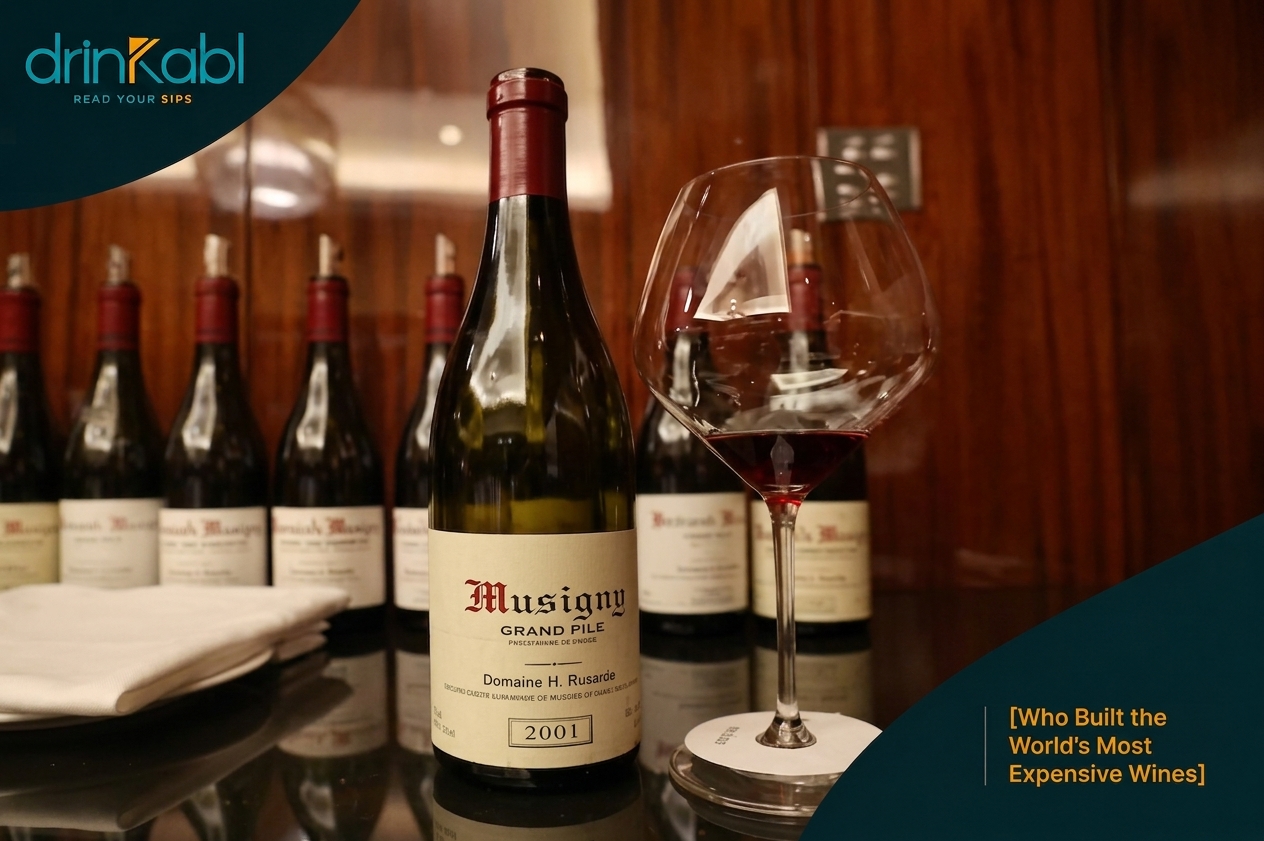

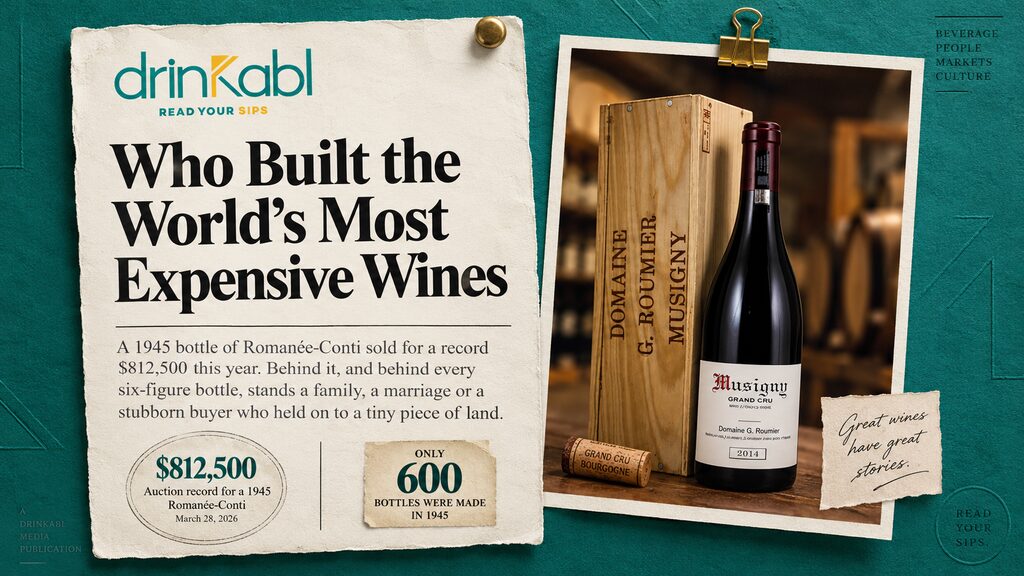
A 1945 bottle of Romanée-Conti sold for a record $812,500 this year. Behind it, and behind every six-figure bottle, stands a family, a marriage or a stubborn buyer who held on to a tiny piece of land.
A 750ml bottle of 1945 Domaine de la Romanée-Conti Romanée-Conti sold for $812,500 at the New York auction house Acker’s La Paulée sale on March 28, 2026. It is the highest price ever paid for a single bottle of wine at auction. It beat the $558,000 record set in 2018 by a bottle from the same cellar, that of Burgundy merchant Robert Drouhin.
Only about 600 bottles were made in 1945, the last vintage from the vineyard’s original pre-phylloxera vines, which were replanted in 1947.
At a glance
- Auction record: $812,500 for a 1945 Romanée-Conti, March 28, 2026
- Previous record: $558,000 in 2018
- Top merchant average: Domaine Leroy Musigny Grand Cru, above $50,000 a bottle
- Vineyard sizes: Romanée-Conti about 1.8 hectares, Leroy’s Musigny 0.27, Roumier’s Musigny 0.10
- Shared traits: tiny land, low output, long reputation, strong owners
Auction Records and Shop Prices Differ
A record auction price shows what one bottle with perfect provenance fetched on one day. A merchant average shows what sellers ask across many vintages. Wine-Searcher tracks the second, and Domaine Leroy’s Musigny Grand Cru leads it. Mid-2025 brought its first average above $50,000 across all vintages. The figure depends on where you look. At the time of writing, Wine-Searcher’s own listing showed about $54,454 among US merchants and $47,550 among European ones, both before tax.
Burgundy fills nine of the ten places on Wine-Searcher’s late-2025 top-ten list, according to VinePair. The exception is a German Riesling. The bottles at the top share four things: exceptional land, tiny output, decades of reputation and owners who turned scarcity into identity. Those owners keep recurring.
Romanée-Conti: A Tiny Vineyard That Became a Dynasty
The Abbey of Saint-Vivant acquired the vineyard in 1232. In 1760 it drew a bidding war between Madame de Pompadour, mistress of Louis XV, and the Prince of Conti. The prince won and gave the vineyard its name. The Revolution broke up the old ownership, and in 1869 Jacques-Marie Duvault-Blochet, a wine merchant who already owned nearby Grand Cru land, bought it at 79.
The second family arrived in 1942, when Jacques Chambon sold his half of the estate to Henri Leroy, a Burgundy merchant. It later passed to Leroy’s daughters, and the same two families have owned the domaine since.
The vineyard covers about 1.8 hectares and yields roughly 6,000 bottles a year. Nothing can expand it. The world’s most expensive bottle may begin with a piece of land too small to matter on an industrial spreadsheet.
Domaine Leroy: Lalou Bize-Leroy’s Small Parcels
If Romanée-Conti is inherited prestige, Domaine Leroy shows what one determined person can build. Lalou Bize-Leroy took over her father’s merchant business in 1955 and co-managed Romanée-Conti from 1974. In the late 1980s she bought the Noëllat and Rémy holdings in Vosne-Romanée and Gevrey-Chambertin, the base of Domaine Leroy, and farmed them biodynamically, an early choice among top Burgundy growers.
She was ousted from Romanée-Conti in 1992 after disagreements that included how the domaine’s wines were distributed. The Leroy family kept its stake.
Her Musigny Grand Cru comes from about 0.27 hectares split across four parcels. VinePair put its Wine-Searcher average at $52,823 in late 2025, up more than 40 percent in a year. Earlier this year a 2015 bottle made $95,600 at Hart Davis Hart, a record for the domaine at that house. Bize-Leroy assembled the parcels, changed how they were farmed and made scarcity part of the label.
Roumier: A Marriage That Brought the Vines
Georges Roumier, born in 1898, came to Chambolle-Musigny in 1924 when he married Geneviève Quanquin. Her family’s vineyards became the core of the domaine. He expanded by sharecropping, including a small Musigny parcel, and began bottling at the estate in 1945, when merchants controlled much of the trade.
His son Jean-Marie later bought that 0.10-hectare Musigny plot outright, in 1978. Today Georges’s grandson Christophe runs the estate. The plot makes roughly 300 bottles a vintage, and the wine averaged about $18,500 in late 2025.
Not every great vineyard starts with a billionaire. Some start with a wedding.
Leflaive: The Engineer Who Came Home
Joseph Leflaive (1870 to 1953) trained at the École Polytechnique and worked as a naval engineer on France’s first submarine. His family had lived in Puligny-Montrachet since the 1700s, but he came back to Burgundy only after an industrial career. In 1905, with phylloxera having wrecked local vineyards and cut land prices, he bought about 25 hectares. He replanted on better-suited rootstock from 1920 and moved from selling grapes to bottling under the family name.
His granddaughter Anne-Claude Leflaive took over management in 1990 and moved the estate to biodynamics, fully by 1997. After she died in 2015, her nephew Brice de La Morandière, Joseph’s great-grandson, took over. Leflaive’s Montrachet averaged about $19,100 in late 2025. The price came from controlling land, repairing it and letting generations of decisions build a reputation.
Egon Müller: Riesling Built on Marriage and Export
Burgundy dominates the top of the market, but Germany’s Saar Valley has a Riesling name of its own. The Scharzhof estate dates to 1797, when Jean-Jacques Koch, a former monk, bought it from the French Republic after church lands were seized.
The Müller name arrived in 1887, when Egon Müller I married Therese Tuckermann. Her father paid 150,000 gold marks for a share of the estate. The couple then took Scharzhofberg abroad, showing the wines at world fairs including the 1900 Paris Exposition. Egon Müller IV has run the estate since 1991. Its Scharzhofberger Trockenbeerenauslese, made only when grapes reach extreme ripeness, fetched 12,000 euros a bottle at a 2015 auction. Here scarcity comes from grapes and weather as well as land.
Pétrus: The Widow Who Priced Like a First Growth
Pomerol has no official classification, yet Pétrus became one of the world’s costliest wines without one. Madame Edmond Loubat, a widow who ran a hotel in Libourne, began buying shares in the estate around 1925 and was sole owner by the late 1940s. She believed the wine deserved the price of the great Bordeaux crus, and she asked for it.
In 1945 the Libourne merchant Jean-Pierre Moueix won exclusive selling rights and pushed Pétrus into Britain and the US. After Loubat died in 1961, Moueix bought out her heirs’ shares over the following years, and by 1969 the Moueix family held full control. The vineyard covers 11.4 hectares and makes about 30,000 bottles a year. No committee ranked Pétrus. Loubat held the property and set the price, and Moueix built the distribution.
Screaming Eagle: The American Exception
Jean Phillips, a former real estate agent, bought 57 acres in Oakville, Napa Valley, in 1986. She sold most of the grapes to other wineries but kept about one acre of Cabernet Sauvignon, roughly 80 vines. The first vintage, 1992, reached the market in 1995 in tiny quantities and won 99 points from critic Robert Parker.
In 2006 Phillips sold to Stan Kroenke and Charles Banks, and Kroenke later became sole owner. A six-litre bottle of the 1992 sold for $500,000 at the 2000 Napa Valley Wine Auction, though charity-auction prices do not compare directly with retail. Phillips started with land, not a label.
Scarcity Sets the Price
Supply cannot grow, but reputation can. The boundaries of Romanée-Conti and Musigny are fixed, and each harvest depends on weather, vine age and yields. Collectors then shrink supply further: every bottle opened leaves one fewer in the world.
Provenance adds another layer. The 1945 record rests partly on the bottle’s traceable history from Drouhin’s cellar, which gives buyers confidence about storage and authenticity. Fakes are a real risk: Acker rescinded a $398,400 sale of a six-litre DRC in 2021 over counterfeit concerns.
Burgundy’s fragmentation sharpens all of this. Centuries of inheritance have split each Grand Cru among many owners, so vineyards metres apart can sell at very different prices. Bize-Leroy’s Musigny trades at extraordinary levels while other growers in the same Grand Cru sit in a different market. The land matters, but the person who farms it decides what the label is worth.
What Travels Beyond Burgundy
African premium drinks makers cannot borrow Burgundy’s soil. They can borrow its discipline: keep supply tight and put the people behind the bottle up front.
The People Behind the Bottle
The greatest bottles are small pieces of agricultural land that became cultural assets because generation after generation protected them, improved them and told their story. At the top of the market, the rarest ingredient is the chance to make more. The wine is liquid. The scarcity is permanent.
Read more: