

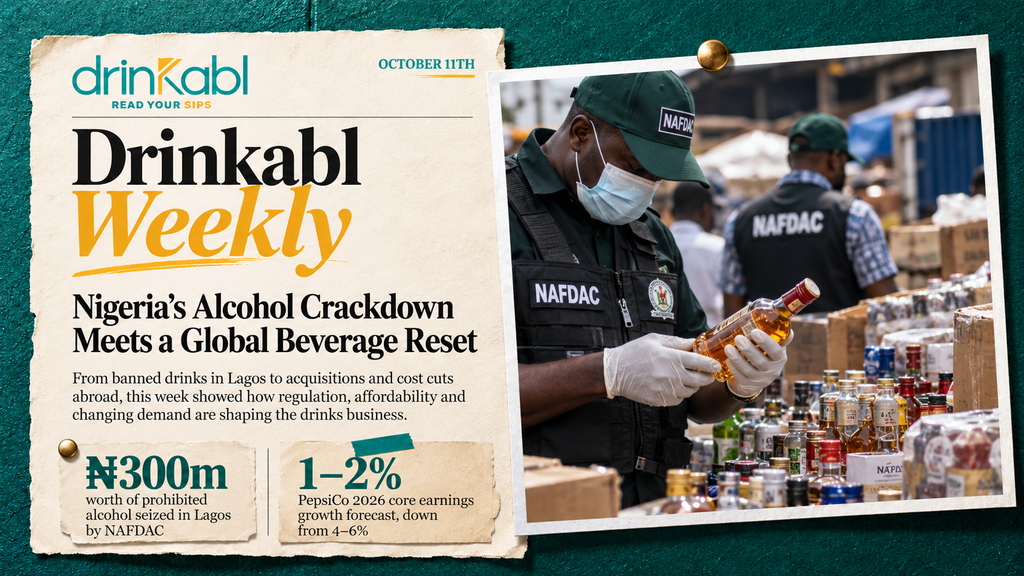
Nigeria’s Alcohol Crackdown Meets a Global Beverage Reset
From banned drinks in Lagos to acquisitions and cost cuts abroad, this week showed how regulation, affordability and changing demand are shaping the drinks business.
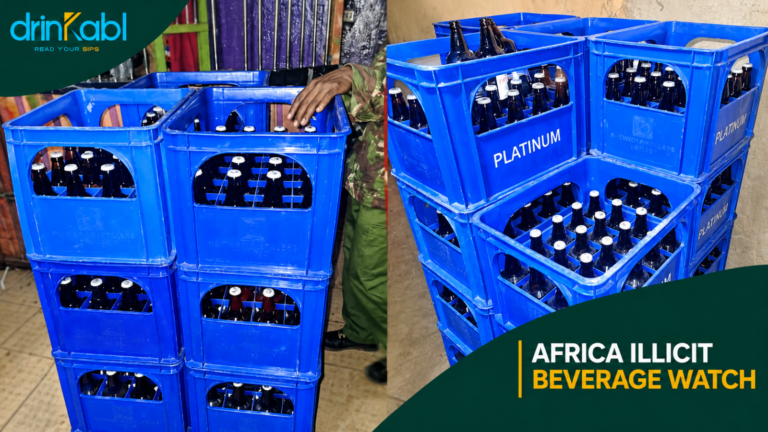
Nigeria’s beverage trade had a difficult week. On 5 October, regulators seized an estimated ₦300 million worth of banned alcoholic drinks in Lagos. Days later, a workers’ union challenged a proposed increase in sugary-drinks taxation. Outside Africa, beverage companies pursued acquisitions and cut costs as they searched for growth in a more demanding market.
Nigeria tightens enforcement
NAFDAC seized alcoholic drinks packaged in sachets and containers below 200 millilitres during operations in Lagos markets, including Ile-Epo, Ojuwoye in Mushin and Oke-Arin on Lagos Island. The agency also reported arrests. The operation puts pressure on distributors and retailers still handling prohibited stock, while manufacturers must ensure that their products and routes to market comply with the restrictions.
The policy is intended to limit young people’s access to alcohol. Its commercial consequences extend beyond producers to wholesalers, retailers and consumers, particularly as companies adjust packaging and product portfolios. The next test is whether enforcement reduces the availability of prohibited products without creating additional space for unregulated alternatives. The Lagos seizure makes clear that compliance remains an active industry concern.
Sugary-drinks tax faces resistance
The National Union of Food, Beverage and Tobacco Employees urged Nigeria’s House of Representatives to reject a proposed change to the taxation of sugar-sweetened beverages. The Senate passed the bill in June, but it still requires House concurrence and presidential assent before becoming law. The proposed system would replace the existing ₦10-per-litre excise with a levy based on retail price, although the final percentage has not been confirmed.
The union argues that a heavier tax could threaten jobs and investment as manufacturers contend with expensive energy, borrowing, logistics and foreign exchange. Public-health advocates, meanwhile, argue that the existing duty has lost much of its deterrent value and that higher taxation could support health programmes. The outcome matters for pricing, sales volumes and product strategy, but its effects cannot be properly assessed until the final rate and implementation terms are known. The tax dispute remains unresolved.
Constellation buys into a new drinking occasion
On 6 October, Constellation Brands acquired SpikedAde, a spirit-based ready-to-drink beverage inspired by sports-drink flavours. The transaction includes $75 million upfront, with additional performance-linked payments of up to $278 million over five years. The brand combines vodka with a zero-sugar, 100-calorie, non-carbonated format.
The deal gives Constellation another route into the ready-to-drink category, where companies are experimenting with flavours and formats beyond traditional beer and spirits. It also carries a marketing challenge: products borrowing cues from sports drinks must be positioned responsibly so consumers understand that they contain alcohol. Whether the acquisition delivers lasting growth will depend on distribution, repeat purchases and the brand’s ability to move beyond novelty. Constellation’s acquisition puts that test into motion.
Carlsberg expands beyond beer
Carlsberg agreed on 5 October to acquire PepsiCo bottling operations in Georgia and Armenia, extending its soft-drinks partnership in the South Caucasus. The businesses will produce, sell and distribute PepsiCo products, complementing Carlsberg’s existing operations in Azerbaijan. Financial terms were not disclosed.
The agreement illustrates the value of distribution infrastructure in a market where companies increasingly seek growth across categories. Existing plants, retailer relationships and sales networks can make expansion more efficient than building an entirely new operation. For beverage groups, however, diversification only works when production capacity, local demand and operating costs support the investment.
PepsiCo confronts the cost of slower growth
PepsiCo lowered its 2026 core earnings growth forecast to 1–2%, down from its earlier 4–6% projection, as North American performance and margins remained under pressure. The company reported stronger-than-expected quarterly revenue but said its recovery was taking longer than anticipated. Additional cost-cutting measures are intended to protect profitability.
The results expose a problem familiar to beverage manufacturers: higher sales do not necessarily produce stronger earnings when input costs and commercial spending rise. In price-sensitive markets, raising prices can protect margins but weaken volumes. Cutting costs can help, provided companies do not undermine the distribution and marketing needed to sustain demand.
What comes next
The coming weeks will test whether Nigeria’s regulators can enforce alcohol restrictions consistently and whether lawmakers change the tax burden on non-alcoholic drinks. Internationally, acquisitions and cost reductions will show which companies can turn portfolio expansion into profitable sales.
For the beverage industry, this week’s common thread was the pressure to adapt. Regulation is changing what can be sold, consumers are scrutinising what they pay, and companies are reconsidering where to invest. The winners will be those that understand the economics of their markets before committing to the next product, price or distribution strategy.
Read more