
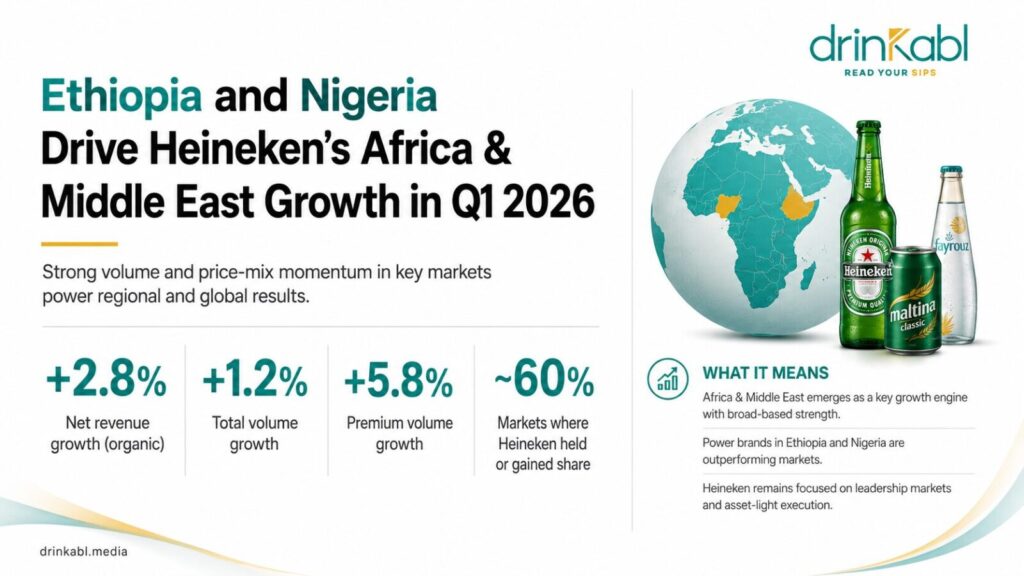
Heineken N.V. posted net revenue of €6,699 million in the first quarter of 2026, up 2.8% organically, with Africa and the Middle East emerging as one of the brewer’s strongest regional performers on both volume and price-mix.
The region was led by Ethiopia, where net revenue grew in the forties and beer volume rose in the high teens, per the company’s 23 April trading update. Bedele and Harar, Heineken’s two Ethiopian power brands, continued to outgrow the market. South Africa’s HEINEKEN Beverages operation reported low-single-digit consolidated volume growth, with its beer portfolio up in the teens. Amstel was the standout, growing in the thirties, partly aided by an earlier Easter. Beyond beer remained anchored by Bernini, up in the high teens, while spirits declined mid-single-digit in a competitive white spirits market. Egypt, Burundi, and Rwanda all posted strong volume growth, with Mützig driving Rwanda’s performance.
Nigeria contributed meaningfully to the region’s low- and non-alcohol numbers. Maltina posted strong double-digit growth, making it one of two African LONO brands called out by name in the quarterly report alongside Egypt’s Fayrouz. Desperados also recorded notable Nigeria-specific momentum, growing in the thirties within the country. Total LONO volume globally came in at low-teens growth, with Heineken 0.0 up by a high-single-digit worldwide.
The region’s performance came alongside a structural exit: Heineken completed the full disposal of its Democratic Republic of Congo operations on 10 April, converting to an asset-light licensing arrangement. The DRC withdrawal, announced earlier this year, reflects the company’s strategy of concentrating resources on markets where it holds genuine leadership positions.
Across the group, total volume grew 1.2% and net revenue per hectolitre rose 3.0%. Premium volume advanced 5.8%, led by the Heineken brand at 6.9%. The company held or gained share in approximately 60% of its markets globally. RBC Capital Markets analyst James Edwardes Jones, writing after the results, described the quarter as “reassuringly uneventful” and noted that top-line outperformance was driven entirely by price.
Heineken confirmed its full-year guidance of 2%–6% organic operating profit growth, though it flagged the Iran conflict as a source of rising energy costs and supply disruption. Outgoing CEO Dolf van den Brink steps down on 31 May 2026; no successor has been named.
Read More