
New Pour Analysis | What the underground alcohol market reveals about price, public health, regulation and the future of Africa’s beverage industry
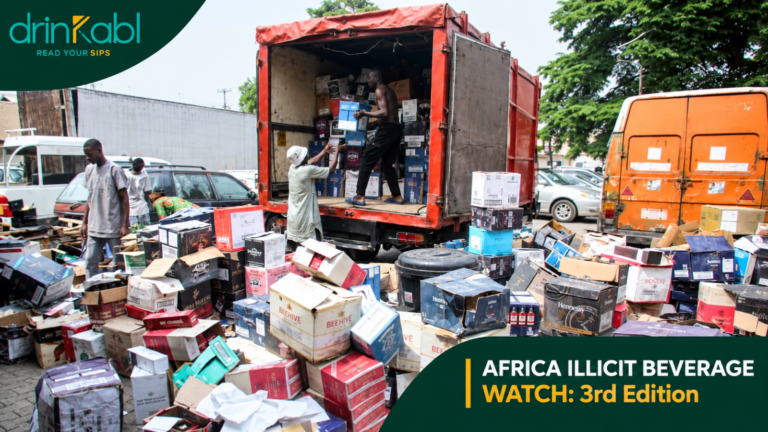
Africa’s illicit alcohol trade is no longer a side issue for the continent’s beverage industry. It is competing directly with legal producers for the same consumer, occasion and shelf space, delegates at the New Pour Summit ’26 in Nairobi heard.
Josiah Kimanzi, Client Service Director ACTNABLE AI, told delegates illicit alcohol drains manufacturer revenue, weakens government tax collections, and leaves consumers unable to verify product quality once a bottle leaves the formal supply chain. Kenya’s numbers show the problem has outgrown the old image of a backstreet brewer selling cheap spirit for a few shillings.
The market beneath the market
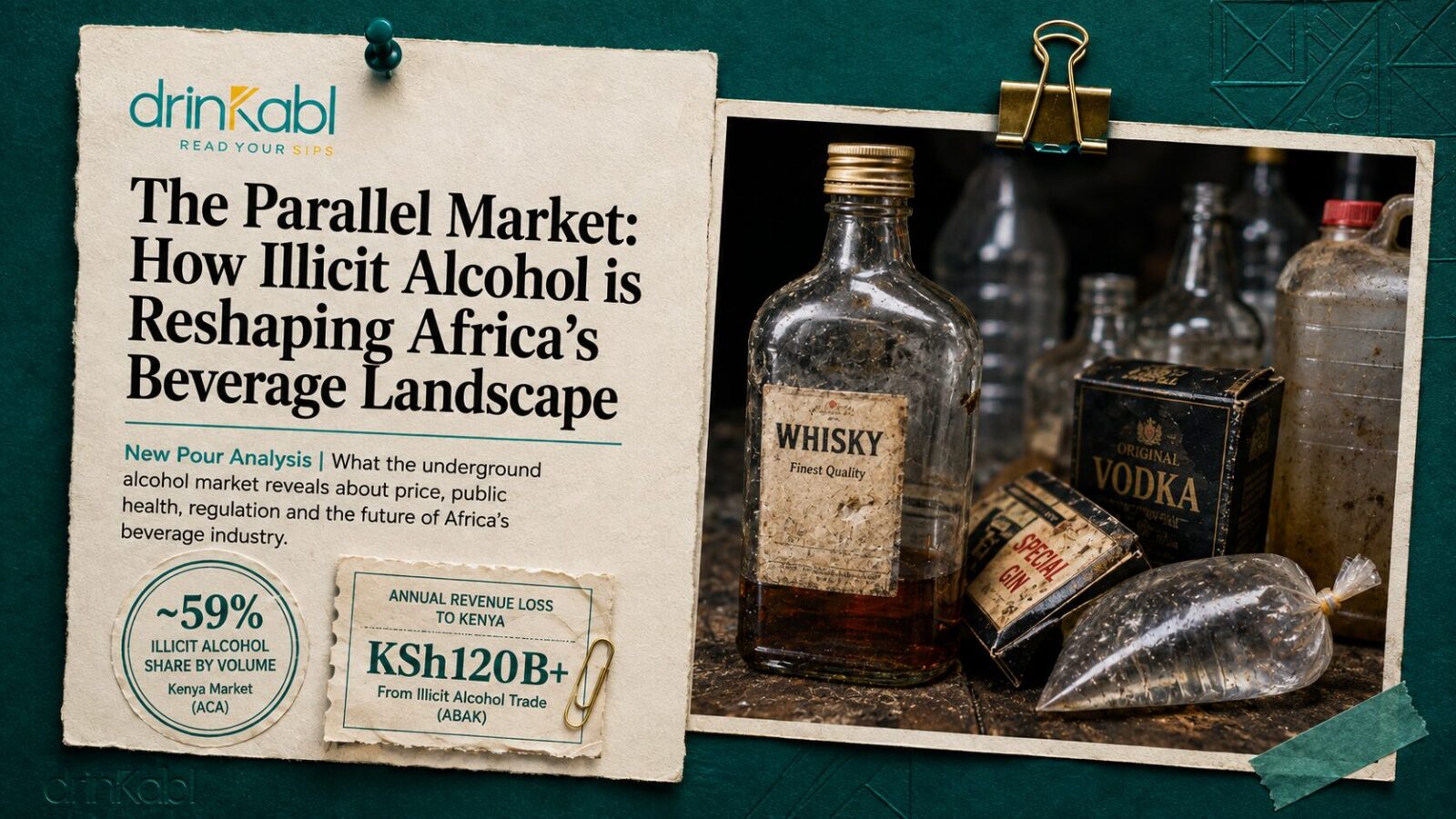
Kenya’s National Assembly heard in April that the country loses more than KSh120 billion a year to illicit alcohol, in testimony from the Alcoholic Beverages Association of Kenya (ABAK), the Anti-Counterfeit Authority (ACA) and the Kenya Association of Manufacturers to the National Assembly’s Public Petitions Committee.
The ACA’s own figures, presented to Parliament in May, put illicit and counterfeit alcohol at roughly 59% of the market by volume but just 21% by value. The Authority attributes the gap to porous borders, diversion of ethanol into illicit production, refilling of genuine bottles, and the growing use of online and social media platforms to distribute fake product.
That volume-to-value gap is the real story. The illicit market rarely wins on quality; it wins on cost structure, bypassing the excise duty, quality control, testing and licensing costs a legitimate manufacturer must carry. That is not simple counterfeiting. It is competitive arbitrage.
The consumer isn’t always choosing “illegal”
This is where the conversation has to move beyond enforcement. It is tempting to frame the consumer as someone deliberately choosing a dangerous counterfeit product, but the evidence is more complicated.
The World Health Organization defines unrecorded alcohol broadly, covering informally produced alcohol, smuggled products, surrogate alcohol and drink obtained outside normal government controls. It estimates roughly a quarter of alcohol consumed globally is unrecorded, and notes that lower prices, unknown strength and poor labelling all add risk. Crucially, the WHO also says the greatest harm is not necessarily contamination; hazardous drinking patterns, affordability and the difficulty of regulating consumption are just as significant.
That distinction matters. Treat illicit alcohol purely as a law-enforcement problem, and the industry can seize counterfeit stock indefinitely without addressing why consumers keep buying it. A 2025 Euromonitor study commissioned by ABAK put illicit alcohol at 60% of Kenyan consumption and losses at KSh120 billion, figures close to, but not identical with, the ACA’s own 59%/21% split presented two months later. The discrepancy is instructive: this market remains genuinely difficult to measure, and an industry cannot manage what it cannot accurately see.
More than a methanol problem
The public-health argument around illicit alcohol is often reduced to one frightening word: methanol. The risk is real, but the medical evidence calls for more precision.
A study of spirits sold in Nairobi’s Kibera examined 28 chang’aa samples alongside 11 cheap licit ones, finding strengths ranging from 42.8% to 85.8% ABV, all exceeding 40%. Researchers concluded the ethanol content itself, not necessarily hidden methanol, was the principal hazard. Often the danger is simpler: the consumer cannot know how strong the drink is, or whether it was made under any meaningful quality control at all.
The wider African evidence reinforces this. A 2026 peer-reviewed study in the International Journal of Drug Policy, based on WHO STEPS data from 11 sub-Saharan African countries and 48,230 adults, found 51.3% of recent drinkers had consumed unrecorded alcohol, mostly homebrewed, correlating with heavier and more frequent drinking. The research team, drawn from the University of Stirling, the WHO and the South African Medical Research Council, argues unrecorded alcohol needs building explicitly into alcohol policy and population-health monitoring.
Counterfeiting has made trust a battleground
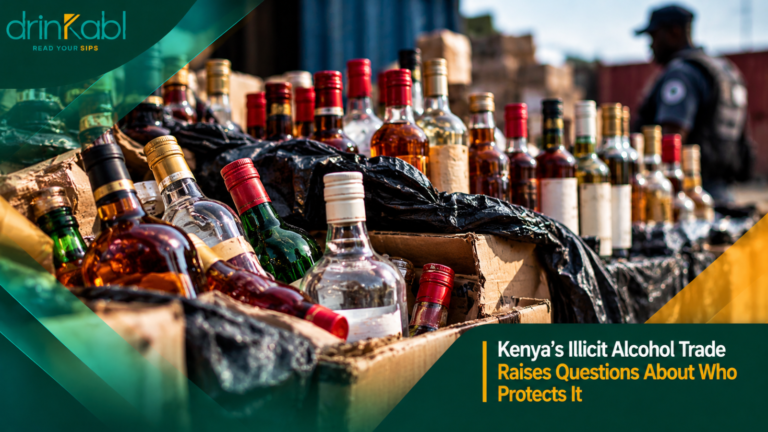
The threat sharpens when illicit operators stop selling obviously informal products and start imitating legitimate brands instead. The ACA says counterfeit alcohol operations have included falsified labels and the refilling of genuine bottles with unsafe liquid. In one 2026 enforcement operation in Kenya’s Lower Eastern region, authorities recovered 1,625 bottles of suspected counterfeit Apple Ice Vodka and Trigger Spirit.
This changes the commercial equation. A counterfeit product does not simply steal a sale; it can steal trust. If a consumer falls ill after drinking a fake carrying a legitimate brand’s name, blame usually lands on the brand, making anti-counterfeit systems a commercial priority, not only a legal one. The ACA is developing a phone-based verification system, with alcoholic beverages among its first target categories.
Nigeria and Kenya: the raids are still happening
The enforcement side of this story is not theoretical. It is playing out in real time in both markets.
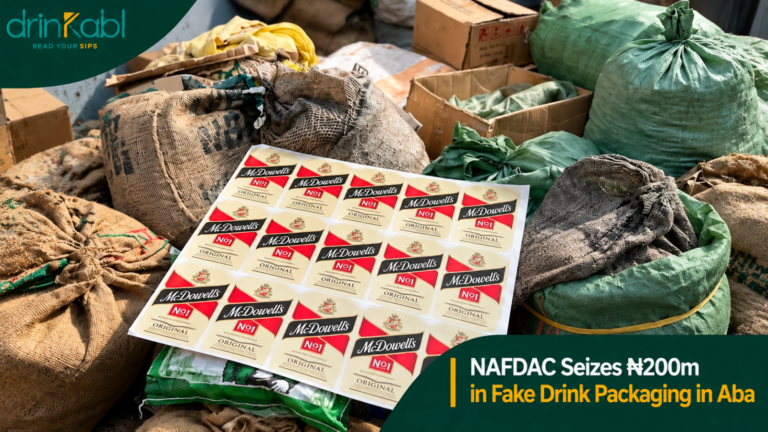
In Nigeria, NAFDAC launched a nationwide mop-up in July targeting sachet alcohol and PET bottles under 200ml in markets, motor parks and bars across all six geopolitical zones, following the expiry of a phase-out deadline. Traders in Oshogbo, Ibadan, Onitsha, Aba, Lagos and Abuja have since reported losing their main source of daily cash flow as stock is seized, underlining how enforcement against illicit product can ripple through legitimate informal retail too. That followed an April raid in which NAFDAC dismantled two Lagos syndicates producing counterfeit Hennessy, Martell, Jack Daniel’s, Glenfiddich and Jameson worth an estimated N350 million, exactly the kind of premium-brand imitation that turns counterfeiting into a brand-trust problem rather than a pricing one.
Kenya’s crackdown has been just as active. In mid-August, police in Laikipia County seized 1,260 litres of kangara from a distillation den along the Kangaitha River in Nanyuki, days after recovering a further 2,600 litres in the same county. In Nairobi’s Kasarani area, officers recovered 4,100 litres of kangara and chang’aa and arrested four suspects in an intelligence-led raid on the Soweto settlement. And in Kitui Town, NACADA seized 1,843 bottles of counterfeit alcohol alongside 80 litres of suspected ethanol, part of a holiday-period push the agency says will continue nationwide. Together, the two countries show the same pattern from different angles: Nigeria pursuing counterfeit premium brands and banned packaging formats, Kenya chasing homebrew production at the source.
Enforcement can’t fix price alone
This is perhaps the hardest question the illicit market raises. Legitimate manufacturers cannot sustainably compete against products that avoid taxes and regulatory costs, but enforcement alone cannot solve a structural affordability problem: if the gap between a regulated product and an informal alternative grows large enough, demand keeps searching for the cheaper option. Taxes are not the sole cause, smuggling networks and weak enforcement play a part too, but price plainly matters. Kenyan industry stakeholders have repeatedly linked tax differentials with neighbouring countries to ethanol-smuggling incentives, and policymakers are now discussing how to narrow that gap without eroding revenue.
There is a related lesson on distribution. Africa’s beverage market is a layered ecosystem of supermarkets, wholesalers, kiosks, bars, open markets and increasingly digital channels, and the illicit market has learned to exploit those layers; the ACA has flagged online and social-media platforms as emerging counterfeit-distribution channels. A strong brand and a good product still leave a company vulnerable if it cannot control how that product moves through the market. The advantage increasingly belongs to companies that know where their product is, who is selling it, and what the consumer is actually buying, as much a data problem as an enforcement one.
The resilience question
The Summit’s “Liquid Resilience” theme framed counterfeiting, currency depreciation, regulatory uncertainty and supply-chain disruption as structural pressures, not one-off shocks. Illicit alcohol sits directly at that intersection: lost revenue and a public-health challenge for governments, unfair competition and brand risk for manufacturers, a route-to-market problem for distributors, and an affordability and safety problem for consumers.
The answer will not come from raids alone, nor from raising taxes on the formal sector while expecting consumers priced out of it to stay loyal. A durable response likely needs intelligence-led enforcement, tighter control of ethanol and other inputs, stronger product authentication, regional cooperation against smuggling, credible quality surveillance, and tax policy that reckons honestly with how much price differentials reshape demand. Africa’s beverage industry cannot future-proof its formal market while treating the informal one as someone else’s problem. The underground economy is already competing for the same consumer; the question is whether the formal industry only tries to eliminate it, or also grapples with the conditions that let it thrive.
Read More on Drinkabl.media: