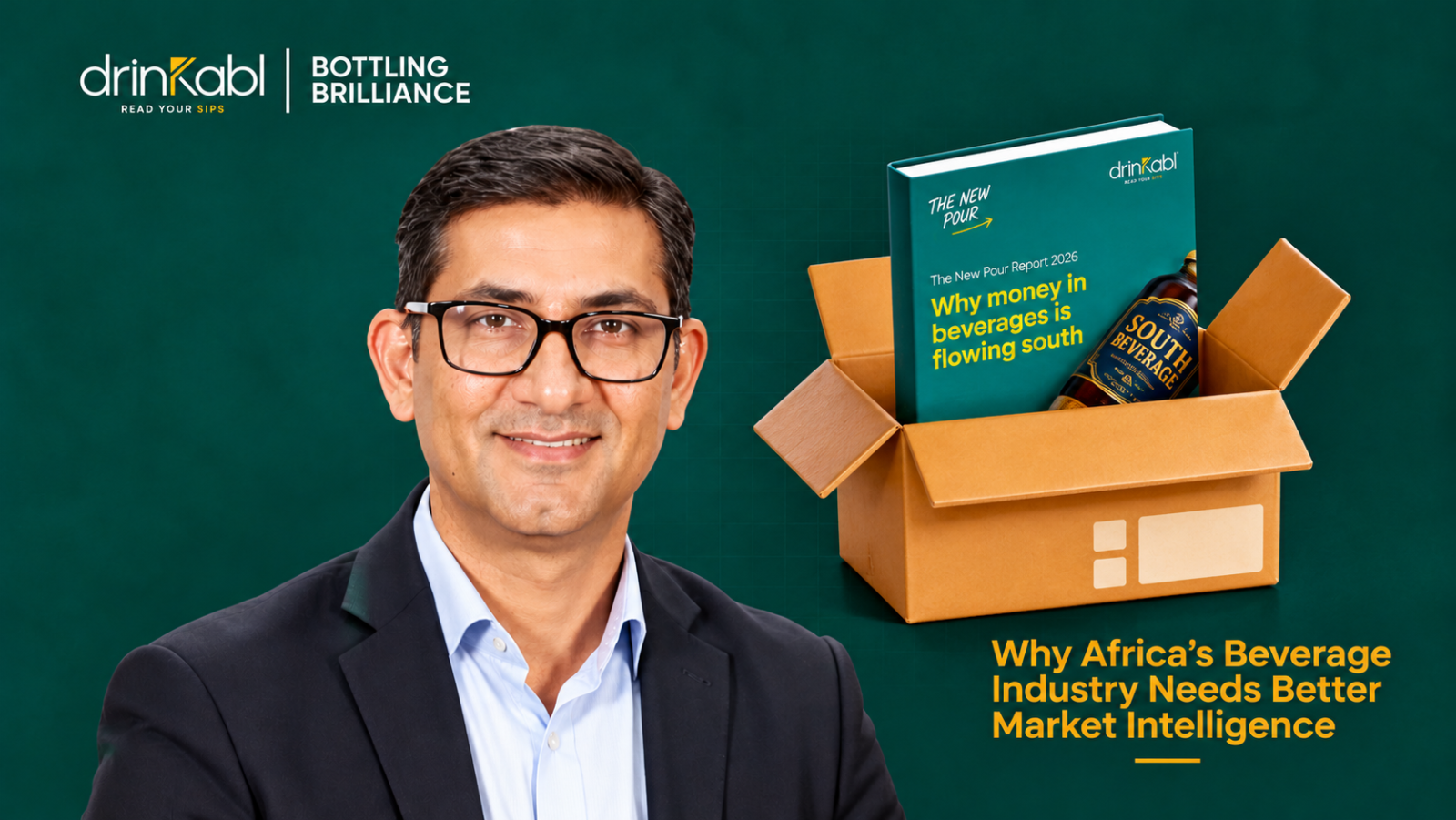

Africa’s beverage companies can collect more data, run research faster and deploy artificial intelligence at a fraction of the time traditional methods once required. Yet none of these advances guarantees that a business understands the people buying its drinks. In a conversation with Drinkabl Africa’s Tosin Balogun, Dharmendra Jain, founder and chief executive of Actnable AI, argued that the industry’s real challenge is learning to turn technology and market information into decisions grounded in local realities.
One continent, many markets
Jain’s warning begins with an assumption that has shaped how international beverage companies approach Africa. Decisions about advertising, new flavours and product launches are sometimes made at global headquarters, then adapted for African markets as though the same proposition will work everywhere. After spending two decades working across African markets, including Nigeria and Kenya, Jain has seen how quickly that assumption can fail.
“Africa is a continent which is 54 countries and hugely, hugely diverse place,” he told Balogun. The distinction matters because a product’s performance depends on more than brand awareness or sales figures. Jain frames meaningful research around three factors: context, consumer and category. The place, its culture, the people buying the product and the conditions surrounding its consumption all influence what the research actually means.
He recalled a study in which a concept expected to work across five markets produced different responses when tested. Cultural differences, local context and the way the idea was communicated changed how consumers received it. For beverage companies, that can mean an advertising campaign that works in one country struggles in another, or a flavour extension that succeeds in one market fails to connect elsewhere.
The same problem runs deeper in distribution. Jain argued that companies need to understand what is stocked in neighbourhood shops, which products are available, whether refrigeration works and how goods reach the consumer. Those details can be missed when decisions rely primarily on formal retail data or broad national market estimates.
AI can shorten the distance to insight
Traditional research has often required substantial time, money and operational coordination, particularly when studies span several countries. Jain established Actnable AI to make research “faster, better and cheaper”, using technology to support the work from study design and data collection through analysis and reporting.
He offered a recent example of a client that required research across five countries within five days. A turnaround that would once have seemed unrealistic became possible through the integration of AI and other technologies across the research process. Questionnaire design, he explained, can also be accelerated considerably when researchers have clear objectives and understand what they need to ask.
The technology can change how information is gathered, too. Jain described WhatsApp-based research communities that collect text responses, numbers, audio, video and emojis. These formats can give researchers a richer picture of consumer reactions than a survey limited to fixed yes-or-no answers. Tools that analyse different data formats can then help connect findings and produce reports more quickly.
But speed is only useful if the questions are right. Jain stressed that AI does not eliminate the need for researchers who understand the market, the category and the people being studied. Without that expertise, a faster process can simply produce irrelevant or misleading conclusions at greater speed.
When a consumer’s face tells another story
One example from beverage product testing illustrates how AI can add another layer to conventional research. In a typical central-location test, participants sample a drink and answer questions about its taste and quality. Jain pointed out a familiar complication: people may give a polite response when offered a complimentary drink, even when their actual reaction is less favourable.
His team explored combining conventional product testing with NeuroAI, which he described as a platform for analysing facial expressions and emotional reactions. Participants still sampled the product and answered questions, but their reactions during the first sip were also captured and analysed before the interview progressed.
The approach offers researchers a second source of evidence to compare with what participants say. Balogun described the value as being able to examine the gap between a consumer’s stated opinion and their observed reaction. Jain agreed, explaining how video analytics and AI could help researchers investigate responses to particular flavour characteristics, including sweetness and aftertaste.
The distinction is important. The example presented in the discussion was a research method, not proof that facial analysis can reliably reveal every consumer’s true feelings. Its practical value lies in supplementing established techniques with additional observations, which still need interpretation and validation.
The risks behind the technology
The promise of faster research brings its own problems. Jain cautioned that AI systems can produce plausible answers that are inaccurate, reflect biases in their training data or fail to account for local realities. Those limitations are particularly relevant when businesses apply general-purpose models to African markets with many languages and distinct cultural contexts.
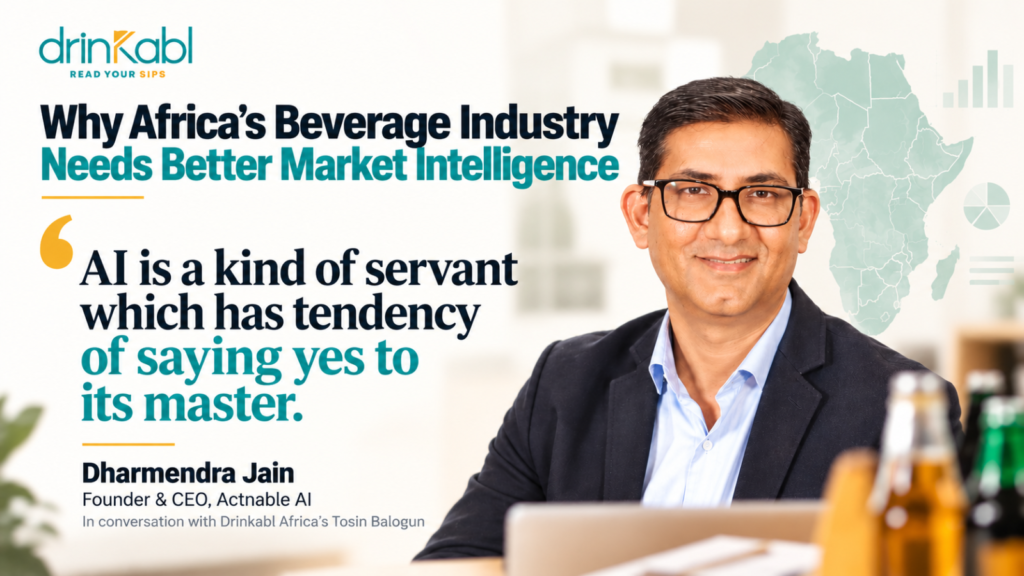
“AI is a kind of servant which has tendency of saying yes to its master,” he said, describing how a system can produce convincing responses that appear to confirm what a user already believes. A recommendation that reads well on a screen can still fail when tested against actual consumer behaviour.
Jain pointed to retrieval-augmented generation, a method that allows AI systems to draw answers from a specified knowledge base rather than relying solely on general information. For businesses, this can help ground analysis in their own research and records, although the quality of those underlying materials remains important.
He also warned companies against feeding confidential client information into AI tools without understanding how the data might be handled. His position was that AI should operate under appropriate supervision, supported by expertise and clear safeguards. The technology, he argued, is not simply something a company switches on and expects to work.
Start with a business problem
For smaller beverage businesses, the question is where to begin without committing scarce resources to expensive technology. Jain’s recommendation was to understand AI first, establish internal guidelines and identify the business problems the company actually wants to solve.
He distinguished between using AI for routine tasks, such as formatting emails and summarising documents, and deploying it to create new value. A business might begin with efficiency, then explore how technology could improve its products, develop new services or give customers access to information they could not previously use easily.
Jain offered an example of a research company that made its clients’ previous studies accessible through an AI assistant. Instead of treating each completed project as a report that sat in storage, the company enabled clients to query research accumulated over several years. That changed the service being offered, potentially making existing knowledge more useful to customers and giving them a reason to return.
For a beverage manufacturer, the equivalent could involve using existing consumer research, sales records and distribution information to answer practical questions about pricing, pack sizes or product availability. The starting point need not be a sophisticated new system. It is deciding which business decision would benefit from better information, then identifying what evidence is available to support it.
Better data needs collective effort
The discussion returned repeatedly to a problem that technology alone cannot resolve: the availability and reliability of market information. Jain argued that companies need confidence in their data before using it to guide important decisions. When that confidence is missing, he suggested bringing relevant stakeholders together to identify available information, share what can be shared and build a more useful collective knowledge base.
Balogun raised a related concern about the conflicting estimates often attached to the size of Africa’s beverage industry. He noted that different publications can quote substantially different market valuations, leaving businesses unsure which figures deserve their confidence. Without transparent definitions and consistent methods, even an impressive-looking market estimate can become a weak foundation for investment or strategy.
Jain proposed greater collaboration among industry participants, including the sharing and synthesis of information where appropriate. He also emphasised responsible AI practices built around transparency, explainability and disclosure, so that businesses can understand how information has been assembled and how it should be used.
That is a larger undertaking than installing a new research platform. It requires organisations to pay attention to the origins of their data, the assumptions built into their analysis and the limits of the conclusions they draw. AI can help process information, but it cannot automatically make an unreliable source dependable.
For beverage companies operating across Africa, the commercial stakes are immediate. Pricing decisions depend on what consumers can afford. Product development depends on what people want to drink and why. Distribution decisions depend on what is actually available where those consumers shop. Better intelligence connects these separate questions to the conditions in which a business must compete.
Jain’s argument is ultimately that technology works best when it is combined with local knowledge and disciplined research. The five-country study completed in five days demonstrates what faster processes can make possible. Whether those faster processes produce better commercial decisions still depends on the questions asked, the evidence collected and the judgement applied to the answers.