

Nigeria’s fermented plantain wine, agadagidi, sits at a commercially interesting crossroads: abundant raw material, zero import dependency, built-in cultural demand, and a production process that health experts say makes the drink routinely unsafe.
The traditional Yoruba beverage, produced by fermenting overripe plantain in water for three to five days, has served communities across South-West Nigeria as a low-cost alternative to palm wine for generations. Its appeal is economic as well as cultural. Overripe plantain has negligible market value; fermenting it recovers that value rather than discarding it. Researchers at Obafemi Awolowo University, writing in The Conversation, recorded Nigeria’s plantain output at 3.12 million tonnes in 2021, up from 994,000 tonnes in 1972, making the raw material base large and growing.
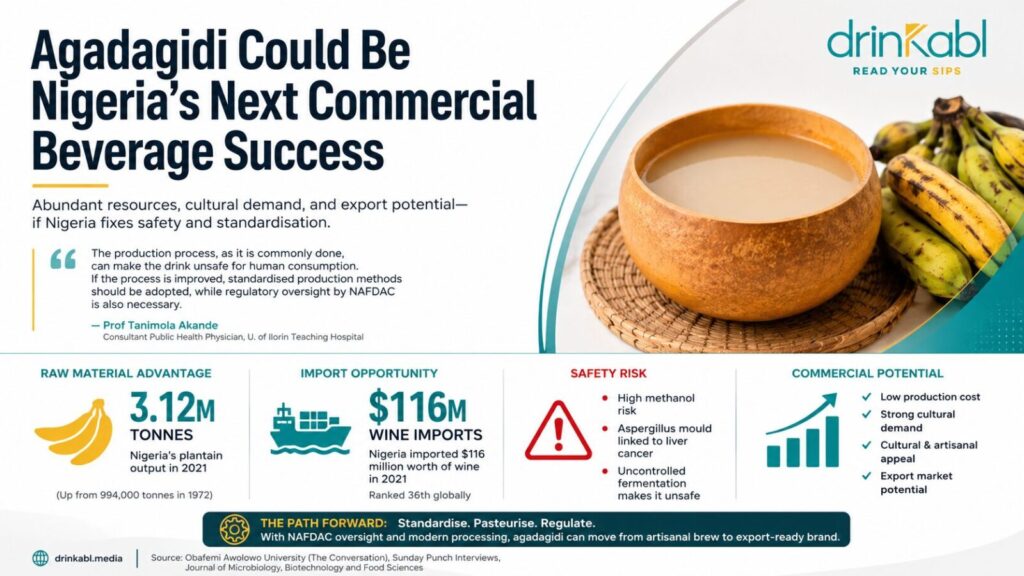
The commercial problem is what happens after fermentation begins. Spontaneous mixed-culture fermentation, the method used in virtually all traditional agadagidi production, introduces uncontrolled bacteria, yeasts, and moulds into the drink. Prof Tanimola Akande, Consultant Public Health Physician at the University of Ilorin Teaching Hospital and former president of the Association of Public Health Practitioners of Nigeria, said in an interview with Sunday Punch that poorly controlled fermentation can generate high methanol content, raising the risk of dizziness, vision impairment, and, in extreme cases, death. Akande also flagged Aspergillus mould as a contamination risk, linking it to potential liver cancer in heavy consumers.
“The production process, as it is commonly done, can make the drink unsafe for human consumption. If the process is improved, standardised production methods should be adopted, while regulatory oversight by NAFDAC is also necessary.” — Prof Tanimola Akande, Consultant Public Health Physician, University of Ilorin Teaching Hospital
The commercial ceiling is significant. Nigeria spent US$116 million on wine imports in 2021, according to the same Obafemi Awolowo University study, making it the 36th largest wine importer globally. Agadagidi, standardised and certified, competes directly in that price-sensitive segment. Chemical biologist and Colearns Ltd Managing Director Obiora Chukwunulu told Sunday Punch that pasteurisation, controlled fermentation, and modern bottling could extend shelf life and unlock branding opportunities. He argued the drink could be positioned as a cultural and artisanal product capable of attracting export interest, particularly among consumers seeking authentic African beverages.
The path from artisanal brew to export product requires regulatory engagement. Akande called explicitly for NAFDAC oversight and standardised processing protocols before any scale-up. A study in the Journal of Microbiology, Biotechnology and Food Sciences, which used sodium metabisulphite with and without Saccharomyces cerevisiae starter culture, found consistent quality achievable under controlled conditions. All unpasteurised sulphited samples met acceptable microbial, physicochemical, and sensory benchmarks.
One constraint sits outside the processing chain. James Oloyede, Director of Nutrition Services at the Osun State Primary Health Care Development Board, cautioned that converting a food crop into an alcoholic beverage draws resources away from direct consumption in a country with acute household food insecurity. That concern does not disappear with better fermentation technology.

Agadagidi currently has loyal consumers, negligible production costs, and traceable cultural equity. What it lacks is the processing infrastructure to make it safe and shelf-stable at volume. That gap is an investment case, not a heritage problem.
Read More: