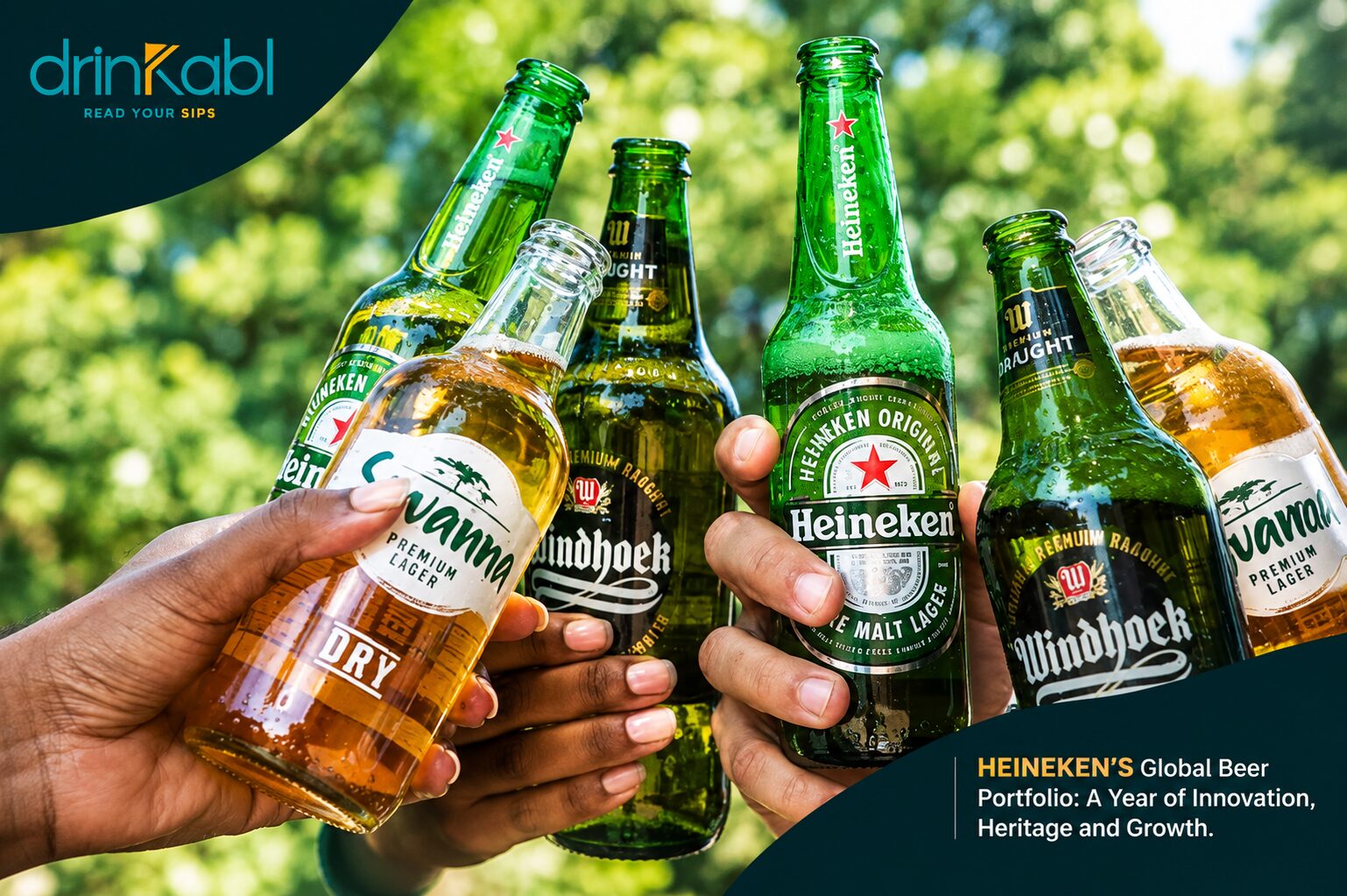

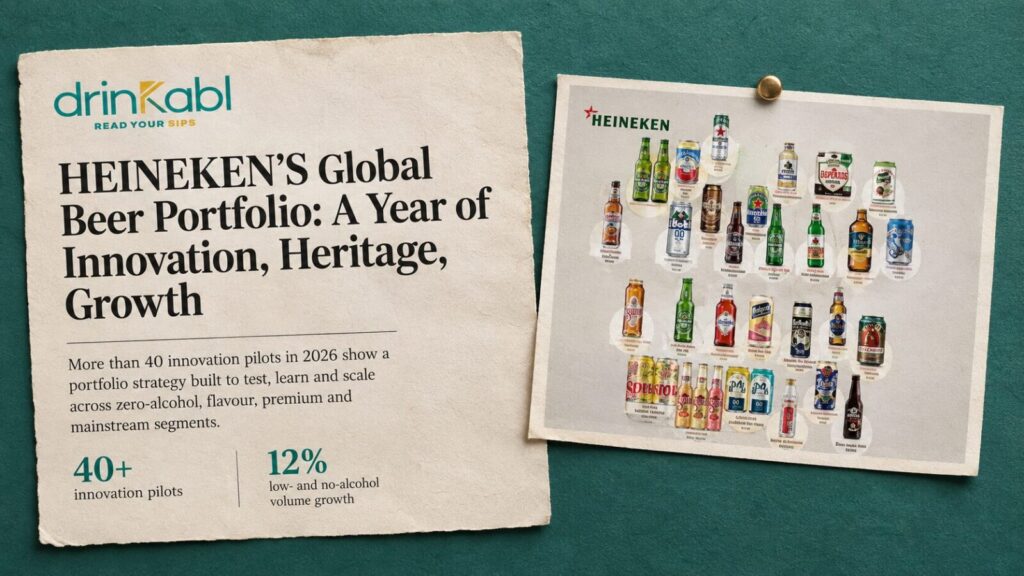
Heineken has launched more than 40 innovation pilots so far in 2026, spanning zero-alcohol beer, flavoured variants and premium extensions, as the company accelerates a five-year strategy called EverGreen 2030. The volume of new products has invited a fair question from industry watchers: is Heineken chasing trends, or creating them? The more useful question may be different. The company appears less focused on picking one winning product than on building a system that can test many ideas at once and scale only what works.
The pilot machine
The clearest example is Heineken 0.0 Ultimate, a “triple-zero” beer with no alcohol, calories or sugar, which launched in the US, the Netherlands and Poland in March. It builds on Heineken 0.0, which the company says has sold more than 13 million cases in the US alone since its 2019 debut, and is now sold in 117 countries. Alongside it, Heineken rolled out flavoured 0.0 variants in the UK, including Lemon & Elderflower and Nectarine & Juniper, aimed at consumers who want moderation without giving up variety.
That bet is backed by consumer research the company has cited publicly. Heineken’s own global survey across the UK, US, Spain, Brazil and Japan found that 72% of consumers now feel they can decline alcohol without needing to explain themselves, a shift the company frames as evidence that moderation has moved from niche to mainstream. Whether that number holds up market by market is a separate question, but it explains why Heineken keeps returning to the zero-alcohol shelf rather than treating it as a one-off launch.
The testing infrastructure behind these launches has its own history. Heineken opened Heineken Studio in April 2025, an experimentation hub built inside its Amsterdam visitor centre where the public can sample pilot brews, personalise draught beer through a “beer printer,” and add flavoured foam tops to a standard lager. Jules Macken, Heineken’s global innovation director, described it at launch as a space for “testing and learning,” with an explicit acknowledgment that only some pilots would ever be scaled beyond the pilot stage. That same logic, tested first on consumers in a bar, now appears to be running across the wider portfolio.
The numbers behind the story
Heineken’s own results show why it keeps funding this approach. In its first-quarter update, the company reported low- and non-alcohol volume growing by double digits globally, led by Heineken 0.0 and by Maltina in Nigeria. Premium volume rose 5.8%, led by the Heineken brand itself, up 6.9%, while beyond-beer products grew at a mid-single-digit pace. The company said it gained or held market share in around 60% of the markets where it operates, a detail that matters more to competitors than any single product launch.
By the half-year mark, the picture had firmed up further. Premium volume was up 6%, beyond beer rose 8%, and low- and no-alcohol volume climbed 12%, with net revenue growing 2.7% and expanding in every region Heineken operates in. All five of the company’s global brands, Heineken, Amstel, Desperados, Tiger and Sol, posted growth in the first half. Heineken’s chief financial officer, Harold van den Broek, credited part of that performance to “a faster pilot-and-scale model” that lets the company test propositions with more speed and discipline before committing to a wider rollout.
Why Africa is not a bystander here
For a continent where Nigerian Breweries, East African Breweries and Coca-Cola Beverages Africa’s bottling partners are all navigating the same tension between affordability and premiumisation, the Nigeria data point matters more than the triple-zero beer itself. Heineken’s first-quarter filing specifically credits Maltina, its non-alcoholic malt brand made by Nigerian Breweries, alongside Heineken 0.0 globally, for driving that segment’s double-digit growth. That is a rare instance of an African brand doing the heavy lifting inside a global set of results rather than simply absorbing strategy set elsewhere.
The regional numbers reinforce that reading. Heineken said its Africa and Middle East region delivered robust price-mix and volume growth in the first quarter, led by Ethiopia and by HEINEKEN Beverages, the entity that houses its Southern and Eastern African operations following the Distell acquisition. By the half-year mark, the company’s executives pointed to Desperados growing strongly in Nigeria and Ivory Coast, supported by a recent launch in Ethiopia. Local brands and local growth, in other words, are shaping which ideas get tested and which get funded further, not simply receiving finished products designed elsewhere.
That pattern echoes what beverage executives have been saying at industry gatherings closer to home. At the New Pour Summit in Nairobi earlier this year, Drinkabl Africa co-founder Tosin Balogun argued that younger African consumers are drinking differently rather than simply drinking less, seeking value, sustainability and brands aligned with their personal identity rather than abstaining outright. Heineken’s own portfolio strategy, spreading bets across moderation, flavour, premium and mainstream segments rather than picking one lane, looks like a direct response to exactly that kind of fragmented demand.
The strategy has a rougher edge, too
None of this should be read as an unqualified success story. Analysts covering Heineken have pointed to weaker momentum in the alcohol-free segment, including the flagship Heineken 0.0 brand itself, as well as friction with major retail chains following price increases introduced to offset inflation. Heineken’s share price and total shareholder returns have also lagged behind rivals AB InBev and Carlsberg during the tenure of outgoing chief executive Dolf van den Brink, according to Bloomberg’s reporting on his departure. Van den Brink announced in January that he would step down on 31 May after almost six years in charge and more than 28 years at the company, a decision he described as “one of the hardest” he had made.
The succession process that followed took months to resolve. Heineken confirmed in June that Rafael Oliveira, previously chief executive of JDE Peet’s and before that a decade-long executive at Kraft Heinz, would take over as CEO and chairman from 1 October 2026. At Kraft Heinz, Oliveira oversaw a portfolio worth more than $7 billion spanning Europe, Africa, Asia Pacific and Latin America as President of International Markets, giving him direct prior exposure to the kind of emerging and African markets that are increasingly driving Heineken’s growth numbers. Whether he continues EverGreen 2030’s pilot-and-scale approach at the same pace, or reshapes it once he takes the seat, is now the most consequential open question hanging over the strategy.
What this means for African brewers watching from the sidelines
None of this guarantees every pilot succeeds, and Heineken has been explicit that it expects some ideas to fail. For African beverage executives watching consumer habits shift toward moderation without necessarily falling altogether, as younger consumers reshape demand across markets like Nigeria and Kenya, the lesson may be less about copying any single Heineken product and more about how quickly a company can learn which bets are worth repeating, and how much organisational patience it takes to let some experiments fail in public before the ones worth scaling reveal themselves.