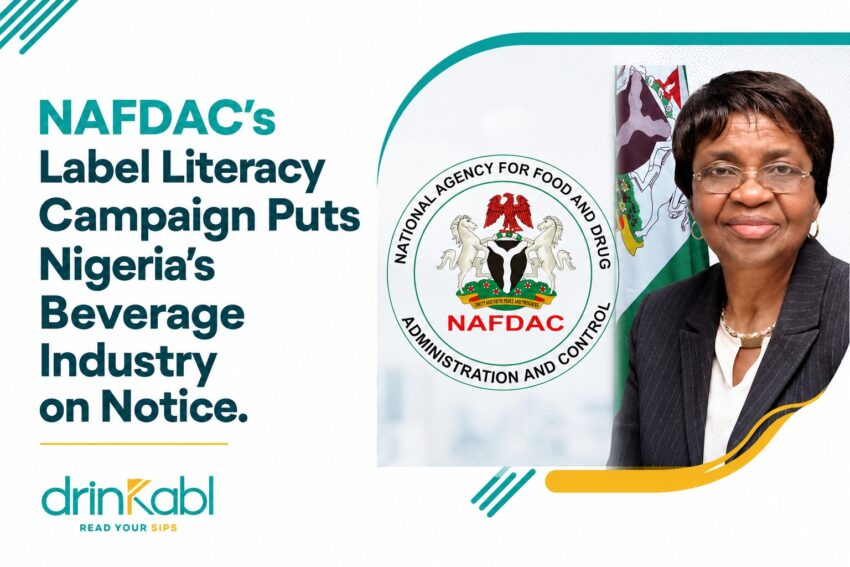

NAFDAC launched a consumer label literacy campaign in Abuja on June 27, calling on Nigerians to read nutrition labels on packaged food and drink products as a tool for managing the country’s rising non-communicable disease burden.
The campaign has a direct commercial implication for beverage producers. Speaking at the launch event, Director-General Mojisola Adeyeye said Non-Communicable Diseases(NCDs) account for roughly 29 percent of deaths in Nigeria, with cardiovascular disease, cancer, chronic respiratory conditions and diabetes the leading contributors. She identified excessive consumption of salt, sugar, saturated fats, trans fats and highly processed foods as key drivers of the burden. Beverages, particularly sugar-sweetened drinks and alcoholic products, sit squarely within that category.
The campaign is designed to run in four phases: internal implementation structures, capacity building, behavioural change through market roadshows, and impact evaluation. Phase three is the one the trade should watch. Market roadshows that draw consumer attention to sugar, sodium, and fat content will create comparative pressure at the shelf, particularly for products positioned in the high-sugar segment of the juice, malt, carbonated drinks, and energy drink markets.
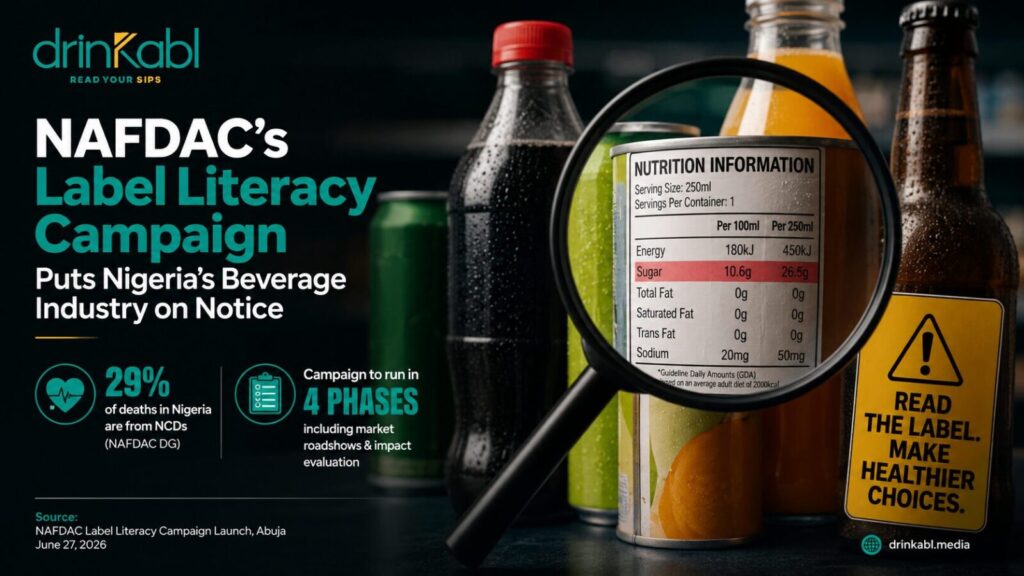
NAFDAC’s Pre-Packaged Food Labelling Regulations 2022 already require comprehensive nutrition disclosure for beverages sold in Nigeria. The campaign operationalises that regulatory framework by building consumer demand for the information those labels contain. A producer whose label is technically compliant but commercially unflattering is now in a different position from a producer whose label is both compliant and competitive on nutrition.
Akinbode Oluwafemi, Executive Director of Corporate Accountability and Public Participation Africa (CAPPA), connected this directly to beverage marketing. Speaking at the launch, he said ultra-processed food and drink products are marketed “aggressively” and “deceptively.” worsening Nigeria’s NCD load. CAPPA has been pressing for legally binding restrictions on beverage advertising since at least early 2026, and released a documentary, Sweet Poison, in May examining sugar-sweetened drink marketing in Nigeria. NAFDAC’s campaign gives civil society a regulatory peg it did not previously have.
Drinkabl.media’s coverage of NAFDAC’s June 2026 enforcement activity has traced an agency operating across multiple fronts simultaneously: banned products, counterfeit spirits, sachet alcohol. The label literacy campaign adds a consumer-facing dimension to that posture. For beverage companies, this is where regulatory pressure and reputational risk converge. A consumer trained to read labels is also a consumer equipped to compare them.
Chinyere Ikejiofor, head of nutrition and food safety at NAFDAC, said the campaign aims to strengthen public understanding of the 2022 labelling regulations. The question for producers is whether consumer education accelerates the regulatory timeline. If Nigerians begin scrutinising labels in volume, the political case for front-of-pack warning labels on high-sugar beverages, a measure already in effect in several Latin American markets, becomes harder for NAFDAC to defer.
READ MORE