
For years, beverage executives measured resilience through production capacity, distribution reach, and access to capital. Those factors still matter. But recent shocks, from inflation and currency volatility to changing consumer spending patterns, have revealed another variable that is harder to quantify and easier to overlook: culture.
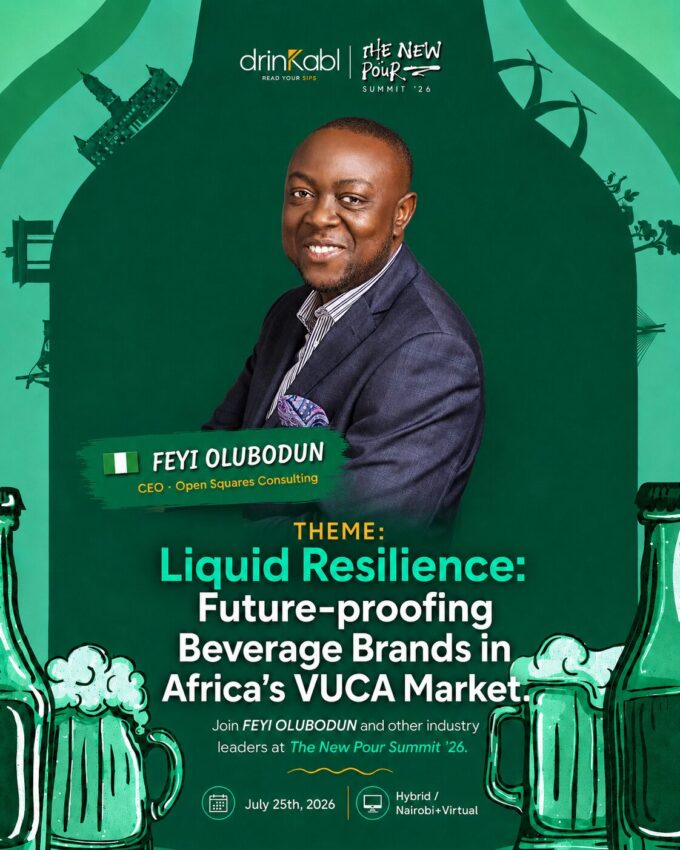
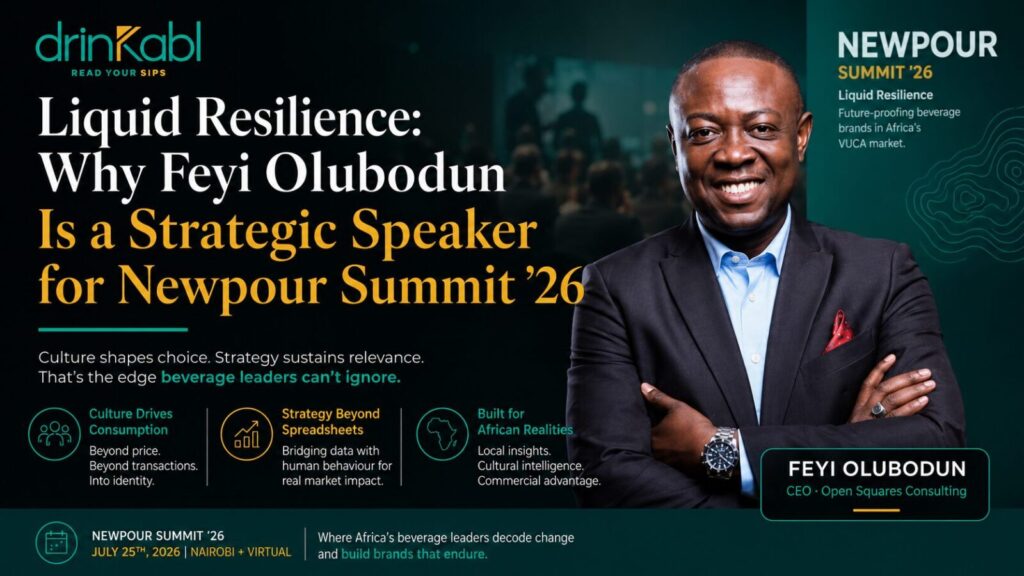
When disposable income shrinks, consumers do not make decisions based solely on price. They make decisions based on habits, rituals, identity, and the social meaning attached to what they buy. Understanding those forces has become increasingly important for beverage companies trying to navigate an environment defined by volatility, uncertainty, complexity, and ambiguity. It is also why Feyi Olubodun’s presence at Newpour Summit ’26 matters.
As Founder and Managing Partner of Open Squares Africa, Olubodun has spent much of his career examining the intersection between consumer behaviour, culture, and commercial strategy. His work sits at a question many beverage companies are now confronting: how do brands remain relevant when economic realities are changing faster than consumer aspirations?
Strategy Beyond the Spreadsheet
Olubodun’s perspective is shaped by both boardroom experience and market observation. As the first non-founder Managing Director and CEO of Insight Publicis, one of West Africa’s largest marketing communications consultancies, he led the organisation through a period marked by recession, digital disruption, and changing consumer behaviour. The challenge was not simply navigating economic storms. It was understanding how those storms altered the relationship between brands and consumers.
That distinction matters. Markets often appear rational from a distance. Consumers rarely do. A spreadsheet can show declining purchasing power, but it cannot fully explain why a consumer continues to buy one beverage brand over another despite economic pressure, nor can it capture the emotional and cultural associations that influence everyday purchasing decisions. That gap between data and behaviour is where much of Olubodun’s work operates.
The Limits of Imported Playbooks
One of the recurring tensions within African consumer markets is the tendency to apply global frameworks to local realities. The logic is understandable: many of the world’s largest beverage companies operate with standardized planning models developed in Europe or North America. The challenge is that African markets often function differently.
Consumer purchasing decisions are shaped by informal retail ecosystems, community networks, social rituals, and cultural norms that rarely fit neatly into imported models. For companies operating across the continent, understanding these dynamics is increasingly becoming a competitive advantage rather than a cultural nicety. Olubodun has spent more than two decades helping organisations interpret those realities.
Understanding the “Village”
At the centre of his thinking is The Villager: How Africans Consume Brands. The book opens with examples of brands misreading Africa to show how cultural blind spots cost market share. Its central argument is deceptively simple: although African consumers are becoming increasingly urban, connected, and globally exposed, their decision-making remains influenced by deeply embedded cultural frameworks. As Olubodun writes:
“The ‘Village’ is no longer a physical space since the consumer has left there. It is a psychological construct that defines the African consumer. It is his world view, the essential filter through which he engages products and consumer brands.” [1]
For beverage companies, this insight has practical implications. Consumption is rarely an individual act; it is often social. Drinks are shared at celebrations, offered as gestures of hospitality, and embedded within rituals that reinforce belonging and identity. Brands that understand these dynamics are often better positioned to maintain loyalty during difficult economic periods. Those that ignore them risk mistaking transactions for relationships.
Why It Matters for Newpour Summit ’26
Liquid Resilience suggests flexibility, adaptation, and endurance in a changing market environment. But resilience is not only about responding to economic shocks; it is also about understanding the people on the other side of those shocks. Inflation may change what consumers can afford, but culture often shapes what they refuse to give up.
That is where Olubodun’s contribution becomes particularly relevant. His work challenges beverage leaders to look beyond conventional metrics and examine the cultural foundations that sustain demand, loyalty, and relevance over time. In an industry where conditions can change rapidly, understanding those foundations may be as important as understanding market share.
The Bottom Line
Africa’s beverage sector is entering a period where adaptability will matter more than certainty. The companies that thrive are unlikely to be those with the most data alone, they will be those that can interpret data through the realities of how consumers actually live, celebrate, spend, and connect.
That is the lens Feyi Olubodun brings to New Pour Summit ’26, and in a market where resilience increasingly depends on cultural intelligence, it is a lens worth paying attention to.
READ MORE