
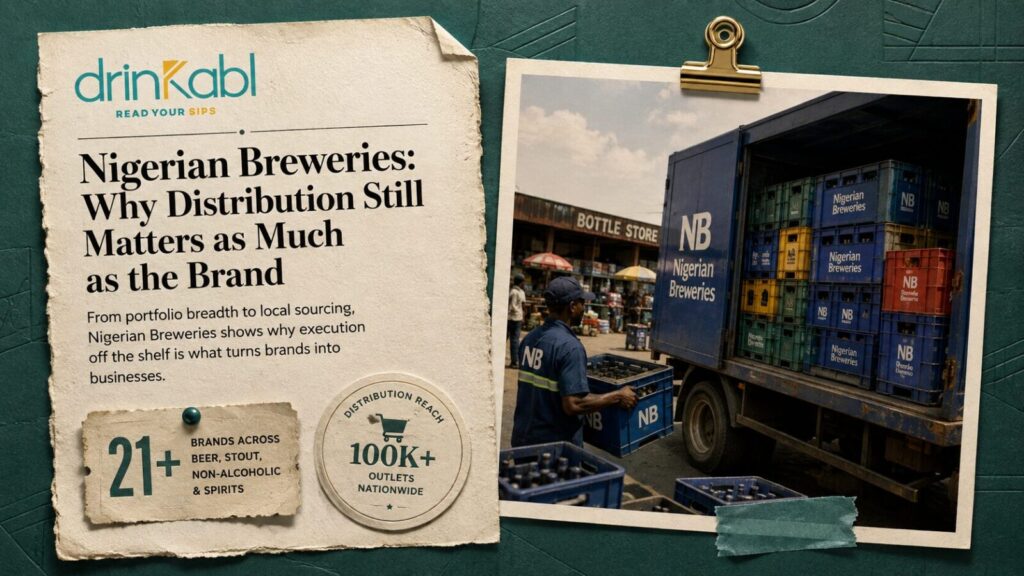
Nigerian Breweries offers one of the clearest case studies in what it actually takes to turn a beverage brand into a mass-market business in Africa. The company sells more than 21 brands spanning beer, stout, non-alcoholic drinks and spirits, and it moves them through one of the continent’s largest and most fragmented consumer markets, from formal supermarkets to open-air markets, neighbourhood stores, bars and wholesalers.
That scale raises a question every African beverage company eventually has to answer: how do you get a brand people love into the hands of people who can’t easily find it?
Brand awareness alone doesn’t guarantee availability
A strong brand creates demand, but demand only converts to sales if the product is sitting in the right outlet, in the right pack size, at a price that fits the moment. In Nigeria’s retail landscape, that means managing several commercial environments at once rather than simply expanding geographic coverage.
A wide portfolio becomes a distribution advantage
Nigerian Breweries’ broad brand lineup lets it compete across multiple occasions and price points. When a consumer trades down from a premium product, a wide portfolio gives the company a chance to keep that customer within a different brand rather than losing them altogether.
This turns portfolio strategy into distribution strategy. The more relevant products a company carries, the more reasons a retailer has to hand over shelf and cold-space allocation.
Manufacturing resilience feeds distribution resilience
The company’s push into domestic barley cultivation shows how the two are connected. Nigerian Breweries has validated the crop’s viability locally and is now calling for infrastructure investment to scale production.
On the surface, that looks like an agricultural story. It’s really a supply chain one. Sourcing key inputs domestically reduces exposure to import disruptions and currency pressure, and builds a sturdier local manufacturing base. The same logic applies to packaging, logistics and energy: weaknesses upstream eventually show up as problems on the shelf.
The lesson for smaller African beverage brands
Nigerian Breweries’ experience points to a sequence many founders skip past: product, brand, distribution, availability, repeat purchase, then scale. Most African beverage entrepreneurs pour their energy into the first two stages and underestimate everything after.
Can the business keep products consistently available? Serve wholesalers reliably? Protect margins while managing multiple channels? Finance inventory and expand without starving its own cash flow?
Those questions, not brand appeal alone, decide whether a beverage company becomes a serious commercial operation or stays an interesting name with limited reach.
Execution will be the next differentiator
Africa’s beverage market will keep producing new brands over the next decade, but new brands won’t automatically mean more winners. The companies that pull ahead will be the ones that pair brand building with operational discipline, the same discipline Nigerian Breweries’ scale reflects.
For the next generation of African beverage companies, the takeaway is simple: build the brand, but build the route to market alongside it.
Read More: