

Africa’s beverage industry opened August under a familiar mix of pressure and opportunity. Regulators tightened their grip, manufacturers defended margins, and companies kept hunting for growth in markets where consumers are both more price-conscious and harder to impress.
The week’s developments point to one truth. Africa’s beverage story is no longer just about population growth. It is about how well companies can manufacture, distribute, price and differentiate products across markets that rarely behave the same way twice.
Regulation is still the industry’s biggest variable
In Nigeria, alcohol regulation stayed high on the agenda. NAFDAC’s ongoing crackdown on sachet and small-format alcoholic drinks kept manufacturers, distributors and regulators on edge, with enforcement teams reportedly finding factories still producing banned packaging weeks after the deadline passed.
The fight matters beyond the products it targets directly. Packaging rules can reshape manufacturing costs, distribution models, retail access and consumer pricing all at once. For beverage companies, regulatory intelligence is quietly becoming a commercial skill rather than a compliance afterthought.
Rwanda sends another signal from East Africa
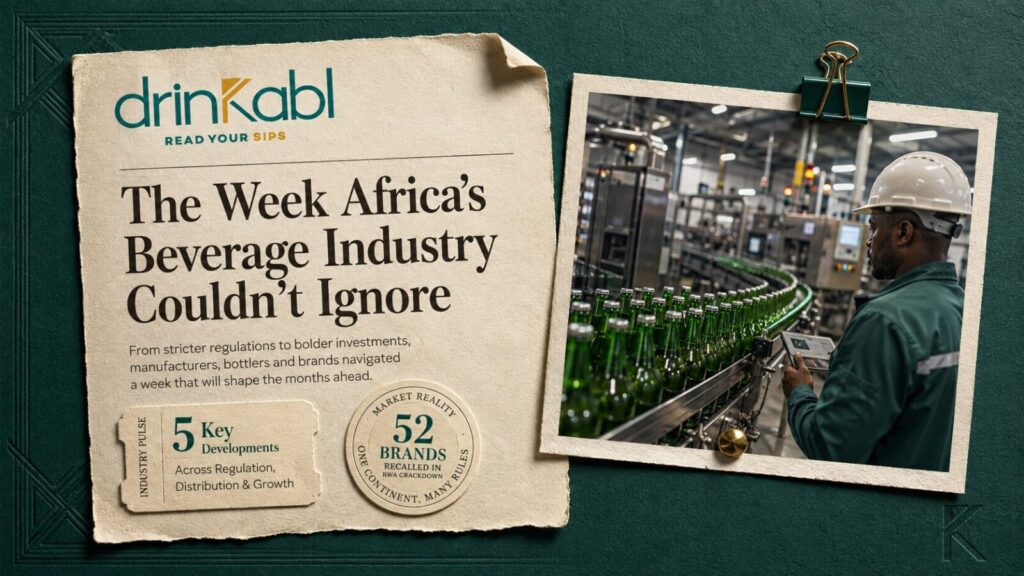
Rwanda’s suspension of 14 Tanzanian alcohol brands this week, part of a wider recall covering 52 listings from six countries, was a reminder that market access across Africa can shift fast once safety concerns enter the picture.
That matters because regional expansion is often sold as the continent’s easiest growth path. In practice, companies still have to navigate different standards, enforcement styles and import rules from one border to the next. Scaling across Africa takes more than trucks and warehouses. It takes regulatory capability.
Distribution is becoming the real battleground
The same question is playing out in non-alcoholic drinks. Varun Beverages’ continued push into Africa, including a new Kenyan subsidiary and manufacturing acquisitions, shows how seriously bottlers are investing in local production instead of leaning on exports.
The pattern is now familiar across the continent: manufacture closer to consumers, cut logistical friction, widen distribution and serve more price points at once. Companies that can pull that off cleanly are pulling ahead of rivals still tied to expensive cross-border supply chains.
Ghana shows what local capital can finance
Ghana’s Kasapreko offered another example of African beverage companies turning to domestic capital markets to fund industrial growth. The company’s IPO, which closed oversubscribed, is financing a new plant to expand output of its water and soft drink brands.
That matters because Africa’s beverage opportunity cannot rest on multinational investment alone. The continent also needs strong indigenous manufacturers that can raise capital, build plants and expand across borders on their own terms.
The bigger picture
Taken together, this week’s news shows an industry growing more industrial and more competitive at the same time. The winners will not necessarily be the companies with the biggest brands. They will be the ones that pair brand strength with manufacturing resilience, distribution depth and regulatory intelligence.
Africa’s beverage market is growing up. Winning it is getting harder.
Read more from Drinkabl: