
Africa’s packaged beverage sector has spent the better part of a decade absorbing rising consumer expectations, tightening regulatory standards, and a structural shift away from informal production. Processors from Lagos to Nairobi have been forced to confront a basic industrial reality: visual clarity and shelf stability are no longer optional at scale.
Beverage producers across the continent are investing in processing capacity at a rate that has outpaced the supply of the specialty inputs those facilities require. Enzyme-based clarification systems, mineral adsorbents, polymeric fining agents, and multi-component stabilizer blends are all seeing demand grow faster than regional distribution networks can reliably deliver them. For commodity-grade products, that gap is manageable. For enzyme concentrates requiring cold-chain logistics and technical application support, it is creating real constraints on production quality and yield.
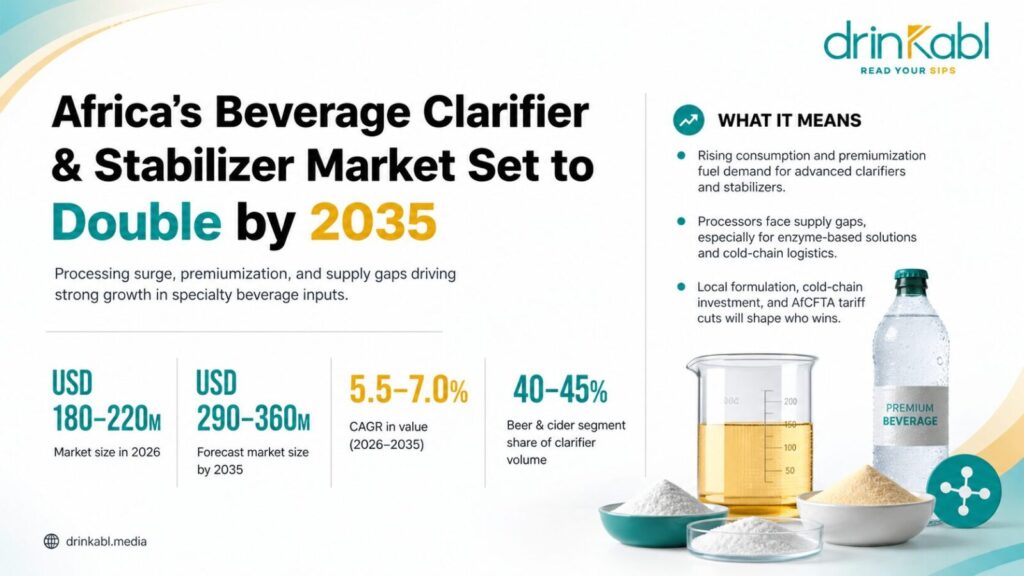
The Africa Beverage Clarifier and Stabilizer market is estimated at between USD 180 million and USD 220 million in 2026, with value growth forecast at a compound annual rate of 5.5 to 7.0 percent through 2035, when the market is projected to reach between USD 290 million and USD 360 million. Volume growth is expected at 4.5 to 6.0 percent annually, with the value premium reflecting a structural shift toward higher-priced enzyme and custom-formulated systems over commodity mineral products.
South Africa accounts for roughly 30 to 35 percent of regional consumption, followed by Nigeria at 18 to 22 percent, Egypt at 12 to 15 percent, and Kenya at 6 to 8 percent. Nigeria, Ethiopia, and Ghana are the fastest-growing country markets, each expanding from a lower base where packaged beverage consumption is accelerating. The beer and cider segment represents approximately 40 to 45 percent of total clarifier volume, but plant-based beverage production, growing at an estimated 10 to 12 percent annually, is generating disproportionate demand for stabilizer blends that address protein-polyphenol haze and calcium instability. Imported solutions remain expensive and poorly calibrated to local raw material profiles, a gap that regional formulators have yet to fill at scale. The broader dynamics shaping Africa’s beverage sector in 2026 point toward sustained input demand across multiple processing categories.
“The enzyme segment is where the real structural change is happening. Cold-processed juice brands in Nigeria and Kenya are moving away from heat-stable fining agents because consumers are demanding cleaner flavor profiles, and that shift requires supply chain infrastructure the market has not fully built yet.”
A senior food ingredient supply chain specialist advising processors across West and East Africa, speaking to trade media in early 2026.
More than 70 percent of specialty stabilizer blends and polymeric fining agents are imported, with European suppliers accounting for 55 to 65 percent of import value. Asian producers, particularly Chinese enzyme manufacturers and Indian biotechnology firms, are gaining share through pricing estimated at 20 to 30 percent below European counterparts. Bentonite mining occurs in South Africa, Morocco, and Kenya, but quality variability in local deposits means only 50 to 60 percent of domestically mined material meets beverage-grade specifications. Nigeria’s expansion of premium processing capacity is among the clearest indicators of where clarifier and stabilizer demand will accelerate most sharply in the near term.
Regulatory fragmentation is complicating market access for advanced stabilizer systems. South Africa applies the European Union’s Food Improvement Agent Package framework. The East African Community enforces harmonized residual limits under EAS 38. West African jurisdictions reference Codex Alimentarius standards with significant national variation, and novel polymer blends face approval timelines of 6 to 18 months in multiple African jurisdictions. The African Continental Free Trade Area tariff reduction schedule is expected to reduce intra-African trade barriers gradually, with regional trade in bentonite and simple blends projected to grow 50 to 70 percent from 2026 levels by 2035.
“Halal and Kosher certification has become baseline, not a premium differentiator, for any supplier targeting the North African corridor or processors with Middle Eastern export ambitions. Suppliers who treat it as optional are already losing specification bids.”
A Casablanca-based food ingredient consultant, speaking to regional trade media, 2025.
The competitive landscape is moderately fragmented, with the top five suppliers holding an estimated 40 to 50 percent of total value. Global players including Novozymes, BASF, and Ashland operate through regional subsidiaries or exclusive distributors in South Africa, Egypt, and Nigeria. Distribution networks with technical sales capability, including Brenntag Africa and IMCD South Africa, play a critical role in last-mile delivery and application troubleshooting, particularly for smaller processors without in-house formulation expertise. Local blending and formulation hubs are consolidating in South Africa and Morocco, reducing import dependence for basic stabilizer systems and enabling faster technical response times. Private capital interest in African beverage processing infrastructure signals that the conditions for deeper domestic input supply are gradually forming.
Cold-chain infrastructure gaps in West and Central Africa remain the most immediate supply constraint. Temperature-controlled warehousing for enzyme products, requiring storage between 2 and 8 degrees Celsius, is concentrated in South Africa, Egypt, and Kenya. Processors in landlocked and tropical-market countries face efficacy loss during distribution, which pushes them toward heat-stable mineral alternatives regardless of preference for enzyme-based systems. Whether Africa’s beverage processing sector closes its stabilizer supply gap from within the region or remains structurally dependent on European and Asian imports through 2035 will turn on two variables: cold-chain investment in underserved markets, and the pace of AfCFTA-driven tariff reductions on specialty processing aids.
Read More
- South Africa’s Apple Legacy Is Anchoring the Southern Hemisphere’s Fruit Beverage Supply Chain
- Major Alcohol Producers Face Historic Inventory Crisis as Global Demand for Premium Spirits Drops
- Tanzania’s Lomatan Launches Four Riviera Spirits as Government Tightens Grip on Counterfeit Alcohol
- Alcohol-Free Beer Is No Longer the Odd One Out