

For most of the past two decades, the M&A narrative in Nigerian beverages ran in one direction. Multinational giants acquired Nigerian assets: Heineken consolidated around Nigerian Breweries, Diageo anchored itself through Guinness Nigeria, AB InBev arrived via the SABMiller route. The structural logic was consistent and rarely questioned. A regional brewer sitting in Aka Uffot, Uyo has now interrupted that logic, and the financial results confirm it was not a symbolic gesture.
The pressure that eventually forced Champion Breweries Plc to reconsider its capital structure was the same pressure facing every Nigerian listed consumer-goods company over the past three years: naira volatility that erased reported earnings, a domestic market absorbing the cost of macroeconomic adjustment, and a widening gap between companies that could generate hard-currency income and those that could not. That gap had become one of the clearest lines separating resilient balance sheets from vulnerable ones on the Nigerian Exchange. Champion read it, and acted.
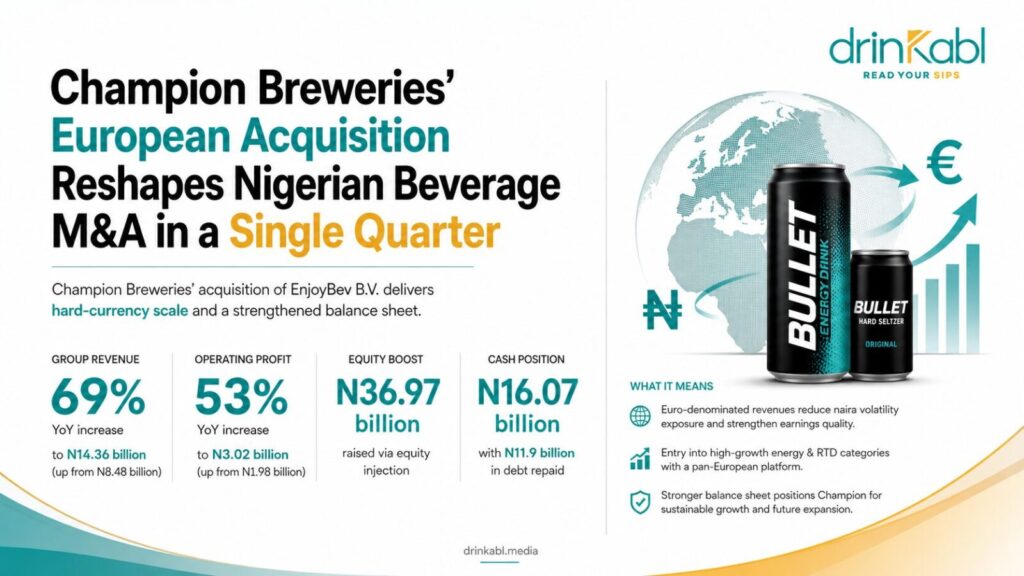
On 26 February 2026, the company closed the acquisition of an 80 percent equity interest in EnjoyBev B.V., a Netherlands-incorporated vehicle carrying the Bullet energy drink and ready-to-drink portfolio. There was no splashy announcement. The transaction appeared as a line in the company’s first-quarter financial statements, filed with the Nigerian Exchange on April 22, and recorded the moment a 52-year-old mid-cap Nigerian brewer became the parent company of a European subsidiary. The Bullet brand now sits inside a Nigerian corporate structure, generating revenues in euros, with West African distribution capacity available to extend that platform’s reach over time.
The first quarterly numbers after the deal closed show the scale of what changed. Group revenue rose 69 percent year-on-year to N14.36 billion, from N8.48 billion in the same period of 2025. Operating profit grew 53 percent to N3.02 billion. Because the EnjoyBev consolidation only took effect on February 26, roughly five weeks of the new subsidiary’s contribution sits in these figures, meaning Champion’s Nigerian operations drove most of the headline growth, with Bullet adding on top. The balance sheet transformation was more immediate: a N36.97 billion equity raise, comprising N1.19 billion in new ordinary share capital and N35.78 billion in share premium, pushed total equity from N13.08 billion at year-end 2025 to N68.29 billion by March 31. The company simultaneously repaid N11.9 billion of borrowings, leaving N16.07 billion in cash and a leverage profile that looks materially different from where it started the year.
For the Nigerian listed beverage sector, the competitive significance of the deal sits less in the headline revenue than in the earnings-quality shift it represents. Hard-currency revenues provide a natural hedge against naira movements that very few domestic listed peers can claim. As Drinkabl.media has reported, Nigerian Breweries, Guinness Nigeria, and the broader brewer cohort have all operated against a backdrop where exchange-rate swings distort reported performance, a point covered in our recent piece on the sector’s supply chain adjustment. Champion has, through a single transaction, stepped outside that constraint. The energy and RTD categories the Bullet portfolio operates in are also among the fastest-growing globally, as Monster Beverage’s 17 percent revenue surge and Nigeria’s expanding energy drink appetite have demonstrated. Champion now holds a brand platform across two continents in precisely those categories.
The implications extend to how Nigerian corporates will be evaluated going forward. The conventional defensive playbook, protect margins, conserve cash, wait for macroeconomic clarity, has served companies through the volatility but has done little to close the structural gap with multinationals that could access cheaper capital and global category exposure. Champion’s restructured balance sheet, clean leverage, substantial cash position, and a euro-denominated revenue stream now embedded in the group, offers a different template for what a Nigerian mid-cap company can look like. Whether other listed consumer-goods businesses follow depends on access to capital markets at the right cost, board-level ambition, and whether the macro environment cooperates. The model itself now has a proof of concept that did not exist six months ago.
The second quarter of 2026 will be the first full reporting period with three complete months of Bullet contribution flowing through the consolidated group. It will also be the first clean benchmark for what the new Champion Breweries generates as a functioning multinational, rather than a regional brewer in transition. Analysts modelling the company, and anyone watching Nigerian corporate M&A more broadly, will find that quarter considerably more instructive than the one just reported. Helios Investment Partners’ separate bet on Nigeria’s beverage supply chain through its Beta Glass acquisition suggests institutional confidence in the sector’s structural direction is not limited to one transaction.
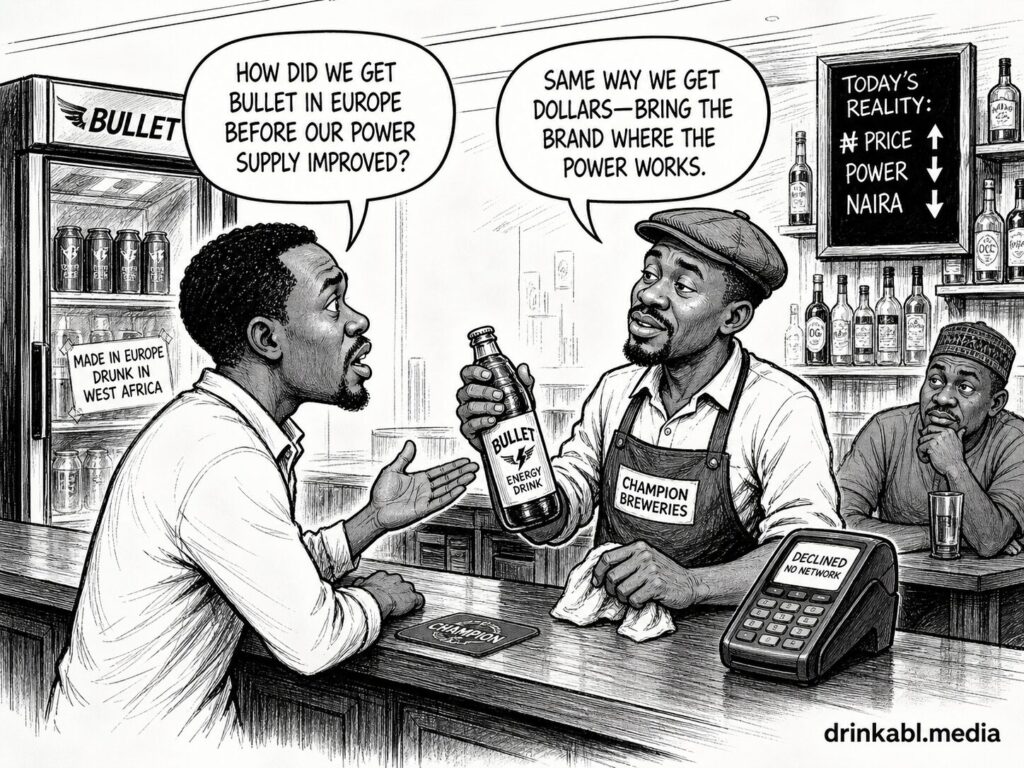
What began quietly in an Akwa Ibom industrial estate has produced the clearest reversal of direction in Nigerian beverage M&A in a generation. The next question is whether it ends there, or opens a chapter.
Read More
How Nigeria’s craft brewing sector found its footing in a mass-market environment: here
Guinness Nigeria’s Q1 profit recovery and what the Tolaram turnaround has delivered: here
Africa’s beverage industry growth drivers heading into 2026: here