
Momentum had been building within Nigeria’s trade policy corridor long before Abuja moved. Successive rounds of foreign exchange pressure, persistent port congestion, and a sustained push to deepen domestic industrial capacity had all signalled that a harder stance on imports was a matter of timing, not intent. When the Federal Ministry of Finance released its revised prohibition schedule on April 1, 2026, the beverage industry found itself squarely in the crosshairs.
The updated directive, which outlines 17 categories of goods banned from entry through all Nigerian ports, carries direct and structural implications for producers, distributors, and retailers operating across the beverage value chain. The Nigeria Customs Service has been tasked with enforcement at all entry points nationwide.
The most immediate pressure falls on bottled water. Imported packaged water, a category with measurable shelf presence in Nigeria’s premium retail and hospitality segments, is now explicitly prohibited. For international brands that have maintained a foothold in high-end outlets, the policy eliminates a distribution pathway that had persisted through multiple prior regulatory cycles. Local manufacturers now face both the opportunity and the obligation to absorb that demand.
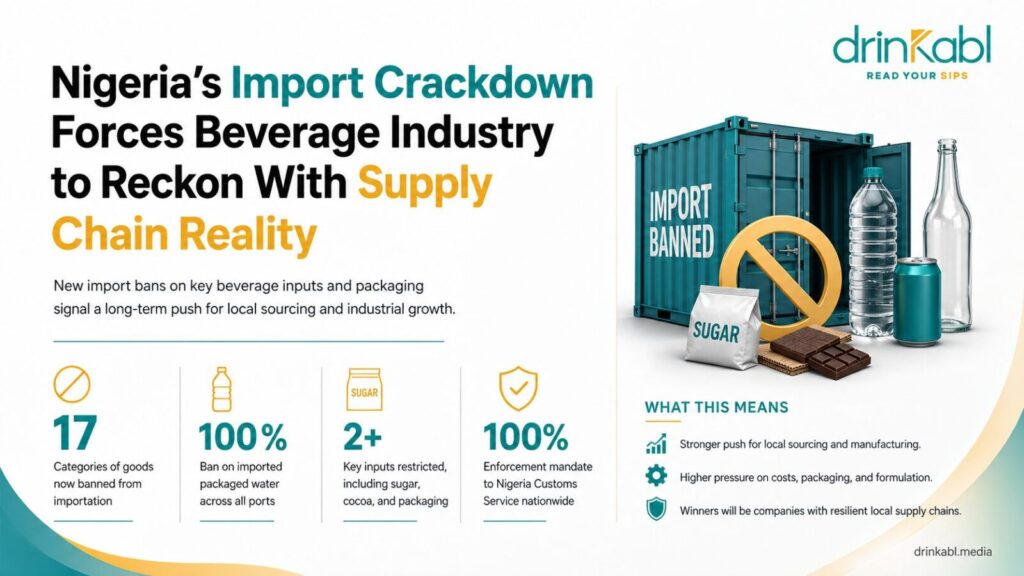
Sugar restrictions compound the challenge further. The ban on retail-packed sugar and flavoured or coloured sucrose strikes at a core input dependency across carbonated soft drinks, energy drinks, juice concentrates, and ready-to-drink formats. Producers that have relied on imported sugar to manage cost and quality consistency will need to accelerate sourcing agreements with domestic refiners, a transition that carries execution risk in an environment where local supply chains remain uneven.
The prohibition also extends to packaging materials, including corrugated cartons and glass bottles above a specified volume threshold. For a sector in which packaging cost structures are already under strain from naira volatility, this layer of restriction tightens the operational margin further. Companies without vertically integrated or locally anchored packaging supply chains face the steepest exposure. The industry has seen similar regulatory dynamics play out across West Africa, where state intervention in packaging and input sourcing has reshaped competitive positioning over multi-year cycles.
Cocoa-derived inputs, including cocoa butter and certain chocolate formats in large retail configurations, are also restricted. While the direct impact on mainstream beverage producers is limited, the policy signals a broader protectionist posture that encompasses flavour ingredients relevant to premium and functional drink categories.
The directive does preserve some flexibility. Crude vegetable oil and certain industrial-use fats remain importable, offering a partial buffer for manufacturers that can reformulate or redirect procurement accordingly. The carve-out for grandparent hatching eggs in poultry, while outside the beverage supply chain directly, reflects a calibrated policy approach that distinguishes between finished goods and productive inputs.
For the beverage industry, the strategic read is clear. Abuja is not signalling a temporary restriction; it is reinforcing a long-term localisation agenda. Operators that have already invested in domestic sourcing, local manufacturing capacity, and supply chain resilience are better positioned to absorb the transition. Those that have deferred that investment now face regulatory pressure as the forcing mechanism.
The Nigeria Customs Service’s enforcement mandate removes ambiguity around compliance timelines. Businesses have no runway to treat the policy as aspirational. Importers, clearing agents, and procurement teams are expected to realign immediately, with seizure risk and legal sanctions cited as enforcement tools.
The broader trajectory favours domestic producers willing to scale, but the near-term cost of adjustment, across sourcing, packaging, and product formulation, will be unevenly distributed across the sector.
Read More