
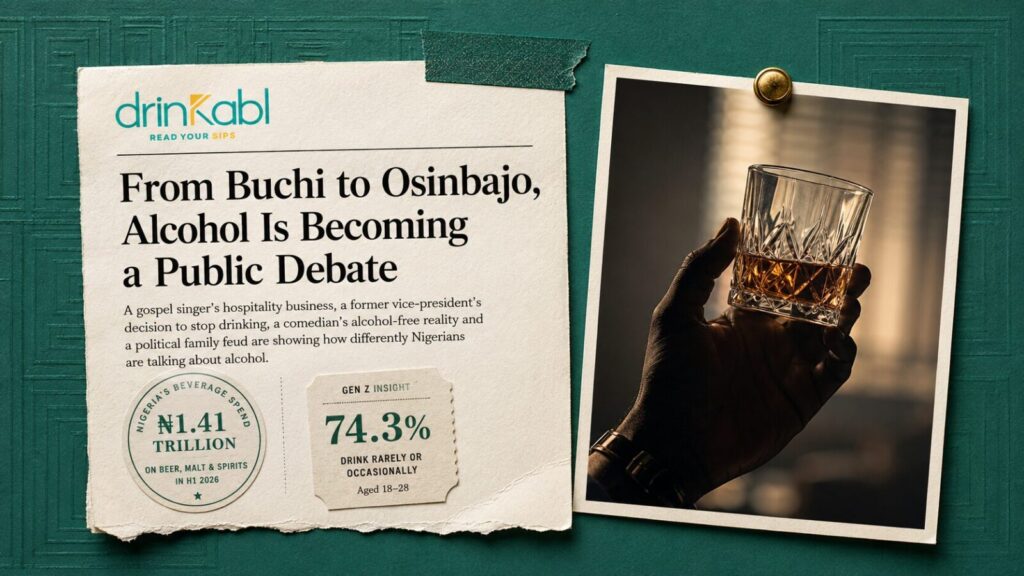
A gospel singer’s hospitality business, a former vice-president’s decision to stop drinking, a comedian’s alcohol-free reality and a political family feud are showing how differently Nigerians are talking about alcohol.
Alcohol is increasingly appearing in Nigeria’s public conversation as more than a beverage. It is being discussed through faith, hospitality, personal discipline, entertainment, marketing, reputation and, most recently, political conflict.
The latest example came on August 29, when Bashir El-Rufai, son of former Kaduna State governor Nasir El-Rufai, attacked his elder brother, Mohammed Bello El-Rufai, a member of the House of Representatives, and accused him of alcohol and cocaine use. The allegations were made in a series of social-media posts during a wider family and political dispute.
Those claims should remain exactly what they are: allegations made by one family member against another. There is no evidence in the report establishing the accusations as fact.
What makes the episode relevant to the beverage industry is the way alcohol has now become part of a much wider Nigerian conversation about identity and public behaviour.
Consider Buchi. The gospel musician recently defended his decision to serve alcohol at Kulture Yard, his Christian-themed hospitality centre in Ikeja. In an interview, Buchi argued that the venue was designed to bring Christian values into ordinary social spaces rather than function as another church. He distinguished alcohol consumption from smoking, saying the latter directly affects other people through second-hand smoke.
The argument is commercially significant because hospitality businesses do not simply sell food and drinks. They sell occasions. Alcohol can be part of how those occasions are designed, especially in venues built around entertainment, socialising and nightlife.
Osinbajo offers a very different case. In April, former Vice-President Yemi Osinbajo spoke publicly about his decision to stop drinking alcohol. He said that while serving as a pastor and working with a United Nations mission in Somalia, he occasionally drank beer and red wine. An encounter with colleagues who appeared uncomfortable being seen drinking around him eventually made him reconsider the example he was setting. He said he has not consumed alcohol since.
The striking part of Osinbajo’s story is that the issue was framed as a personal decision shaped by faith, responsibility and public example. Alcohol was not the business proposition. It was a question of personal conduct.
Then there is Klint Da Drunk. The Nigerian comedian built his public identity around a character whose entire appeal depended on drunkenness. Yet Klint says he does not drink alcohol. He previously trended for disclosing that he was allergic to it after attempts to drink left him sick for days.
That contradiction has since taken on a commercial dimension. Drinkabl reported that liquor brands that previously worked with Klint have become more cautious about associating themselves with a character built around drunkenness, even though the comedian says he is personally alcohol-free.
The four stories are not equivalent, and that is what makes them useful together. Buchi treats alcohol as part of hospitality. Osinbajo treats giving it up as a matter of conviction and example. Klint exposes the distance between an alcohol image and an individual’s actual drinking behaviour. The El-Rufai dispute shows something harsher: alcohol can also become ammunition in a public argument.
For beverage companies, that matters because alcohol is no longer being judged only at the point of purchase. Consumers bring their own beliefs into the category. Religious identity, health concerns, family expectations, professional reputation and changing attitudes among younger consumers can all influence how alcohol is perceived.
Nigeria’s beverage market reflects the same complexity from a commercial angle. Nigerians spent roughly ₦1.41 trillion on beer, malt drinks and spirits in the first half of 2026, even as the market faces tighter regulation and changing consumption patterns.
The consumer picture is becoming more nuanced, particularly among younger Nigerians. A nationwide study of respondents aged 18 to 28 found that 74.3 per cent drank rarely or occasionally, while 56.2 per cent said their alcohol consumption had declined over the previous two years.
That does not point to a simple Nigerian move toward or away from alcohol. It points to a market where the meaning of drinking is becoming more complicated.
The industry therefore has a broader question to solve. How should brands market alcohol when consumers increasingly judge the category through personal values as much as taste, price or social status?
Nigeria’s alcohol debate is becoming less about whether people drink and more about where, why, how and what drinking says about them. That is a much more complicated market to sell into.