

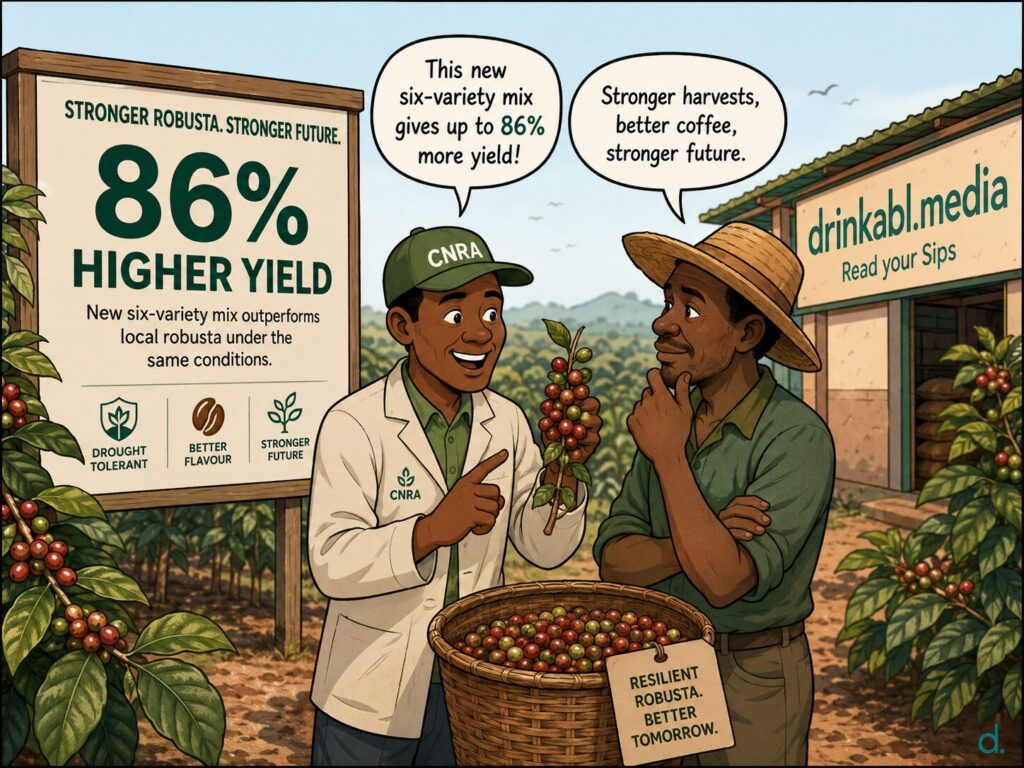
Nestlé has published findings from a multi-year robusta breeding trial in Côte d’Ivoire showing that a selected mix of six coffee varieties can raise yields by up to 86% when compared with the commonly used local variety, using identical inputs.
The research, conducted by the Nestlé Institute of Agricultural Sciences in collaboration with Centre National de Recherche Agronomique (CNRA), ran from 2018 across four coffee-growing regions. Researchers evaluated 18 robusta varieties for yield, drought tolerance, bean quality, and flavour performance under climate stress. The six strongest performers, two developed by Nestlé and four by CNRA, were then tested in combination. Trials showed the blend outperformed any single variety across all measured criteria.
Sensory tests confirmed that coffee from the varietal mix produced a smoother cup, with less bitterness and fewer woody notes than are typical of robusta. The six varieties have been officially registered in Côte d’Ivoire and will be distributed to farmers through cooperatives participating in the Nescafé Plan, Nestlé’s sustainable coffee sourcing programme.
“Together with partners such as CNRA, we are exploring resilient coffee varieties to help protect farmers’ livelihoods and ensure consumers can continue to enjoy great-tasting coffee in the future.”
— Hubert Coffi, Agronomy Manager, Nestlé Institute of Agricultural Sciences, Côte d’Ivoire
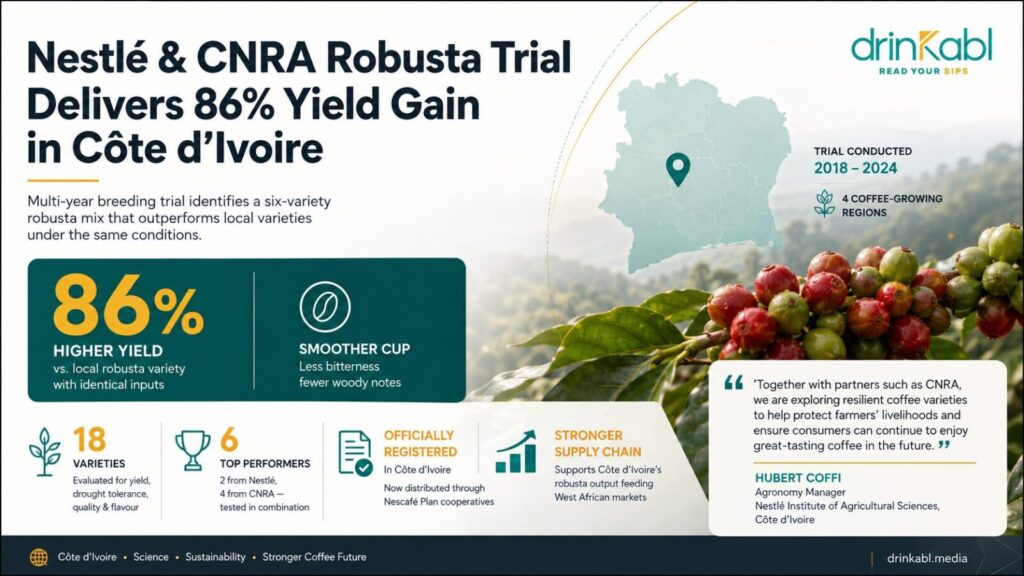
“Côte d’Ivoire is feeling the effects of climate change, with shifting rainfall and rising temperatures impacting crop health and yield,” said Hubert Coffi, Agronomy Manager for the Nestlé Institute of Agricultural Sciences in Côte d’Ivoire. “Together with partners such as CNRA, we are exploring resilient coffee varieties to help protect farmers’ livelihoods and ensure consumers can continue to enjoy great-tasting coffee in the future.”
The announcement has direct supply-chain implications. Côte d’Ivoire is one of Africa’s largest robusta producers, and its output feeds directly into soluble coffee manufacturing, including Nestlé’s own 9,000-tonne processing facility in Abidjan. The country’s robusta exports primarily serve West African markets, with Nigeria among the leading buyers of Ivorian soluble coffee, according to the Tea & Coffee Trade Journal.
The breeding programme is anchored at Nestlé’s experimental farm in Zambakro, Côte d’Ivoire, in collaboration with local partners and its plant sciences department in Tours, France. The company said it continues to train farmers on regenerative agriculture practices at the Zambakro site. Nestlé’s previous varietal work includes Roubi 1 and Roubi 2, two robusta varieties delivering up to 50% higher yields in Mexico, per Nestlé.
The Côte d’Ivoire trial adds to a broader industry effort to accelerate robusta breeding. A review led by World Coffee Research’s Robert Kawuki, published in Frontiers in Plant Science, noted that current variety-development cycles can exceed 20 years and that programmes across Côte d’Ivoire, Uganda, Ghana, Vietnam, India, and Brazil need faster tools and stronger collaboration to stay ahead of climate change.
READ MORE: