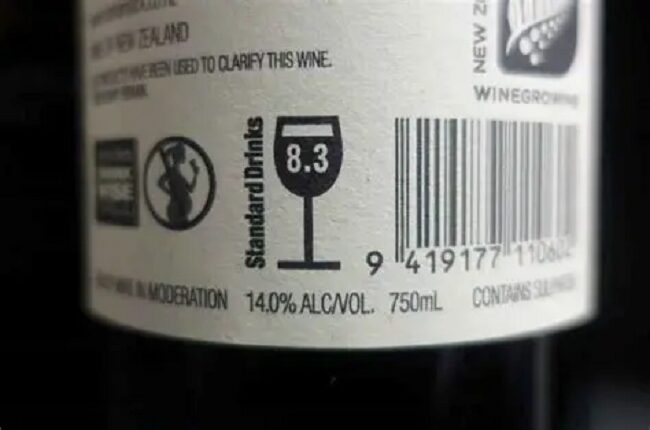

A Lagos-based public health group is pressing Nigeria’s government to support mandatory warning labels on alcohol bottles at the 49th session of the Codex Committee on Food Labelling, which convenes May 11–15, 2026 in Ottawa, Canada.
The Renevlyn Development Initiative (RDI) directed the call at Nigeria’s Codex National Contact Point ahead of Agenda Item 8.1, which covers a formal proposal to begin new international work on alcohol labelling. Codex, the joint FAO/WHO standard-setting body, is being asked to amend three existing texts that currently treat alcohol as an ordinary food product under CXS 1-1985, CXG 2-1985, and CXG 23-1997.
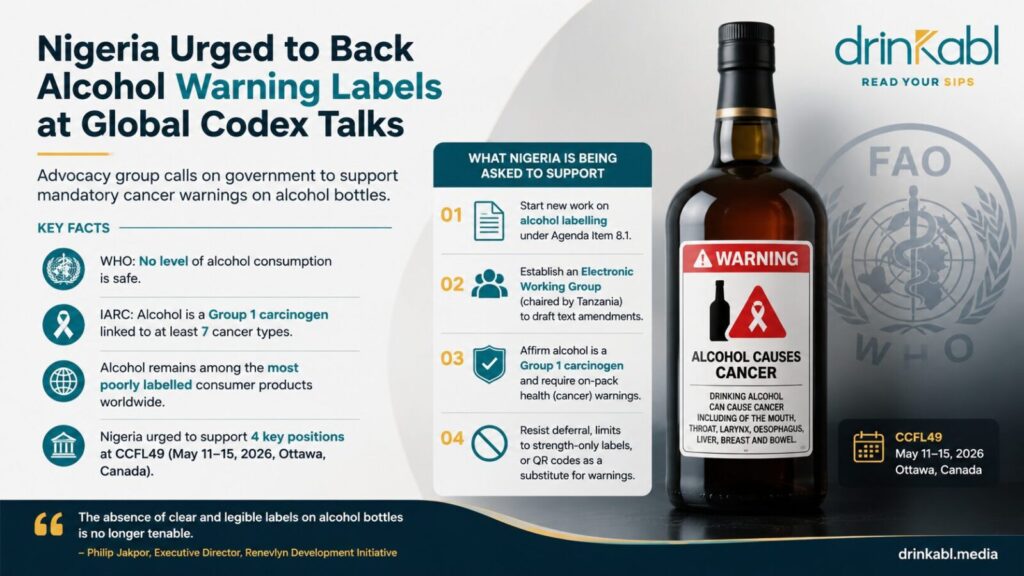
The scientific foundation for the push is well established. The International Agency for Research on Cancer classified alcoholic beverages as a Group 1 carcinogen in 1988, the highest risk designation, citing links to at least seven cancer types. In January 2023, WHO published a statement in The Lancet Public Health confirming that no level of alcohol consumption can be considered safe. Despite this, RDI argues that alcohol remains among the most poorly labelled consumer products globally, with cancer warnings absent from bottles in most markets.
“The absence of clear and legible labels on alcohol bottles is no longer tenable.”
— Philip Jakpor, Executive Director, Renevlyn Development Initiative
“The CODEX discussions present an opportunity for the Nigerian government to take a firm stand in support of labels on every bottle,” said Philip Jakpor, RDI Executive Director, in a statement released in Lagos. “Consumers have the right to information about products they buy and use to enable them to make informed choices. The absence of clear and legible labels on alcohol bottles is no longer tenable.”
Jakpor said Movendi International, which RDI describes as the largest independent global movement for development through alcohol prevention, has published a policy brief to guide government delegations, including Nigeria’s, at the talks.
RDI is asking Nigeria and other member countries to back four specific positions at CCFL49: the initiation of new work on alcohol labelling under Agenda Item 8.1; the establishment of an Electronic Working Group, proposed to be chaired by Tanzania, to draft text amendments for consideration at the committee’s next session; formal affirmation that alcohol is a Group 1 carcinogen and that health warnings, including cancer warnings, belong on-pack; and resistance to any attempt to defer the work, limit labelling to alcohol strength only, or allow QR codes and electronic labels to substitute for printed health information.
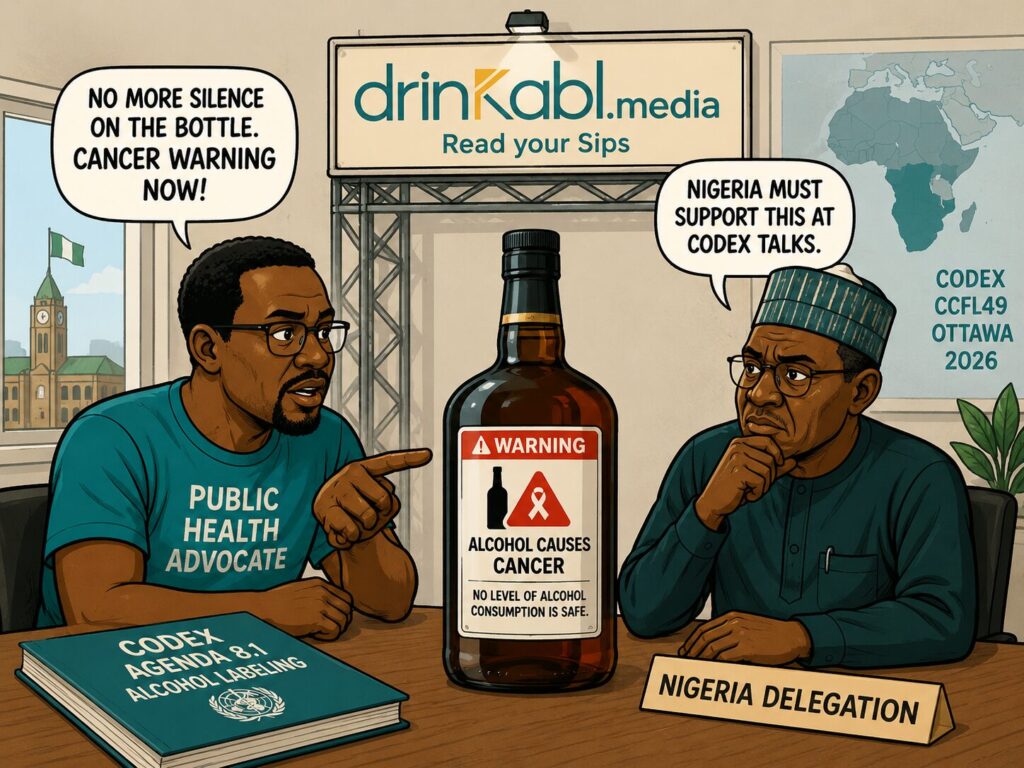
The Ottawa session follows a turbulent stretch of Nigeria’s domestic alcohol regulation. As Drinkabl.media reported, the country’s ban on sachet alcohol and bottles under 200ml has been enforced, suspended, and contested across three branches of government since late 2025, with a Federal High Court case still pending. The label push at Codex would extend that fight to the international standard-setting level.
Read More:
Africa’s Drinks Industry Has a Sober Problem, & a Bigger Opportunity
Alcohol Advertising Exposure Increasing Children’s Interaction With Alcohol, New Study Shows